Trader Vic's
Warren Zevon saw a werewolf drinking a pina colada at Trader Vic's. That lyric, from the 1978 hit 'Werewolves of London,' is how most people outside the Bay Area first encountered the name - as a place exotic enough to attract supernatural clientele. But the real Trader Vic's origin story is stranger than any werewolf tale. Victor Jules Bergeron, Jr. lost a leg to tuberculosis as a child. He attended Heald College in San Francisco, borrowed five hundred dollars, and on November 17, 1934, opened a small bar across from his uncle's place at San Pablo Avenue and 65th Street in Oakland's Golden Gate District. He called it Hinky Dink's. Within a few years, it would become something else entirely - the seedbed of American tiki culture and the birthplace of one of the most contested cocktails in history.
From Hinky Dink's to Polynesia
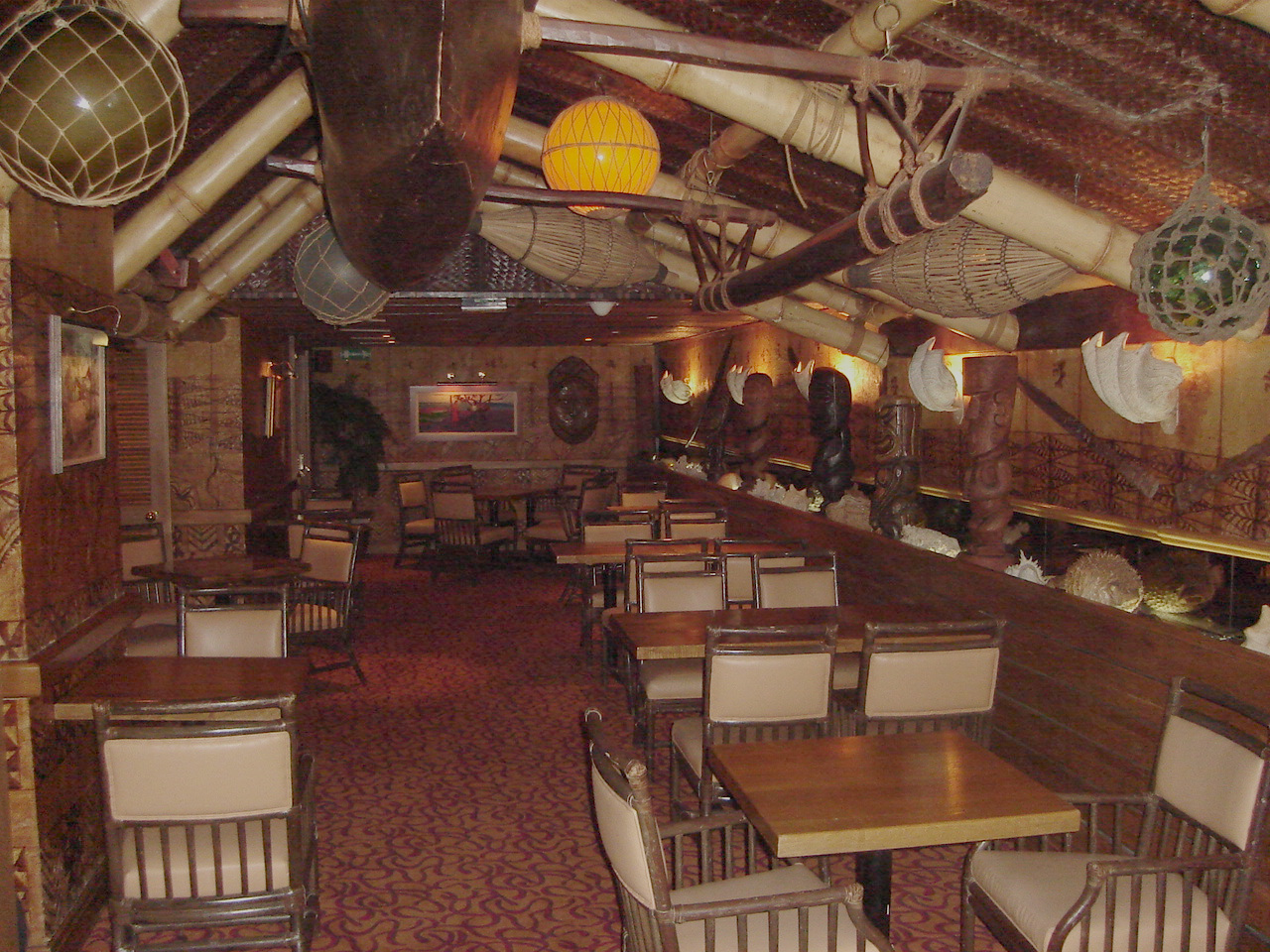
The transformation happened in stages. In 1937, Bergeron traveled to Cuba to sharpen his bartending skills. When he returned, he visited Don the Beachcomber in Hollywood, the Polynesian-themed bar run by his future rival Donn Beach. Those two trips changed everything. Bergeron began decorating his Oakland bar with tropical flair - bamboo, carved tikis, nautical flotsam - and renamed it Trader Vic's to match the new atmosphere. The name suited him. Bergeron had always been a trader at heart, a dealmaker who understood that atmosphere was as important as alcohol. By the late 1940s, his reputation had reached the hotel industry. In 1949, Western Hotels executive Edward Carlson convinced Bergeron to open a franchised location in Seattle's Benjamin Franklin Hotel. It started as a small bar called The Outrigger, expanded into a full restaurant by 1954, and was renamed Trader Vic's in 1960. Bergeron had opened a Hawaii location as early as 1940 and a San Francisco outpost at 20 Cosmo Place in 1951. Hilton Hotels soon estimated the tiki restaurants were earning the chain five million dollars a year. Sheraton scrambled to compete, launching its own Polynesian-themed Ports O' Call and Kon-Tiki chains.
The Mai Tai Wars
According to Trader Vic's own account, the Mai Tai was born in 1944 in Oakland. Bergeron mixed aged Jamaican rum with lime juice, orgeat syrup, orange curacao, and rock candy syrup, handed it to friends visiting from Tahiti, and heard one of them exclaim 'Mai Tai - Roa Ae!' - Tahitian for 'Out of this world - the best!' Donn Beach disagreed. He claimed to have invented the drink at his Hollywood bar years earlier. The dispute was never definitively settled, and both men went to their graves insisting on their version. What is undeniable is that Bergeron built an entire cocktail philosophy around rum and tropical ingredients. Beyond the Mai Tai, his signature drinks included the Fog Cutter - served in a highly decorated mug - and the Scorpion Bowl, a communal punch that proliferated across virtually every tiki bar that followed. His Hot Buttered Rum came in a skull-shaped ceramic mug. He also created the Eastern Sour, which broke from tiki convention by using rye whiskey, and the Mexican El Diablo, an early tiki-world foray into tequila. Restaurant menus listed dozens of tropical concoctions, and Bergeron published multiple recipe books, from 'Trader Vic's Book of Food and Drink' in 1946 to 'Trader Vic's Helluva Man's Cookbook' in 1976.
A Werewolf, a Cheeseburger, and a Dugout Canoe
Trader Vic's became a fixture of mid-century American culture in ways that outlasted the tiki craze itself. The London location, which opened in 1963, was immortalized in Zevon's 'Werewolves of London.' In the 1988 film 'Scrooged,' Bill Murray's character name-drops it. In 'Frost/Nixon,' David Frost orders a cheeseburger from the Trader Vic's inside the Beverly Hilton. In Jess Walter's novel 'Beautiful Ruins,' a New York Times bestseller and one of the newspaper's 100 Notable Books of 2012, two characters meet at the Seattle location in September 1967. One walks 'into a burst of warm air and bamboo, tiki and totem, dugout canoe hung from the ceiling.' Neil Simon referenced it in 'Plaza Suite' in 1968. Even Trader Joe's, the grocery chain, was partly inspired by the success of Trader Vic's brand of curated exoticism. The name 'Trader' worked because Bergeron had proved that Americans would pay for the feeling of being somewhere else.
The Empire at Low Tide
At its peak, Trader Vic's stretched across continents - locations in hotels from Chicago to Tokyo, Munich to Dubai. The brand survived Bergeron's death and the long decline of tiki culture that began in the 1970s, when the Polynesian aesthetic fell out of fashion and many locations closed. As of 2024, there are three Trader Vic's restaurants in the United States, one in Europe, ten in the Middle East, two in Asia, and one in Africa. The company, headquartered in Martinez, California, has experimented with sub-brands over the years: the Mai Tai Lounge (defunct), Trader Vic's Island Bar & Grill (opened 2010 in Sarasota, closed 2013), and Senor Pico, which has one remaining location at The Palm Dubai. The corporate offices have drifted around the Bay Area - Emeryville, Corte Madera, San Rafael. But the origin point remains fixed: a small bar on San Pablo Avenue in Oakland where a one-legged bartender decided that what his neighborhood really needed was a little bit of Polynesia.
From the Air
Trader Vic's original location was at San Pablo Avenue and 65th Street in Oakland's Golden Gate District, approximately 37.838N, 122.308W. The site is in the urban flatlands of North Oakland, west of the Berkeley Hills and east of the San Francisco Bay waterfront. From the air, look for the grid of San Pablo Avenue running northwest-southeast through Oakland and Emeryville. The company's headquarters in Martinez, California, is approximately 20 nm northeast. Nearest airports: Oakland International (KOAK) approximately 10 nm south, Buchanan Field (KCCR) approximately 18 nm northeast. Best viewed at lower altitudes in clear conditions, though the original bar location is no longer visually distinguishable from surrounding commercial buildings.