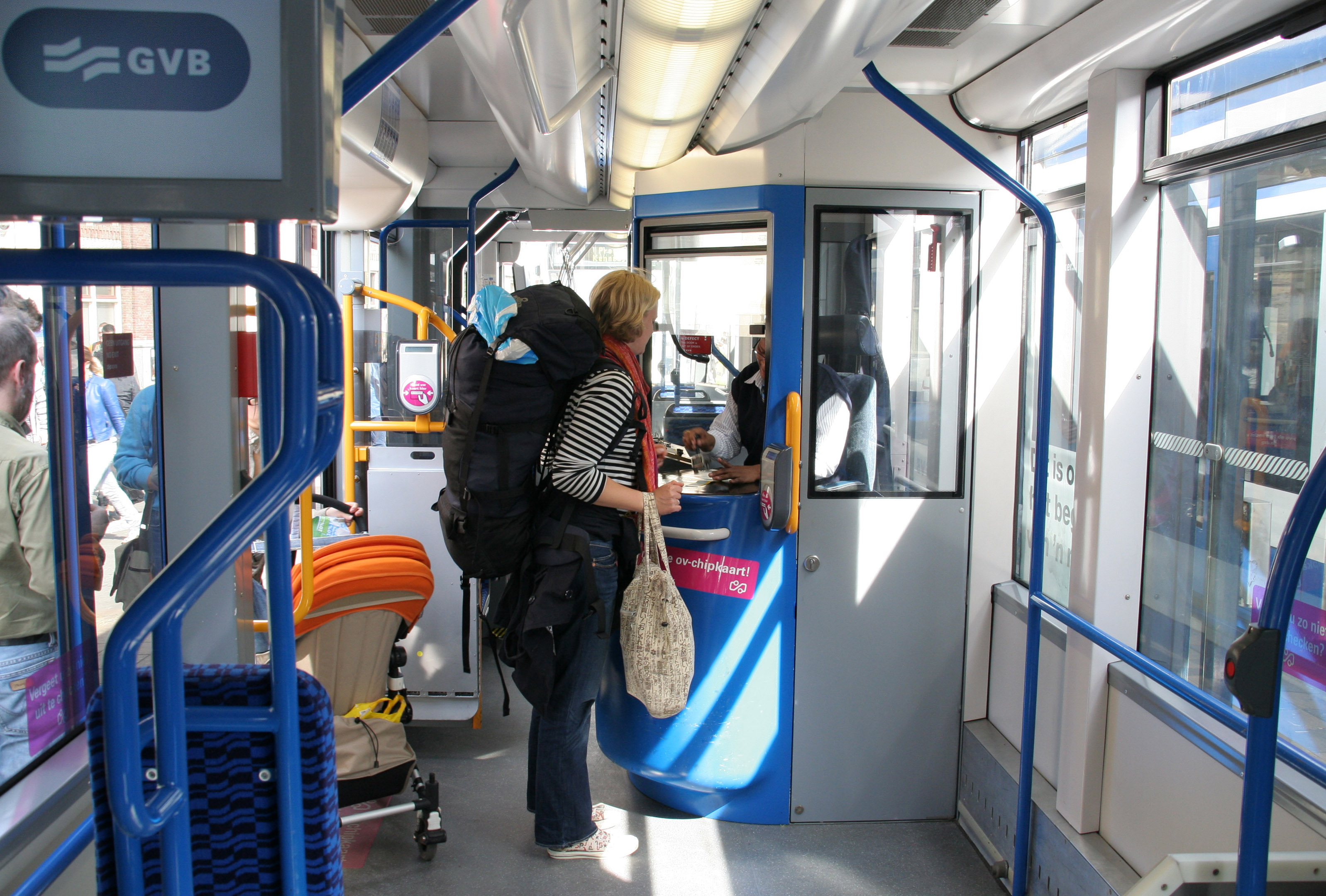
Trams in Amsterdam
On a foggy June morning in 1875, a horse pulled the first Amsterdam tram out of Plantage and clattered toward Leidseplein. The line was paid for by a company called the Amsterdamsche Omnibus Maatschappij, founded three years earlier by a man named Karel Herman Schadd, and it carried a few dozen Amsterdammers along a route that today's tram line 7 still partly retraces. Eight horses were stabled for every car; every kilometre worked them hard. A century and a half later, the descendants of that single horse-drawn line carry roughly 200,000 people a day, the cars run on electricity from green sources, the route from Centraal Station to the Leidseplein is virtually unchanged, and the operator's blue-and-white livery is one of the most recognisable city colours in Europe.
Horses, Wires, and Mailboxes
The first electric tram in Amsterdam ran on line 10 on 14 August 1900, between Planciusstraat and Leidseplein. Within six years the city had electrified all but one of its lines and inherited from the old company 242 tramcars, 758 horses, and 15 buildings - a strange municipal accession of livestock and copper wire. The last horse line, the number 12 between Nassauplein and Sloterdijk, held out until 1916. From 1922 to 1971, every Amsterdam tram carried a mailbox at the back, emptied at Centraal Station beside the central post office. A letter posted into a moving tram could still be sorted for the night train if all the regular postboxes had already closed. For half a century the trams were not only public transport but a backup postal infrastructure, threading the city's correspondence in along with its passengers.
The Years They Almost Lost
October 1944. The Hunger Winter is closing in, coal has run out, and the entire Amsterdam tram service grinds to a stop. Many of the cars are shipped east by the occupiers, never to return. Service resumes in June 1945 with a handful of lines, badly damaged rolling stock, and a city that has changed in ways the network has not yet caught up with. Then, just as the network is rebuilt, the 1950s bring a wave of bus enthusiasm. One line after another is replaced: lines 18, 12, 11, 17, finally line 5 in 1965. Only the Leidsestraat and Utrechtsestraat keep their trams, and only because those streets are too narrow for buses. The future of the Amsterdam tram is balanced on the width of two 17th-century lanes. A 1955 order for 25 articulated trams to work those two streets saves the system. The order is well received. By 1968 the city has 160 new articulated trams. The tram is back.
The Combino Crisis
Between 2002 and 2004, GVB took delivery of 155 brand-new Siemens Combino trams - sleek, low-floor, modern. Within months the structural problems began appearing. Cracks developed in the aluminium frames. Every single Combino had to be progressively withdrawn and rebuilt; the repairs ran from 2004 to 2008. Siemens absorbed enormous costs across multiple cities. In Amsterdam, the trams went back to work strengthened. They are still the backbone of the fleet, joined since 2020 by 72 Spanish-built Urbos 100 trams from Construcciones y Auxiliar de Ferrocarriles, the first of which ran on the new line 25 between Amstelveen and Amsterdam Zuid. In 2022 a Hanning and Kahl three-way point system was installed at Centraal Station, automatically routing arriving trams 4, 14, and 24 onto the correct platform, the indicator board flicking from line to line as each car pulls in.
Snow, Squatters, and Strange Trams
The system has had bad days. Between 1981 and 1983, rioting squatters set fires that destroyed four trams. In February 2021, Storm Darcy buried the rails in ice and snow and shut the whole network down. GVB had no working snow plough. So they called the Electrische Museumtramlijn Amsterdam, the city's working tram museum, and borrowed two preserved cars from the 1960s with their original museum crew - a vintage snow scraper that had originally belonged to the Wiener Linien in Vienna, and a converted streetcar carrying a brine tank. The two old cars scraped the contemporary network back into service over three days. In June 2021 the GVB officially retired the last of its BN trams; the museum took one of each type for preservation, and the two cars made a ceremonial final run from the Havenstraat depot to the Lekstraat depot, with bell-ringing tram drivers leaning out the windows.
Lines That Come Back
Line 3 had been running since 1902. In March 2026, GVB will discontinue it and split its route among lines 7, 12, and 25. For 30 percent of line 3's 15,000 daily riders, this means a forced transfer. A line that has run for 124 years simply ends, and a network reorganises around its absence. But Amsterdam tram numbers have a way of returning. Line 17 was closed in 1956, then reborn in 1962. Line 14 disappeared in 1942, was reopened in 1982. Line 25 vanished in 2013 and came back in 2020 as the new Amstelveen tram, with the southward extension to Uithoorn Centrum opening on 21 July 2024. A trip from Uithoorn to Amsterdam Zuid now takes 30 minutes by tram. The 1875 horse drivers, who could only reach Leidseplein, would not believe it.
From the Air
The Amsterdam tram network is centred on 52.378 N, 4.900 E, radiating from Centraal Station across roughly 95 km of route and 200 km of standard-gauge track. From the air the network is easiest to read by its overhead-wire poles and the white-painted tracks crossing the canal bridges of the Singelgracht and the Grachtengordel. Major lines run south to the Buitenveldert campus of the VU, west to Osdorp and De Aker, east to IJburg via the Piet Heintunnel, and southwest to Amstelveen and Uithoorn. Nearest airport is Amsterdam Schiphol (EHAM), 12 km southwest; the city centre passes under the Buitenveldertbaan approach corridor at 2,000-3,000 feet.