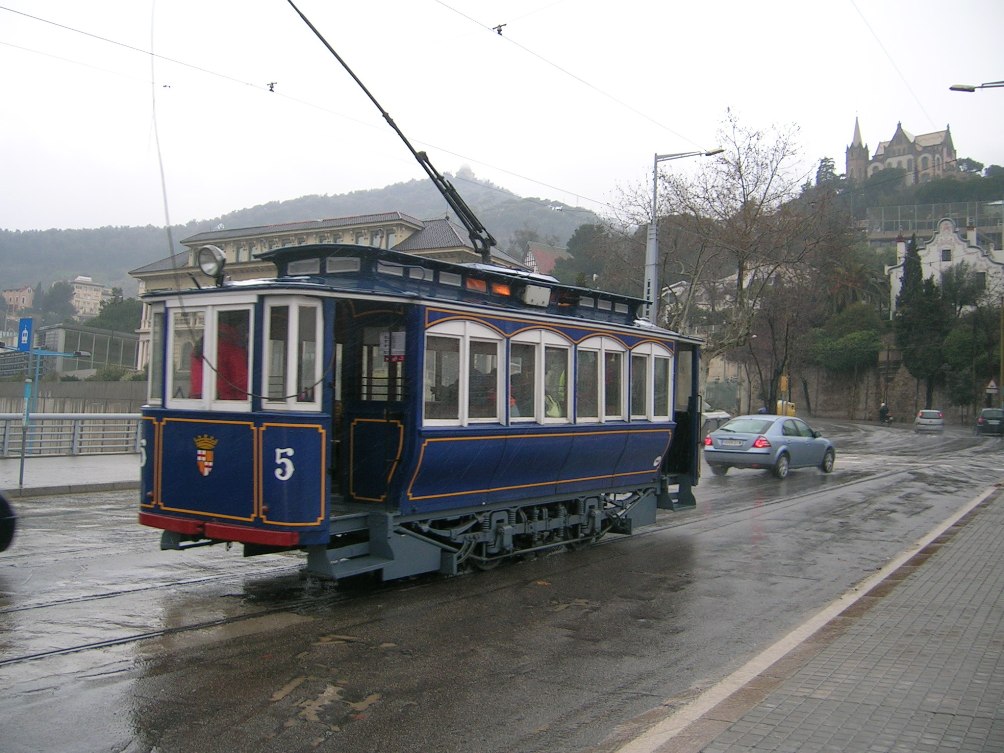
Tramvia Blau
Every other tram in Barcelona was scrapped in 1971. The city's extensive streetcar network, once threading through neighborhoods from the port to the hills, was torn up in favor of buses and metro lines -- the standard mid-century modernization story repeated in cities worldwide. But on the Avinguda Tibidabo, in the leafy Sarria-Sant Gervasi district, one line kept running. The Tramvia Blau had always been different: separately owned, independently operated, climbing a route so steep and specific that no bus could easily replace it. When the rest of Barcelona's trams disappeared, the Blue Tram simply carried on -- until January 2018, when it was taken out of service for planned modernization. As of 2026, it remains suspended, with restoration work projected to begin in 2027.
A Developer's Tram
The line exists because of a real estate venture. In 1901, Dr. Salvador Andreu was developing an upscale residential neighborhood along the axis of Tibidabo Avenue, and he needed a way to connect his hilltop properties to the city below. The tramway he built ran 1.276 kilometers from Placa Kennedy, where it met Barcelona's city tram system, up to the base of the Funicular del Tibidabo. The line's distinctive blue livery -- chosen, like everything else about the project, by Andreu -- quickly gave the tram its name. Independently owned from the start, it operated outside the municipal tram network, a private hill-climber serving a private neighborhood.
The Sole Survivor
When the Tranvias de Barcelona company closed its remaining routes in 1971, the Tramvia Blau's separate ownership proved to be its salvation. It kept running through the decade under private management, was taken over by the city in 1979, and continued operating under municipal authority. For thirty-three years -- from 1971 to 2004, when the modern Trambaix and Trambesos lines opened -- the Blue Tram was the only streetcar in Barcelona, a solitary relic of a system that had once crisscrossed the entire city. Its survival was never guaranteed; it endured because the steep gradient and narrow avenue made replacement impractical, and because Barcelonans had developed an attachment to the old blue cars that went beyond transportation.
Climbing the Hill
The numbers are modest but the experience is not. The line covers 1.276 kilometers of track, climbing 93 meters at a maximum gradient of eight percent. It is double track for most of its length, narrowing to single track at the stub terminals. The tram ran unsegregated in the center of the Avinguda Tibidabo, sharing the road with cars and pedestrians, passing under plane trees that arch overhead. The fleet consists of seven historic cars, wooden-bodied and open-sided, the kind of vehicles that transit museums elsewhere display behind ropes. When running, they rattled up the hill past Modernista villas and garden walls heavy with bougainvillea, tickets sold by the conductor on board.
The Journey Upward
The Tramvia Blau was never really a transportation system. It was a prologue. Riders would board at the bottom of the avenue after stepping off the FGC Metro Line 7, and the tram carried them slowly uphill through one of Barcelona's most elegant neighborhoods. At the top, the Funicular del Tibidabo waits to continue the ascent to the summit, where the Temple Expiatori del Sagrat Cor and the vintage Tibidabo Amusement Park sit against the sky. The entire journey -- metro to tram to funicular -- was a progression from urban density to hilltop air, and the Blue Tram served as the transitional passage, the moment where the city begins to thin and the view begins to open. The tram's slowness was the point. It asked you to look around. Whether it will do so again depends on Barcelona's plans to restore the line -- a project the city has promised but not yet begun.
From the Air
Located at 41.414N, 2.134E along the Avinguda Tibidabo in the Sarria-Sant Gervasi district of northwest Barcelona. The tram line runs in a straight line up a tree-lined avenue toward Mount Tibidabo, which is crowned by the distinctive Sacred Heart church (Temple del Sagrat Cor). From the air, the avenue is visible as a green corridor climbing the hillside from the city grid toward the mountain. Nearest airport is Barcelona-El Prat (LEBL), 17 km south-southwest. Best spotted at 2,000-4,000 feet AGL when approaching Tibidabo from the southeast.