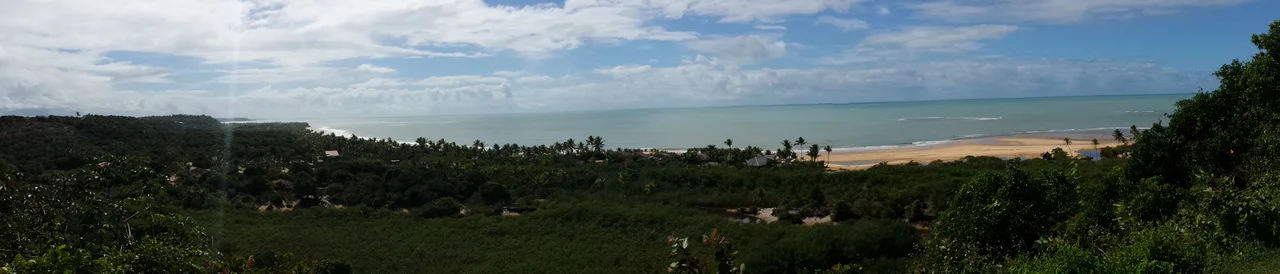

Trancoso, Bahia
The square is called the Quadrado, which means exactly what it sounds like in Portuguese — and yet it is rectangular, not square, a long green plaza framed by ankle-high whitewashed houses painted in the clear candy colours of coastal Bahia: mango, turquoise, pink, lime, blue. At one end stands a small white church that has been watching the Atlantic for almost four and a half centuries. Between the houses and the sea there is nothing but grass, then a sudden drop, then a strip of golden sand the colour of coconut milk. This is the centre of Trancoso, a place that has stayed strangely itself even after the world discovered it.
The Jesuit Village
The Portuguese came to this coast first: on 22 April 1500, Pedro Álvares Cabral's fleet landed just to the north, at what is now Porto Seguro, and claimed the continent for the Portuguese crown. In 1583, Jesuit priests founded a mission for the indigenous Tupiniquim of the region, naming it São João Baptista dos Índios — Saint John the Baptist of the Indians. The simple whitewashed church they built, São João Batista, still stands at the eastern end of the Quadrado, its door opening toward the sea where missionaries and native peoples first crossed paths. The Jesuits were expelled from Portuguese territories in 1759, but the settlement held on, surviving first as a Tupiniquim community, then as a fishing village of mixed descent, and then as nothing at all — a quiet place too far from anywhere to matter.
The Road Arrives
For most of the twentieth century, reaching Trancoso meant a boat or a donkey or a long, hot walk through the mata atlântica. That was part of what kept it whole. In the 1970s a small trickle of counter-culture travellers from Rio and São Paulo began finding the place and staying; they restored the candy-coloured houses around the Quadrado and learned, slowly, how to live near the sea. In 1999 a highway opened from Trancoso to Porto Seguro, which has a commercial airport, and the trickle became a flood. Club Méditerranée arrived, and then the fashion photographers, and then the Italian billionaires. What is remarkable is how much of the old village survived the arrival. The Quadrado is now protected by UNESCO as part of the Costa do Descobrimento heritage complex. The colours remain. The little church still looks out at the Atlantic.
The Beaches
South of the Quadrado the cliffs fall away to a long chain of half-wild beaches, each with its own reputation. Praia dos Nativos has beach-bars and music. Praia dos Coqueiros — Coconut Palm Beach — is a small crescent hedged by more than a hundred palms and protected at low tide by coral reefs that form natural warm swimming pools. Further south, Praia da Pedra Grande is narrower, quieter, better for surfing and for solitude. Half an hour's drive on a red-dirt road leads to Praia do Espelho, the Mirror Beach, named for the way its reef-bound tidepools reflect the sky. The road is often passable only in dry weather. That is part of the point. Trancoso's beaches are not resorts; they are places where the coconut palms lean and the sand is soft and the Atlantic, here, is warm almost year-round.
A Festival of Drums
Every 20 January the Quadrado fills for the festival of São Sebastião — Saint Sebastian, a patron whose feast day the locals celebrate with drums, guitars, and a short sung verse that begins São Sebastião, hoje chegou o dia. Vimos festejar com toda a alegria — Saint Sebastian, your day has arrived; we have come to joyfully celebrate it. The festival is old, rooted in the same Catholic-Portuguese-Afro-Brazilian layering that runs through all of Bahia, and for one night the Quadrado belongs entirely to the people who live here, not to the visitors who have bought up the colour-block houses around it. It is a reminder that the village is still a village, that the square is still the square, that the church door still opens toward the sea.
The Careful Present
Around Trancoso, the APA Caraíva-Trancoso — a state Environmental Protection Area — works to slow the speed of new building along the coast and inland; the federal Ministry of the Environment is expanding nearby parks to protect the last patches of Atlantic rainforest that once covered this entire shore. The balance is never simple. The real estate has boomed; the snowbirds from Canada, Italy, and Israel have settled; some of the old families have been priced out. But the Quadrado itself is almost exactly what it was forty years ago, and the local association that maintains it intends to keep it that way. Some places resist more than they accept. Trancoso is one of them.
From the Air
Trancoso lies at 16.59°S, 39.10°W on the southern coast of Bahia, roughly 25 km south of Porto Seguro. From altitude the area reads as a long, low, green coastal shelf cut by red-dirt roads, with cliffs of pale stone dropping to sand beaches and a shoreline lined with coconut palms. The nearest airport is Porto Seguro (SBPS), about 10 nm north, which serves the entire southern-Bahia beach region. Weather here is reliably pleasant: average temperatures 22–28°C, prevailing southeast trades, highest rainfall November–January with brief tropical showers rather than systems. Cruising altitudes of 3,000–6,000 ft give the best view of the distinctive reef-protected pools at Praia do Espelho and the famous green Quadrado at the village centre.
Nearby Stories
- Campo Bahia 24 km away
- SS Principessa Mafalda 97 km away
- Nanuque 126 km away
- Jequitinhonha 138 km away
- Mata Escura Biological Reserve 141 km away
- Itaúnas 180 km away
- Battle of 4 May 349 km away
- 2019 Northeast Brazil Oil Spill 395 km away