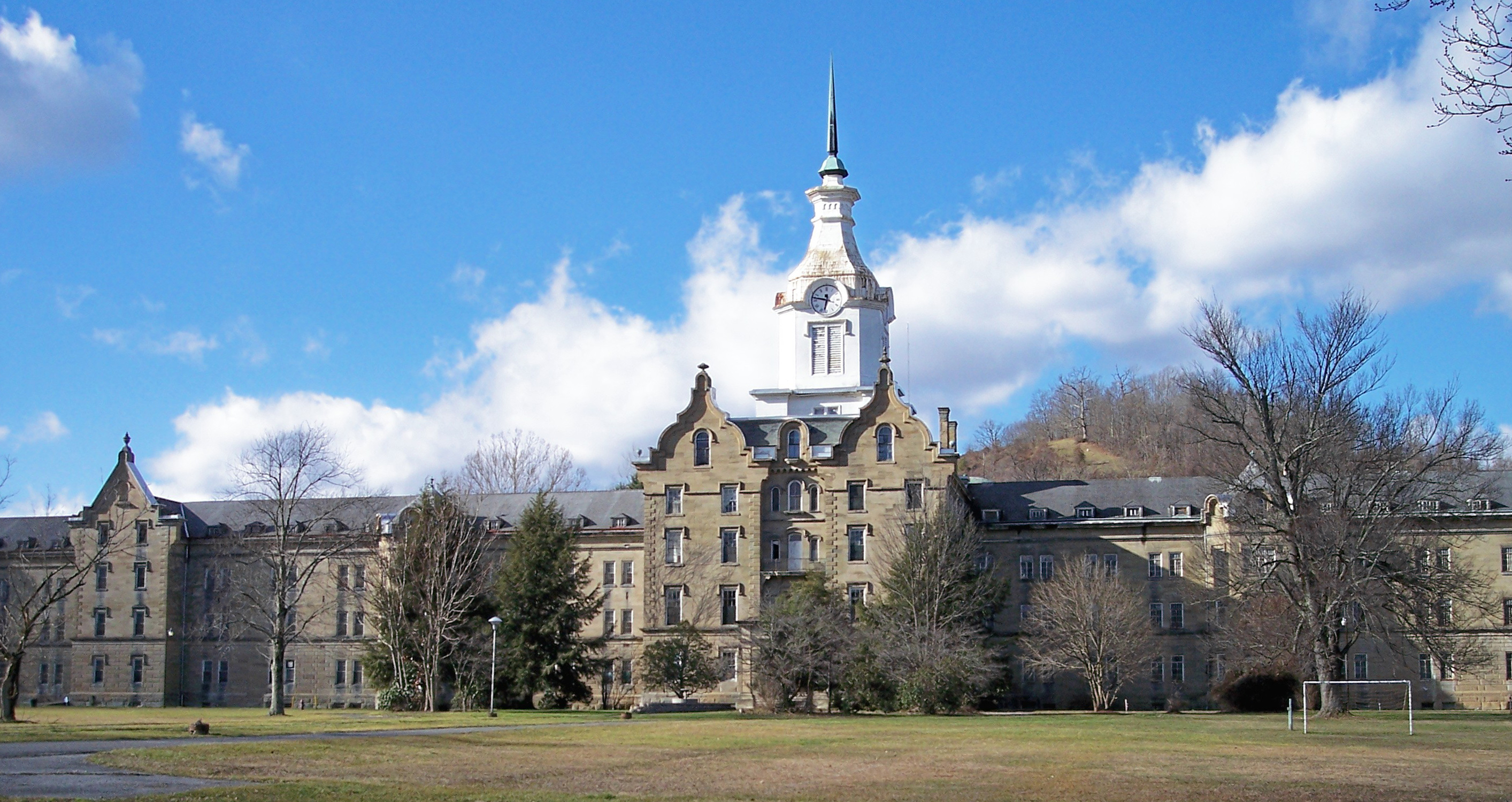
Trans-Allegheny Lunatic Asylum
It took 23 years to build and was designed for 250 patients. By the 1950s, 2,400 people were crammed inside its walls. The Trans-Allegheny Lunatic Asylum in Weston, West Virginia, is one of the largest hand-cut stonemasonry buildings in the United States, a Gothic Revival behemoth stretching along the West Fork River whose history mirrors the arc of American attitudes toward mental illness: ambitious idealism, grotesque overcrowding, slow abandonment, and, finally, a second life as a place people pay to visit. Designated a National Historic Landmark in 1990, the asylum opened to patients in 1864 and closed in 1994, a span of 130 years that encompassed the Civil War, the rise and fall of institutional psychiatry, and some of the darkest chapters in the treatment of the mentally ill.
A Hospital Born in War
The Virginia General Assembly authorized construction of the asylum, and work began in 1858 on a parcel of land near the West Fork River, when the site was still part of Virginia. Architect Richard Snowden Andrews of Baltimore designed the facility using the Kirkbride Plan, a progressive 19th-century approach to asylum design that emphasized natural light, air circulation, and therapeutic environments. But the Civil War intervened. The grounds and partially built structures were occupied by both Union and Confederate forces, and Confederate raiders stripped building supplies. Funding for continued construction came from a treasury established for what would become the new state of West Virginia in 1862. The central clock tower was completed in 1871, and separate rooms for Black patients were finished in 1873. The full building was not completed until 1881, two decades after the war that nearly prevented its construction.
The Kirkbride Dream and Its Collapse
Thomas Story Kirkbride, the Philadelphia psychiatrist whose plan inspired the asylum's design, believed that architecture itself could heal. His system placed patients in staggered wings radiating from a central administration building, ensuring each ward received sunlight and fresh air. The Trans-Allegheny asylum was intended to be self-sufficient, a contained world where structured routine and humane surroundings would restore troubled minds. For a time, it may have worked as intended. But the facility was designed for 250 patients, and demand overwhelmed capacity. By the 1950s, the population had swelled to 2,400, nearly ten times the intended number. Overcrowding obliterated the Kirkbride philosophy. Patients who could not be controlled were locked in cages. The therapeutic environment became a warehouse of human suffering, its soaring Gothic corridors now lined with the forgotten.
Decline and the Final Decades
Changes in the treatment of mental illness, particularly the shift toward deinstitutionalization and community-based care, gradually reduced the hospital's population through the latter decades of the 20th century. In February 1986, Governor Arch Moore announced plans to close the Weston facility and convert it to a prison, but the state found the conversion unconstitutional, and work was suspended. The hospital continued to operate under the name Weston State Hospital until May 1994, when the remaining patients were transferred to the new William R. Sharpe Jr. Hospital, also in Weston, named after a member of the West Virginia Senate. For more than a decade after its closure, the massive stone building sat empty, its corridors deteriorating, its future uncertain. A gas well drilled on the hospital grounds in 1902 hinted at the building's strange relationship with the land beneath it, a structure built to contain human turbulence sitting atop geological forces of its own.
A Second Life After Abandonment
In 2007, the asylum was sold at auction for $1.5 million. New owner Joe Jordan began maintenance and restoration projects, and in March 2008, the facility reopened as a tourist attraction. The main building, known as the Kirkbride, now houses a museum on its first floor, displaying paintings, poems, and drawings created by patients in the hospital's art therapy programs, alongside medical artifacts including a straitjacket and a hydrotherapy tub. Tour guides dress in 19th-century nurse attire. Visitors can choose a shorter historical tour covering the first floor, or a longer tour spanning all four floors, staff apartments, the morgue, and the operating room. The asylum also offers paranormal tours beginning at sunset, with overnight options available. The building has appeared in the video game Fallout 76 as a Brotherhood of Steel base called Fort Defiance, and was featured in the Discovery Channel series Expedition X and the podcast Lore. West Virginia author Jayne Anne Phillips set part of her Pulitzer-winning 2023 novel Night Watch within the asylum's Civil War-era walls.
From the Air
Located in Weston, West Virginia, at 39.039N, 80.471W, along the West Fork River. The asylum's massive Kirkbride building is visible from the air as one of the largest structures in the area, with its distinctive staggered-wing Gothic Revival layout. Best viewed at 2,000-3,000 feet AGL. Nearest airports: Lewis County Airport (9WV) approximately 3 nm south; North Central West Virginia Airport (KCKB) in Clarksburg approximately 20 nm north. The West Fork River provides a useful visual reference running past the asylum grounds. Terrain is hilly Appalachian with moderate relief.