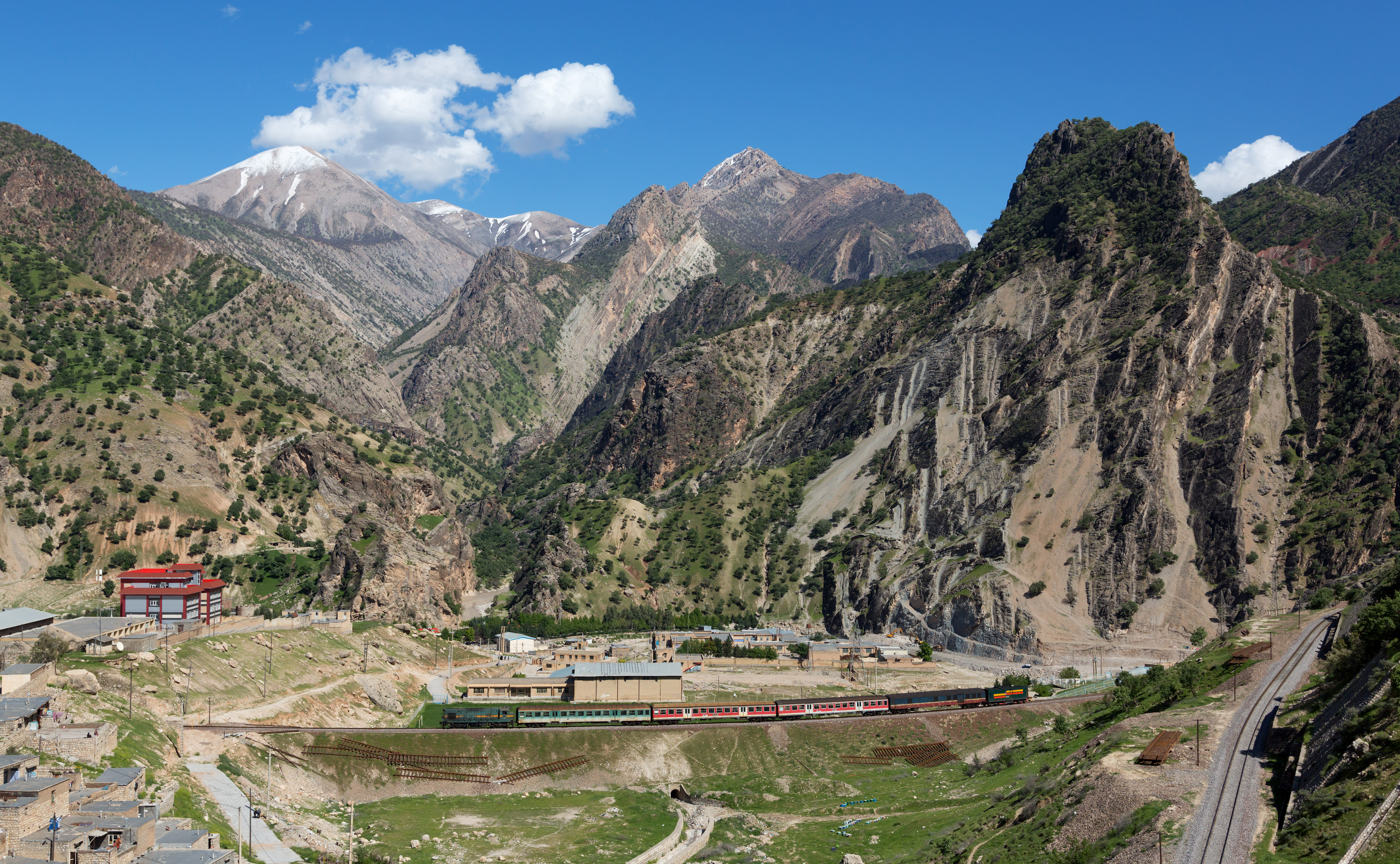
Trans-Iranian Railway
One tunnel hit a salt dome and had to be abandoned because the water table would dissolve the mountain around it. Another bored into what appeared to be solid rock, only to strike powdery gypsum that filled the excavation as fast as workers could dig. A third tunnel entered pumice so sticky that picks and shovels became permanently embedded. And a fourth broke through into a vast underground cavern that required building a bridge inside the mountain itself. These were not the problems of a normal railway. The Trans-Iranian Railway, built between 1927 and 1938, was an act of geological defiance that connected the Persian Gulf to the Caspian Sea across some of the most punishing terrain on Earth.
Decades of Imperial Scheming
Before a single rail was laid, the idea of a Trans-Iranian railway consumed three decades of diplomatic maneuvering among empires that wanted it for their own purposes. In 1889, Russia and the Qajar Shah agreed that no railways would be built in Iran without Russian consent. Britain wanted the line to run east-west, connecting its military bases in India and Mesopotamia. Germany threatened both by pushing its Berlin-Baghdad railway closer to Tehran. By 1912, Russian, French, and British financiers had formed a consortium to fund the project, but the Balkan Wars froze their investments. World War I buried the plan entirely. It took Reza Shah, who seized the throne in 1925, to cut through the imperial entanglements. He would build the railway north to south, on Iran's terms, with Iran's money.
Paid for in Sugar and Tea
Reza Shah's solution to the funding problem was blunt: tax the staples. The railway's cost, over two billion rials through 1938-1939, came primarily from levies on sugar and tea. No foreign loans, no imperial strings. Cabinet ministers who criticized the financial burden risked prison, accused of being British collaborators trying to keep Iran backward. The construction itself drew an international cast. An American-German syndicate built the initial test sections before the Americans quit over payment disputes in 1930. In 1933, the Shah turned to Kampsax, a Danish engineering firm working in Turkey. Denmark posed no political threat to Iranian sovereignty. Kampsax subcontracted the project into 43 lots spread among European, American, and Iranian companies, coordinating everything from its Tehran office. The firm completed the line under budget and ahead of schedule, formally opening it on August 26, 1938.
Three Golden Lines
The railway's engineering borders on the absurd. In 1,394 kilometers, the line passes through roughly 230 tunnels and crosses 4,100 bridges. Its highest point reaches 2,220 meters above sea level at Arak. Long stretches climb at gradients of 1 in 36, requiring spiral techniques borrowed from mountain railways in the Alps. The most celebrated is the Se Khat Tala, the Three Golden Lines, a spiral in Savadkuh County of Mazandaran province where the track passes through the same area three times at different heights, threading the Dowgal twin tunnels as trains either climb toward the Alborz or descend toward the Caspian lowlands. The Veresk Bridge, a soaring arch across a mountain gorge, became another icon of the line. Hossein Orang, the first official Iranian locomotive conductor to ride the completed railway, piloted his train through terrain that had defeated imperial ambitions for half a century.
The Persian Corridor
The railway Reza Shah built to assert Iranian independence became the instrument that ended his reign. When World War II began, the Shah declared neutrality. The Allies did not care. In August 1941, Soviet and British forces invaded Iran, deposed Reza Shah, and installed his young son Mohammad Reza Pahlavi. Their prize was the Trans-Iranian Railway itself, which became the backbone of the Persian Corridor, the supply route that funneled oil to Britain and war material to the Soviet Union. British Royal Engineers expanded freight capacity, built new railway yards at Bandar Shahpur, Ahvaz, and Andimeshk, and shipped in dozens of heavy locomotives from Britain. The U.S. Army Transportation Corps pushed daily freight traffic to an average of 6,489 tons by 1944. The railway that Iran had built with sugar taxes helped save the Allied war effort.
World Heritage
In July 2021, UNESCO designated the original 1938 Bandar Shahpur-to-Bandar Shah route as a World Heritage Site, recognizing it as an outstanding example of railway engineering in a challenging landscape. The line continues to operate. In 2014, a new connection linked Gorgan to Etrek in Turkmenistan, joining the Trans-Iranian Railway to the International North-South Transport Corridor. Because the former Soviet states use a wider Russian gauge, break-of-gauge services are required at the Turkmen border, where cargo must be transferred between different-sized trains. Nearly a century after Reza Shah forced his railway through salt domes and pumice fields, the line remains Iran's spine, connecting the warm waters of the Persian Gulf to the Caspian shore.
From the Air
The railway runs roughly north-south through western Iran, with its Tehran terminus at approximately 35.66N, 51.40E. From the air, the most dramatic sections are visible in the Alborz mountain crossings north of Tehran, particularly the Veresk Bridge and the Three Golden Lines spiral in Savadkuh County, Mazandaran province. The southern terminus at Bandar-e Emam Khomeyni sits on the Persian Gulf. Best viewed at medium altitudes (5,000-10,000 feet) in the mountain sections. Nearest airports: Tehran Imam Khomeini International (OIIE), Mehrabad International (OIII). The Alborz crossing sections offer spectacular viewing in clear weather.