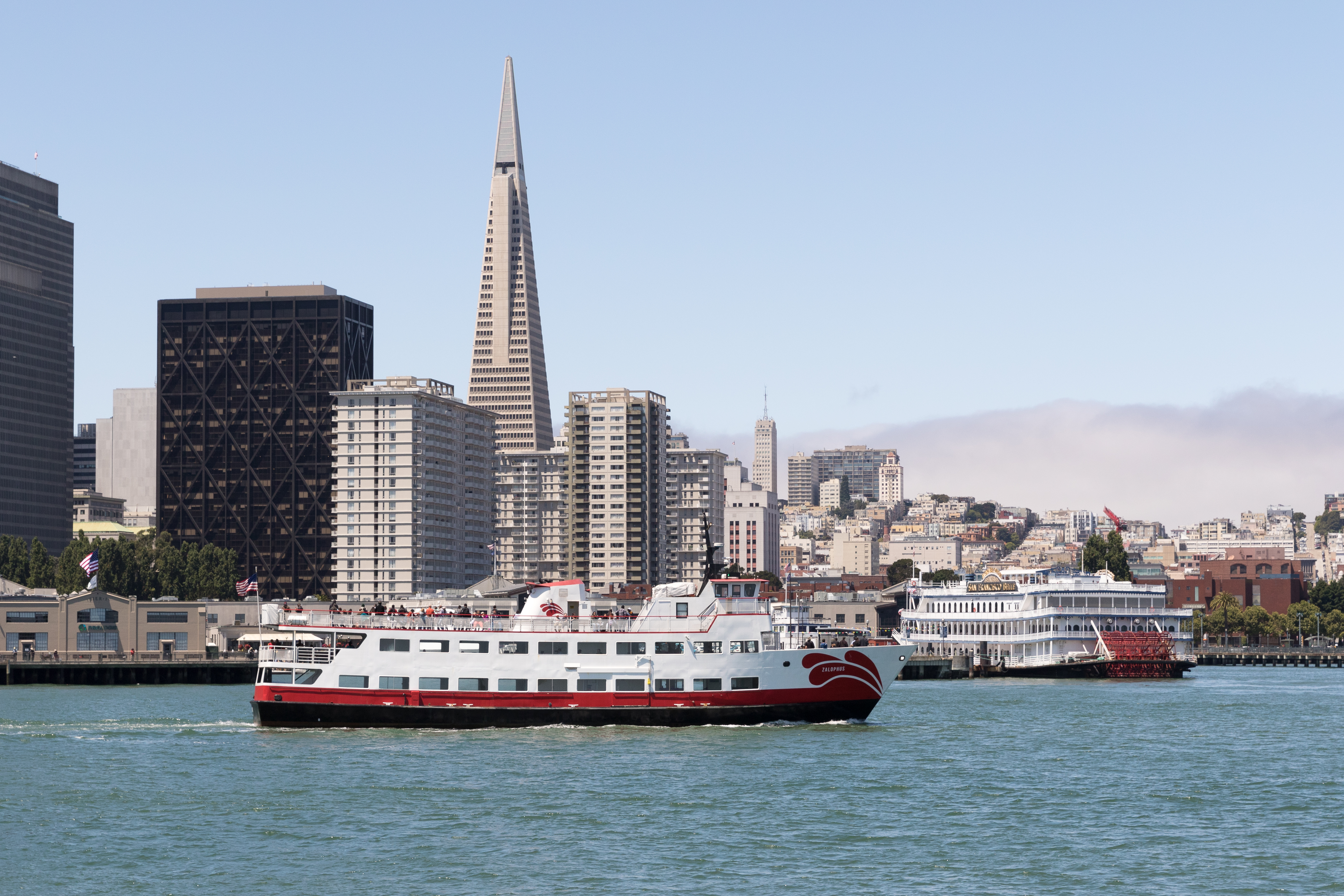
Transamerica Pyramid
Buried beneath 600 Montgomery Street lies the hull of the whaling vessel Niantic, abandoned during the 1849 Gold Rush when her crew deserted for the goldfields. Above that hull rises the Transamerica Pyramid -- 48 stories, 853 feet, 3,678 windows, and a facade covered in crushed quartz that catches the light differently with every shift in San Francisco's weather. The juxtaposition is pure San Francisco: layers of ambition stacked atop layers of ambition, each generation building on the wreckage of the last.
From Shoreline to Skyline
The site of the Transamerica Pyramid was once the shoreline of Yerba Buena Cove, where in 1846 a detachment from the USS Portsmouth landed and raised the American flag at what is now Portsmouth Square, establishing U.S. control over the settlement. The cove was gradually filled as the city expanded, and in 1853 the Montgomery Block was built on the reclaimed ground -- a landmark that housed financiers, lawyers, and artists for over a century before being demolished in 1959 for a parking lot. Transamerica Corporation, founded by A. P. Giannini in 1928, originally occupied the Fugazi Bank Building across the street. CEO John R. Beckett commissioned the new tower in the late 1960s, choosing the unconventional pyramidal shape because he wanted to allow light to reach the streets below.
The Pyramid Nobody Wanted
Construction began in 1969 and was completed in 1972, overseen by Hathaway Dinwiddie Construction Company. Architect William Pereira's design provoked fierce resistance. Critics called it "Pereira's Prick" and objected that the original 1,150-foot proposal would have blocked views of San Francisco Bay from Nob Hill. The city planning commission rejected the taller version; the 853-foot compromise still made it the tallest building west of Chicago at the time. During the foundation pour -- a three-day, round-the-clock continuous concrete operation that resulted in a nine-foot-thick base containing 16,000 cubic yards of concrete and over 300 miles of steel rebar -- spectators tossed thousands of dollars in coins into the pit for good luck.
An Icon Earns Its Place
Time softened the criticism into affection. San Francisco Chronicle architecture critic John King wrote in 2009 that the Pyramid had become "an architectural icon of the best sort -- one that fits its location and gets better with age." Its distinctive silhouette became one of the city's most recognizable symbols, appearing on the Transamerica Corporation logo long after the company moved its operations to Cedar Rapids, Iowa. At its base, Redwood Park shelters trees transplanted from the Santa Cruz Mountains, a fountain with a bronze frog commemorating Mark Twain's Jumping Frog story, and a plaque honoring Bummer and Lazarus, two nineteenth-century dogs celebrated for their rat-catching prowess. Only two of the building's 18 elevators reach the top floor, and most windows can pivot 360 degrees for interior cleaning -- a practical necessity of the pyramid shape.
Second Act
In 2017, the Salesforce Tower surpassed the Pyramid as San Francisco's tallest building. The shift in stature coincided with a more fundamental transformation. Transamerica was acquired by the Dutch insurer Aegon in 1999, and the building's iconic tenant gradually drifted away. By 2020, the building was sold to New York investor Michael Shvo, who hired Norman Foster for a $250 million renovation. The Pyramid had been largely closed since the late 1990s, a ghost inhabiting one of the world's most recognizable silhouettes. Whether Foster's renovation returns it to active life or not, the building's place in the skyline is secure. From the Bay, from the hills, from the window of a descending aircraft, the Transamerica Pyramid still catches the eye first -- the sharp point where San Francisco's ambition meets the sky.
From the Air
Located at 37.795N, 122.403W in San Francisco's Financial District. The pyramid shape is unmistakable from any altitude or approach direction. Nearest airports: KSFO (11nm south), KOAK (10nm east). Visible from nearly any approach to the Bay Area.