TransAsia Airways Flight 235
A dashcam in a car on the Huandong Expressway recorded the moment: a white ATR 72-600 banking steeply left, its wing clipping a taxi on the elevated road before the aircraft plunged into the Keelung River. The date was February 4, 2015. TransAsia Airways Flight 235 had departed Taipei Songshan Airport just two minutes earlier, bound for Kinmen with 58 people aboard. The footage, stark and almost incomprehensible in its matter-of-factness, circled the globe within hours. Behind those few seconds of video lay a chain of mechanical failure and human error that investigators would spend more than a year unraveling.
Two Minutes After Takeoff
The weather at Songshan that morning was unremarkable: a cloud base around 1,500 feet, unrestricted visibility, a light easterly breeze at 10 knots, and a temperature of 16 degrees Celsius. The ATR 72-600 was ten months old. Shortly after takeoff, a fault in the autofeather unit of the number-two engine triggered the automatic takeoff power control system to feather that engine's propeller, effectively shutting it down. An ATR 72 can fly on one engine. What happened next turned a manageable emergency into a catastrophe. The flight crew, responding to the loss of the right engine, shut down the left engine -- the one still operating normally. With both engines now producing no thrust, the aircraft climbed briefly to 1,630 feet before the pilots transmitted their final words to air traffic control: "Mayday, mayday, engine flameout."
Into the River
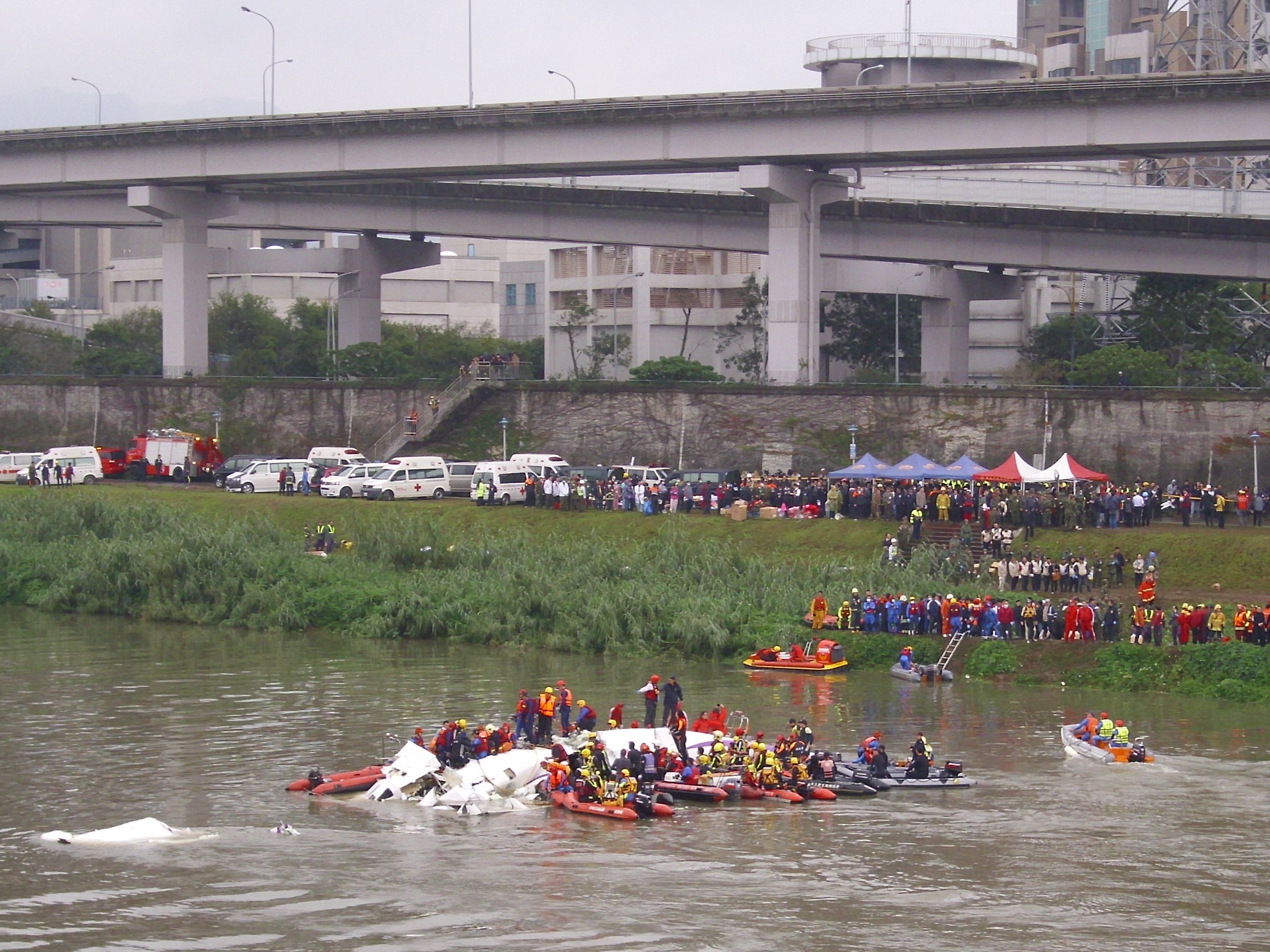
The aircraft descended rapidly, banking left over the city. Its wing struck a taxi on an elevated section of the Huandong Expressway, scattering debris and pieces of the viaduct guardrail across the road surface. The two occupants of the taxi suffered minor injuries. The plane continued its uncontrolled descent and broke into two main pieces as it crashed into the Keelung River, approximately five kilometers from the airport. Of the 58 people aboard -- crew, passengers, and an observer pilot seated in the cockpit jump seat -- 43 died. Among the 15 survivors was flight attendant Huang Ching-ya. Over half the passengers were Chinese nationals, prompting immediate responses from both Taipei and Beijing.
The Investigation
Taiwan's Aviation Safety Council led the investigation, with participation from France's Bureau of Enquiry and Analysis, Canada's Transportation Safety Board, and the aircraft and engine manufacturers ATR and Pratt & Whitney Canada. The interim report confirmed what the flight data had already suggested: the pilot in command had shut down the wrong engine. The report also revealed that he had failed a simulator test in May 2014, partly for demonstrating insufficient knowledge of the engine-flameout-during-takeoff procedure. He retook and passed the test the following month. During the investigation, TransAsia Airways leaked confidential draft report information to Next magazine in an apparent attempt to influence the findings, drawing a NT$3 million fine. The final report was published in July 2016.
Aftermath and Accountability
Taiwan's Civil Aeronautics Administration ordered supplementary proficiency tests for all TransAsia ATR pilots. The labor ministry fined the airline for breaches of the labor code involving excessive working hours. TransAsia offered NT$14.9 million -- roughly US$475,000 -- in compensation to each victim's family, though not all families accepted. The taxi struck by the aircraft was transported to the Taxi Museum in Su'ao, Yilan County. Flight 235 was the second fatal ATR 72 crash involving TransAsia in less than a year; Flight 222 had crashed during approach in July 2014, also due to pilot error. Together, the two accidents destroyed public confidence in the airline. On November 22, 2016, TransAsia Airways ceased all operations and shut down indefinitely.
Fifty-Eight Lives
The numbers from Flight 235 are precise and clinical: 58 aboard, 43 dead, 15 survivors. Behind those figures were people on a routine domestic flight, traveling to Kinmen for business, family visits, or the Lunar New Year holiday that was days away. The observer in the jump seat, Hung Ping-chung, was 63 years old with 16,121 flight hours to his name. The crew were all Taiwanese citizens; the co-pilot held dual New Zealand-Taiwanese citizenship. In the months that followed, the dashcam footage became one of the most-watched aviation disaster videos in history, replayed in living rooms and classrooms around the world. The Canadian series Mayday devoted an episode to the crash in 2017. But for the families of the 43 who did not survive, the video was not content. It was the last moment.
From the Air
The crash site is located at approximately 25.063°N, 121.618°E in the Keelung River, about 5 km from Taipei Songshan Airport (RCSS). The flight departed Songshan's runway 10 heading east. The aircraft reached a maximum altitude of approximately 1,630 feet before descending. The Huandong Expressway viaduct where the wing struck the taxi runs parallel to the river at this point. Taoyuan International Airport (RCTP) is 30 km southwest. The Keelung River corridor is visible from altitude as it winds through Taipei's Nangang and Neihu districts.