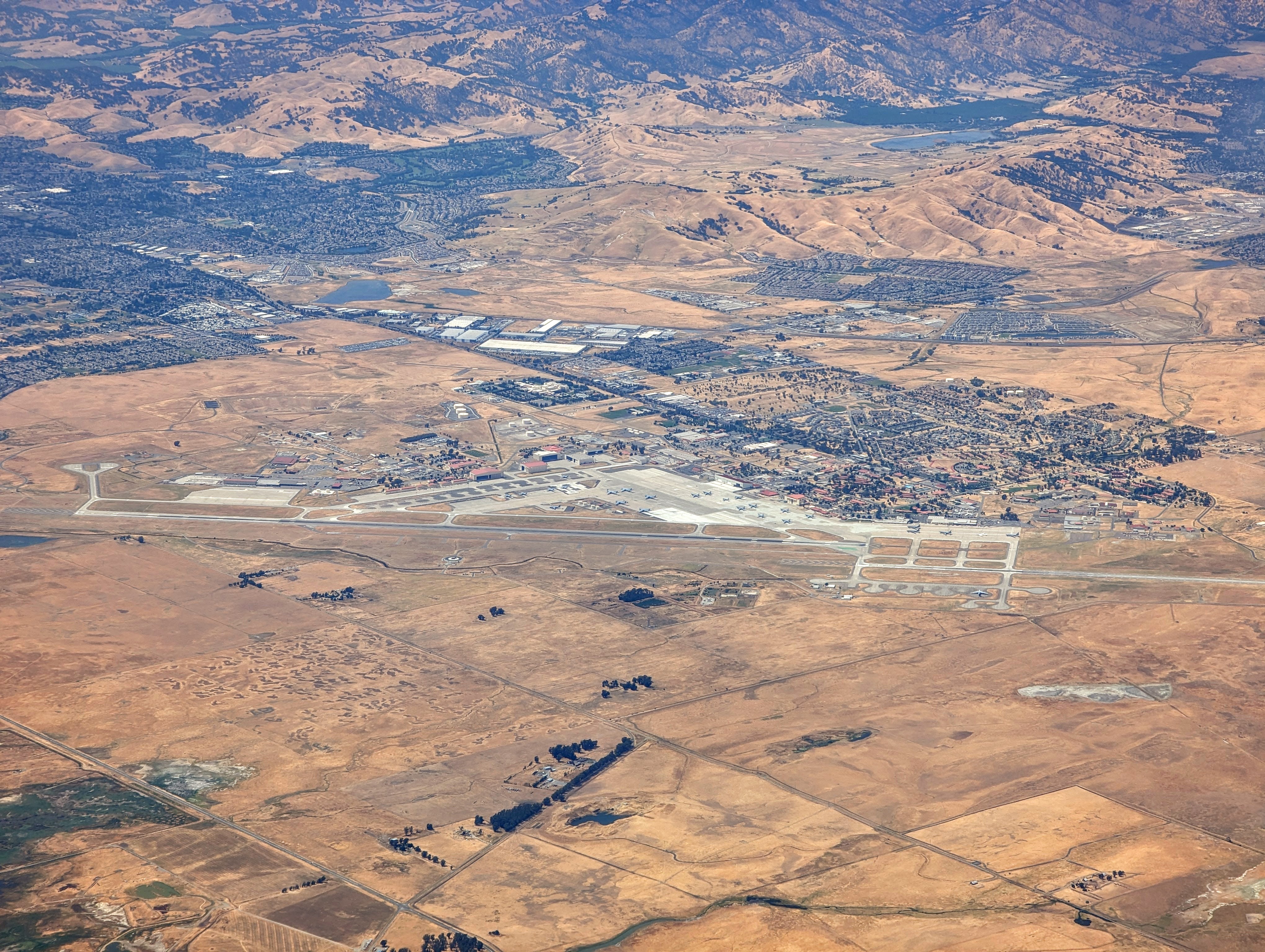
Gateway to the Pacific
On August 5, 1950, a B-29 Superfortress lifted off from Fairfield-Suisun Air Force Base and almost immediately came back down. The crash ignited 10,000 pounds of high explosives in the cargo hold -- a Mark 4 nuclear weapon, minus its fissile core -- and the detonation killed Brigadier General Robert F. Travis and 18 others. A year later, the base was renamed in his honor. It is a strange kind of memorial: a working military installation that handles more cargo and passenger traffic than any other military air terminal in the country, named for a man whose death was caused by the very weapons it was built to carry. Travis Air Force Base has been called the Gateway to the Pacific since the 1960s, and the title is not ceremonial. Everything the Air Force needs to move west -- troops, equipment, humanitarian aid, diplomats -- has a good chance of passing through Solano County first.
Built for One War, Remade for the Next
Construction began in 1942 under the name Fairfield-Suisun Army Air Base. The original plan called for medium attack bombers, but the War Department had other ideas. By October of that year, the base was assigned to the Air Transport Command, and its wartime mission became ferrying aircraft and supplies to the Pacific Theater. When the Air Force became a separate service in 1947, the installation was renamed Fairfield-Suisun Air Force Base. Two years later, Strategic Air Command took control and transformed the base into a nuclear bomber installation. B-29 Superfortresses gave way to B-36 Peacemakers, which gave way to B-52 Stratofortresses. Runways were widened, hangars multiplied, and permanent quarters replaced temporary barracks. For nine years, airlift was secondary to the business of nuclear deterrence.
The Airlift Era
In 1958, the Military Air Transport Service reclaimed Travis, and the base returned to what geography had always suited it for: moving things west. The shift defined the next three decades. The 60th Military Airlift Wing arrived in 1966, bringing with it the C-141 Starlifter, the Air Force's first all-jet heavy airlifter. In 1970, the wing began operating the C-5 Galaxy, the largest aircraft in the Air Force inventory -- a plane so enormous that its cargo hold can swallow six Greyhound buses. The Air Force Reserve's 349th Wing joined as an associate unit in 1969, and the two wings eventually blended their crews so seamlessly that active-duty and reserve personnel flew the same missions on the same aircraft. When the Cold War ended and the Air Force reorganized in 1992, Travis came under the new Air Mobility Command, adding KC-10 Extender aerial refueling tankers to its fleet.
Solano County's Largest Employer
The numbers tell a story the base's nickname does not fully capture. Approximately 7,390 active-duty personnel, 3,260 reservists, and 3,690 civilians work at Travis, making it the largest employer in both Fairfield and Solano County. The base's annual economic impact exceeds one billion dollars. Military families and retirees have settled permanently in the surrounding communities, and the skilled workforce the base produces feeds into the region's labor pool long after uniforms are retired. David Grant USAF Medical Center, a 265-bed teaching hospital on base, serves both active-duty and retired military personnel -- a $200 million facility that functions as the region's de facto military healthcare hub. Travis is not just a runway and a control tower. It is a small city grafted onto a larger one, with its own medical system, housing, schools, and economic gravity.
From Starlifters to Pegasus
The fleet has evolved continuously. The C-141 Starlifters were retired in 1997, transferred to other wings across the country. The C-17 Globemaster III arrived in 2006 -- Travis named its first one the Spirit of Solano -- bringing a more versatile airlifter that could land on shorter, rougher runways in austere environments. In January 2017, the Air Force announced that Travis would receive 24 Boeing KC-46 Pegasus tankers, the replacement for the aging KC-10. The first Pegasus arrived on July 28, 2023. Travis's final KC-10 departed for storage at Davis-Monthan Air Force Base in Arizona on September 26, 2024, closing a chapter that had begun when the aerial refueling mission first came to Travis in 1992. Today the 60th Air Mobility Wing operates C-5M Galaxies, C-17 Globemaster IIIs, and KC-46 Pegasus tankers -- making it the largest wing in Air Mobility Command.
The Land Next Door
Between 2018 and 2023, a company called Flannery Associates quietly purchased over 50,000 acres of land surrounding Travis Air Force Base, spending nearly a billion dollars in the process. The purchases triggered federal investigations into who was behind the acquisitions and why someone would want that much farmland next to an active military installation. In August 2023, the mystery was resolved -- or at least reframed. Flannery Associates was a subsidiary of California Forever, a venture backed by Silicon Valley investors who planned to build an entirely new city on the land. The proposal turned Travis from a military logistics story into an urban planning controversy, raising questions about water rights, agricultural preservation, and what it means to drop a planned community next to the busiest military air terminal in the country. The debate continues, and the base watches from behind its fences, doing what it has done since 1942: moving things west.
From the Air
Travis Air Force Base (KSUU) is located at 38.26N, 121.93W in Fairfield, California, at the southwestern edge of the Sacramento Valley. The base has two parallel runways and is clearly visible from altitude with its extensive ramp areas, hangars, and parked C-5 and C-17 aircraft. KSUU is an active military airfield with restricted airspace -- civilian pilots should consult NOTAMs and remain clear. Nearby civilian airports include Nut Tree Airport (KVCB) 5nm east, Rio Vista Airport (O88) 12nm south, and Sacramento Executive Airport (KSAC) 35nm northeast. Suisun Bay and the Carquinez Strait are visible to the south. Clear conditions are common in summer; tule fog can reduce visibility to near zero in winter months.