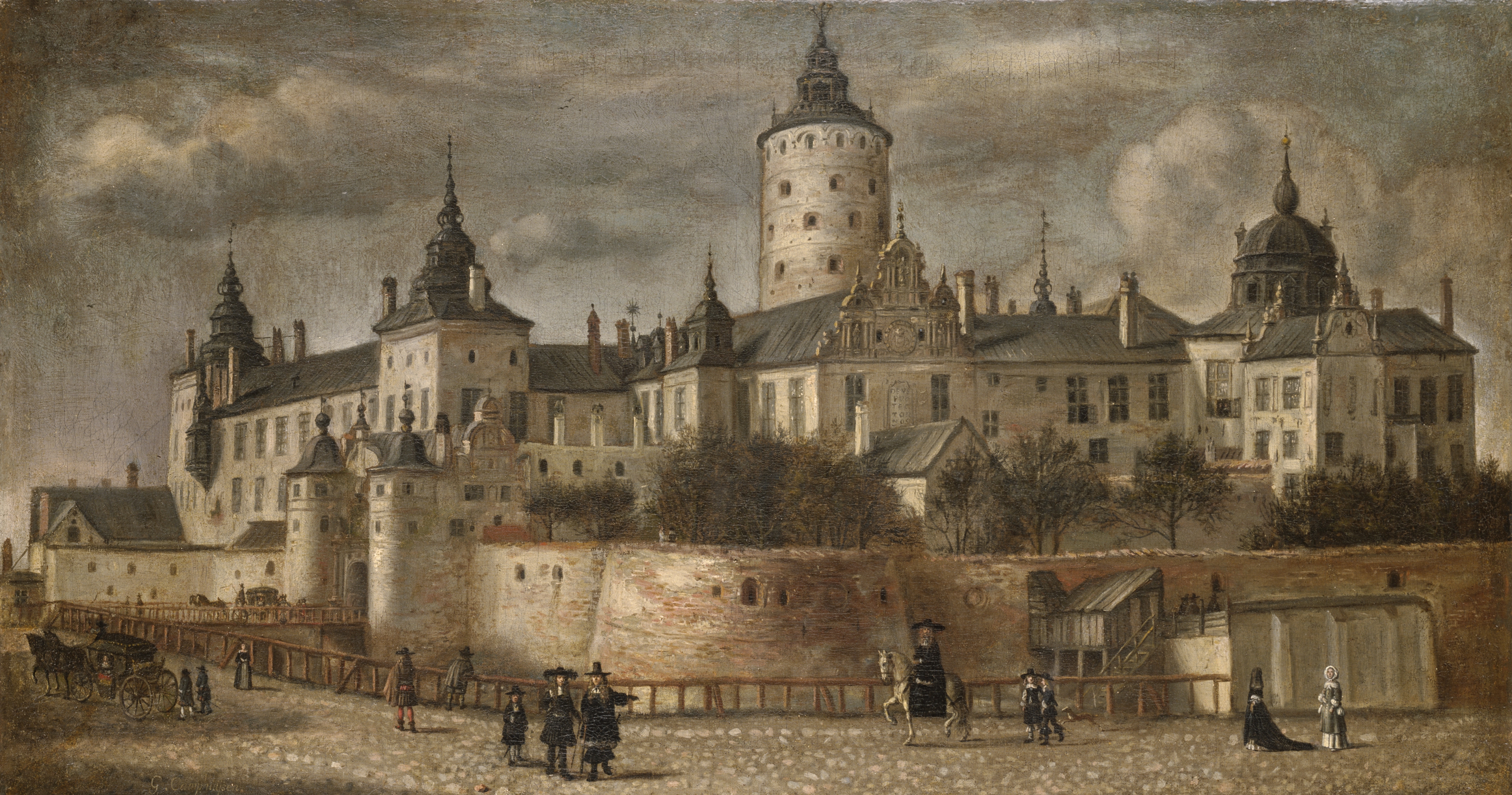
Tre Kronor Castle
On the night of May 7, 1697, young King Charles XII fled down the stairs of Tre Kronor Castle as flames consumed the medieval fortress behind him. Servants rushed past carrying his recently deceased father's body and the crown jewels. Within hours, the seat of Swedish power for over four centuries would be reduced to charred stone, and with it, most of the nation's historical records would vanish into smoke. The Three Crowns Castle, named for the heraldic symbol on its tower during the reign of King Magnus Eriksson in the 14th century, had been the heart of the Swedish kingdom since Birger Jarl transformed an existing citadel into a royal residence in the mid-1200s.
A Kingdom's Cradle
When Gustav Vasa broke Sweden free from the Kalmar Union in the 16th century, Tre Kronor became his most important seat of power. The castle stood on Stadsholmen, the small island at the heart of what is now Stockholm's Gamla Stan. Gustav Vasa expanded its defenses, while his son John III transformed the medieval fortress into a Renaissance palace, adding elaborate decorations and a castle church. The structure grew to encompass two distinct areas: the main castle, called the hogborgen, and the walled ekonomigarden with its commanding tower at the center. Within these walls, Gustavus Adolphus was born in 1594, the future warrior king who would lead Sweden to continental prominence during the Thirty Years' War. For generations of Swedish monarchs, these stone walls witnessed coronations, court intrigues, and the business of empire.
The Night Everything Burned
The fire that consumed Tre Kronor exposed a web of negligence and corruption. Castle keeper Georg Stiernhoff discovered the blaze, but when fire marshal Sven Lindberg tried to reach the extinguishing equipment, flames blocked his path. The castle's construction made it a tinderbox: wooden frames and copper roof plates that, once heated, ignited everything below. As the royal family evacuated and servants scrambled to rescue what treasures they could, the fire spread with devastating speed. The subsequent investigation revealed that the two soldiers assigned to fire watch that night had both abandoned their posts. Anders Andersson was running errands for the fire marshal's wife. Mattias Hansson had gone to the kitchen for food. The royal court also discovered that Lindberg had been accepting bribes for castle positions. The sentences handed down in February 1698 were severe: both Lindberg and Hansson received death sentences, later commuted to running the gauntlet and six years of hard labor. Lindberg died during the punishment.
Lost to History
The true casualty of that night extended far beyond stone and timber. The fire destroyed most of Sweden's national library and royal archives, creating gaps in the historical record that scholars still struggle with today. Documents tracing centuries of Swedish history, diplomatic correspondence, royal decrees, and administrative records turned to ash. This loss makes Sweden's medieval period unusually difficult to document, a scholarly challenge that persists to the present day. Johan Fredrik Hockert captured the drama in his 1866 painting depicting the young Charles XII fleeing with his grandmother and sisters, while his father's body and the crown jewels were carried down the stairs behind them. The image has become one of the most recognizable depictions of Swedish history.
Rising from the Ashes
Architect Nicodemus Tessin the Younger was tasked with rebuilding on the old foundations. His vision was ambitious: a grand Baroque palace that would rival those of continental Europe. Construction proceeded slowly, and Tessin died in 1728, twenty-six years before Stockholm Palace was finally completed in 1754. Today, the current palace stands precisely where Tre Kronor once dominated the Stockholm skyline. Beneath the Baroque grandeur, remnants of the medieval fortress survive. The Museum Three Crowns, located within Stockholm Palace's cellars, displays fragments of the original castle including marble pieces and architectural elements. A one-third scale replica of Tre Kronor was constructed for the 1897 General Art and Industrial Exposition of Stockholm, giving visitors a glimpse of what had been lost two centuries earlier.
From the Air
Located at 59.327N, 18.072E on Stadsholmen island in central Stockholm. The site is now occupied by Stockholm Palace (Kungliga Slottet), visible as a large ochre-yellow Baroque structure on the northern edge of Gamla Stan. Best viewed from the east over Saltsjoen or from the north over Strommen. Nearby airports include Stockholm Bromma (ESSB, 8km northwest) and Stockholm Arlanda (ESSA, 40km north). The distinctive waterway pattern of Stockholm's islands makes the location easy to identify from altitude.