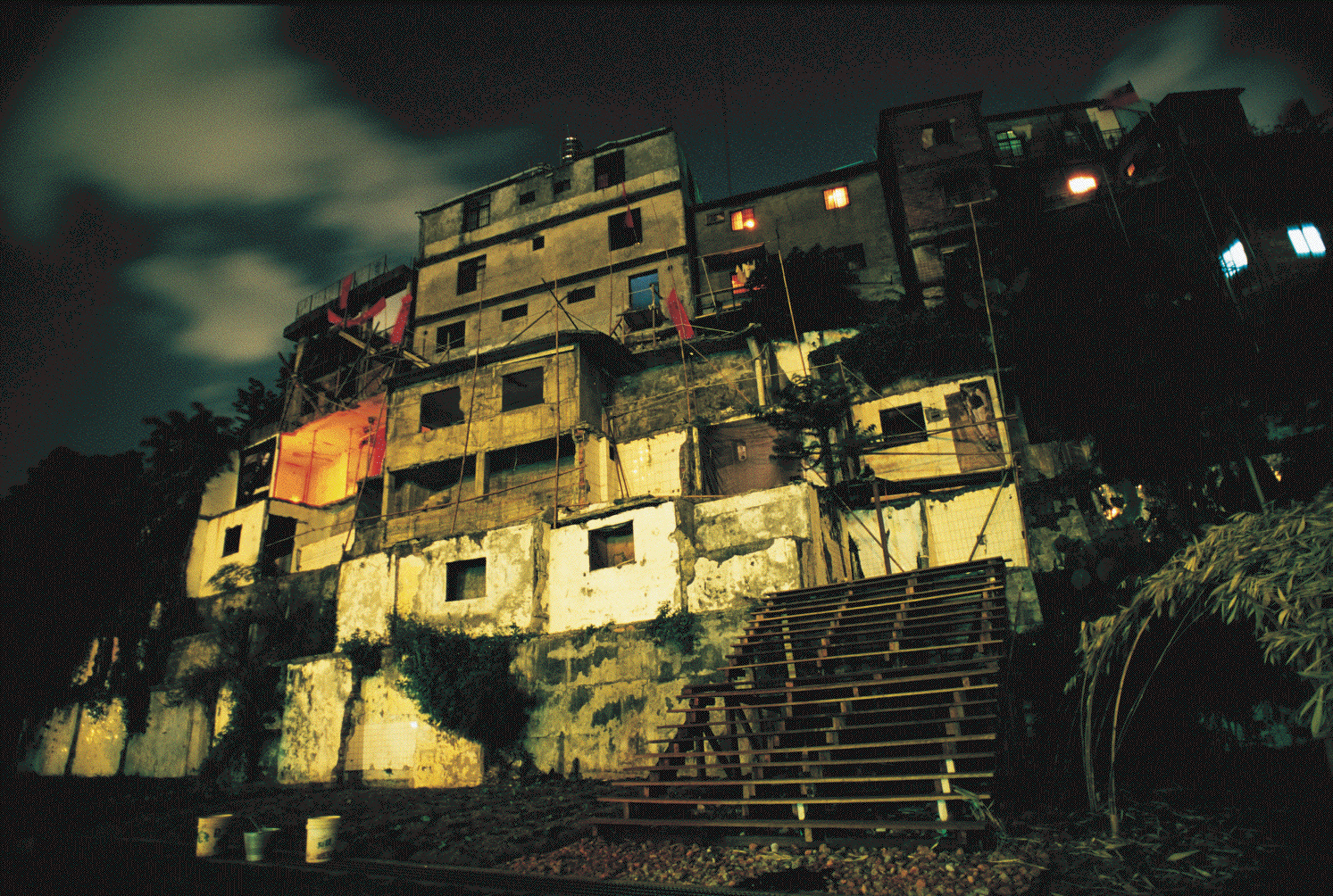
Treasure Hill
When Finnish architect Marco Casagrande arrived at Treasure Hill to design an ecological masterplan for the Taipei city government, he discovered something unexpected: the plan was already built. The illegal settlement clinging to a hillside above the Xindian River had, through decades of improvisation and necessity, evolved into a functioning ecological system. Residents recycled and filtered grey water, composted organic waste, stole minimal electricity from the city grid, and repurposed Taipei's discarded materials as building supplies. "For the ecological urban laboratory I had to do nothing," Casagrande said. "It was already there."
Soldiers on a Hillside
Treasure Hill began at the end of the 1940s, when Kuomintang military veterans retreating from mainland China built an informal settlement on a hillside that had served as an anti-aircraft position. The community was never authorized, never planned, never sanctioned by any government office. It simply grew, one concrete-block addition at a time, as veterans and their families carved living spaces into the slope above the river. For decades, the settlement existed in a kind of administrative limbo, too small and too marginal to attract official attention, too established to simply remove. The Xindian River below provided drinking water, fish, and gravel for construction before pollution made it unreliable. Urban farms spread between the settlement and the riverbank.
Accidental Ecology
What made Treasure Hill remarkable was not its architecture but its metabolism. Because the settlement was illegal, it was never connected to Taipei's municipal infrastructure in the conventional sense. Residents developed their own systems: grey water was recycled and filtered through improvised channels, organic waste was composted, and electricity was siphoned from the city grid in amounts too small to draw notice. The settlement consumed Taipei's waste stream -- scrap wood, discarded fixtures, abandoned materials -- and built itself from what the formal city threw away. Casagrande recognized this as a genuine ecological model, a community that operated according to principles urban planners were only beginning to theorize about. He built wooden stairways to connect the houses and shelters where the elderly residents played mah-jong and ping-pong, but the ecosystem itself he left alone.
The New York Times and the Bulldozer
The community attracted international media attention, including a feature in The New York Times naming it one of Taiwan's must-see destinations. The Taipei City Government, working with the non-governmental Global Artivists Participation Project, developed plans to transform the settlement into an "artivist compound" that would preserve its fabric while incorporating artist residencies, an international youth hostel, and cultural exchange programs. The vision was appealing on paper: a community reborn through art and ecology. In 2007, police closed the area for restoration work. When Treasure Hill reopened as an artist village in 2010, only 22 of the original families managed to return.
Whose Hill Is It Now?
The restoration drew sharp criticism. What had been a living community of lower-income families -- people with deep roots in the settlement's improvised social fabric -- was reborn as a curated space celebrating individual artistic expression. The old residents who had built the ecological systems that drew Casagrande's admiration were largely displaced by the very process meant to honor their creation. The tension is not unique to Treasure Hill. Cities around the world grapple with the question of what happens when marginal communities become culturally valuable, when the qualities that make a place interesting to outsiders are inseparable from the poverty and informality that produced them. Casagrande himself framed it with characteristic directness: "Treasure Hill is the attic of Taipei carrying the memories, stories and traditions of the past generations. For the stories to surface the industrial city must be turned over: the city must be a compost."
From the Air
Located at 25.0105°N, 121.533°E on a hillside along the Xindian River in southern Taipei. The settlement is small and nestled into terrain, making it difficult to identify from high altitude. Look for the green riverbank area south of Gongguan, near where the Xindian River bends. Nearest airport is Taipei Songshan (RCSS), approximately 6 km north. Taoyuan International (RCTP) is 30 km west. Best viewed below 2,000 feet to distinguish the hillside structures from surrounding urban fabric.