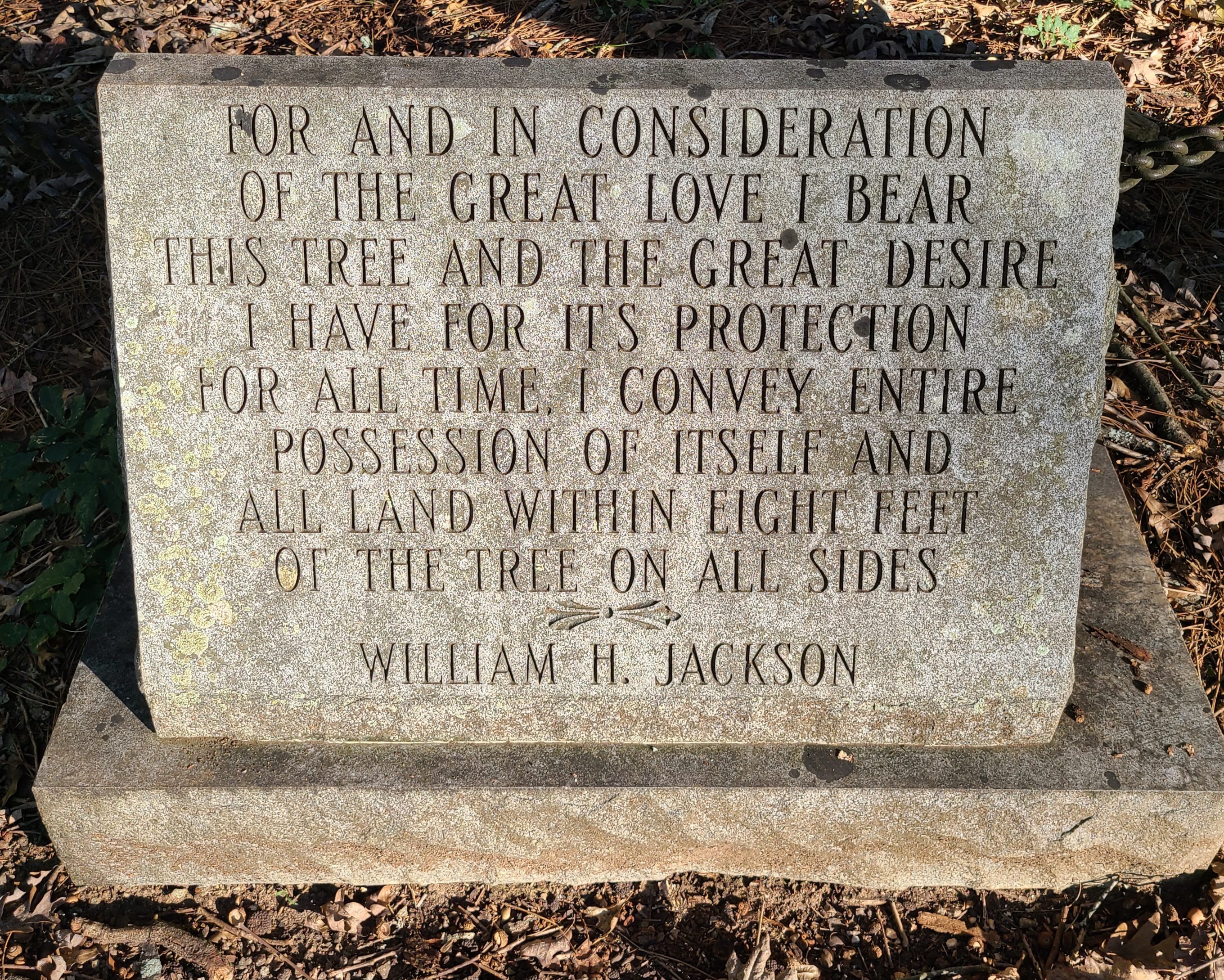
Tree That Owns Itself
Under common law, the recipient of a piece of property must have the legal capacity to receive it. A tree cannot sign documents. A tree cannot appear in court. A tree is not, by any definition, a legal person. And yet the Athens-Clarke County Unified Government maintains, as a matter of official policy, that a white oak at the corner of South Finley and Dearing Streets owns itself. The story of how a tree came to hold a deed is a tale of one man's affection, a newspaper article, a windstorm, a boy with an idea, and a community that decided the law could, on this one occasion, look the other way.
The Colonel's Gift
The earliest known account of the tree's origins appeared on the front page of the Athens Weekly Banner on August 12, 1890. According to the article, Colonel William Henry Jackson, who owned the property across Dearing Street, had cherished the oak since childhood. Desiring to protect it, Jackson reportedly deeded the tree ownership of itself and all the land within eight feet of its base, sometime between 1820 and 1832. Jackson came from Georgia political royalty: his father, James Jackson, had fought in the American Revolution and served as a Congressman, U.S. Senator, and Governor of Georgia. His brother Jabez Young Jackson was also a Congressman. Only one person, the anonymous author of that 1890 article, has ever claimed to have actually seen the deed. Most writers acknowledge it is lost or never existed at all.
A Legal Impossibility, Publicly Recognized
The legal problems with the deed are obvious and total. Under common law, a recipient of property must have the capacity to receive it, and the property must be delivered to and accepted by the recipient. A tree can do neither. Jackson sold his own property across the street to a Dr. Malthus Ward in 1832, the same year cited on a plaque as the date of the tree's deed. Clarke County real estate records contain no trace of when Jackson originally acquired the land or any formal transfer to a tree. As one writer observed at the beginning of the 20th century, "However defective this title may be in law, the public recognized it." That spirit persists: Athens-Clarke County officially maintains that the tree does, in fact, own itself, and the city treats it as a public street tree under municipal care.
The Fall of the Original Oak
The original Tree That Owns Itself was estimated to have started life sometime between the mid-16th and late 18th centuries. At its peak, some considered it both the biggest tree in Athens and the most famous tree in the United States. It predated the transformation of its neighborhood from open land into a residential district beginning in the mid-19th century. The adjacent Dominie House was built in 1883 at a different location and moved next to the tree about twenty years later. By the early 1940s, root rot had likely claimed the oak from within. The tree collapsed in 1942. Its core may have been too rotten to count the rings, which would explain why no one ever determined its precise age.
The Son Rises
For four years after the original tree fell, its small plot sat empty. Then Dan Magill, the young son of Athens' Junior Ladies Garden Club member Elizabeth Magill, suggested that his mother's club find a replacement. Several Athenians had cultivated seedlings from the original tree's acorns. A sapling growing in the yard of Captain Jack Watson was chosen as the best candidate for transplantation. Roy Bowden of the University of Georgia's College of Agriculture directed the planting, assisted by horticulture students. The new tree, sometimes called the Son of the Tree That Owns Itself, took root in the same spot. It grows there still, surrounded by two stone tablets and a brass plaque that paraphrase Jackson's supposed deed.
Resident of Dearing Street
The tree stands within the Dearing Street Historic District, which was added to the National Register of Historic Places in 1975. The district, roughly bounded by Broad, Finley, Waddell, and Church Streets, was recognized for its architectural significance. The tree itself was locally designated a historic landmark on February 2, 1988. Today, Athens-Clarke County confirms the tree sits in the public right-of-way, "accepted for care" by municipal authorities. Local government and the owners of the adjacent property jointly serve as stewards, while the Junior Ladies' Garden Club acts as its primary advocate. The tree is, in the language of the historic district, a permanent resident, one whose property rights no one in Athens has any interest in contesting.
From the Air
The Tree That Owns Itself stands at 33.9548N, 83.3823W at the corner of South Finley and Dearing Streets in Athens, Georgia, within a residential neighborhood near the University of Georgia campus. The tree itself is not visible from altitude, but the University of Georgia campus and Athens' historic downtown district provide clear orientation landmarks. Nearest airports: Athens-Ben Epps Airport (KAHN) 4 miles east, Hartsfield-Jackson Atlanta International (KATL) 70 miles west. Best viewed as part of a low-altitude pass over Athens at 2,000-3,000 feet AGL.