Tremé
Every Sunday, in a dirt square just north of Rampart Street, enslaved people gathered to do something their owners could not suppress: they danced. They drummed. They sang in rhythms carried from West Africa and the Caribbean, and they sold handmade goods that sometimes earned them enough to buy their own freedom. That square—originally called Place des Nègres, later renamed Congo Square—became the beating heart of Tremé, a neighborhood founded in the 1810s on land once owned by Claude Tremé and widely considered the oldest African-American neighborhood in the United States. From those Sunday gatherings, through the brass bands of Creoles of color, through the improvisational spirit that became jazz, Tremé has been the place where Black culture in America found its public voice.
Where Freedom Took Root
Tremé began as the Morand Plantation and two forts—St. Ferdinand and St. John—on the lake side of the French Quarter, what earlier New Orleanians called "back of town." Near the end of the 18th century, Claude Tremé purchased the land. By 1794, the Carondelet Canal split the area as it connected the French Quarter to Bayou St. John. Developers carved subdivisions from the plantation grounds, and a diverse population moved in: Caucasians, free people of color, and newly freed people who had scraped together their purchase price in Congo Square. The Faubourg Tremé was formally created from Tremé's land in 1810, bounded by Rampart Street, Canal Street, Esplanade Avenue, and Broad Street. It was, from its earliest days, a racially mixed neighborhood where free Black residents owned property, ran businesses, and built institutions.
The Sound That Changed the World
Congo Square was more than a gathering place—it was an incubator. After the United States took control of Louisiana and officials grew anxious about unsupervised assemblies of enslaved people, the Sunday dances were eventually curtailed in the years before the Civil War. But the musical traditions persisted. Creoles of color formed brass and symphonic bands that gave concerts in the square, blending European instrumentation with African rhythmic sensibilities. That fusion provided the foundation for a more improvisational style that would come to be known as jazz. The neighborhood produced an extraordinary lineage of musicians: clarinetist Alphonse Picou, trumpeter Kermit Ruffins, trombonist Troy "Trombone Shorty" Andrews, drummer Shannon Powell—known as "The King of Treme"—and the Rebirth Brass Band, often said to have been born at Joe's Cozy Corner in the heart of the neighborhood. Even jazz musicians of European ancestry, including Henry Ragas and Louis Prima, called Tremé home.
Scars of Renewal
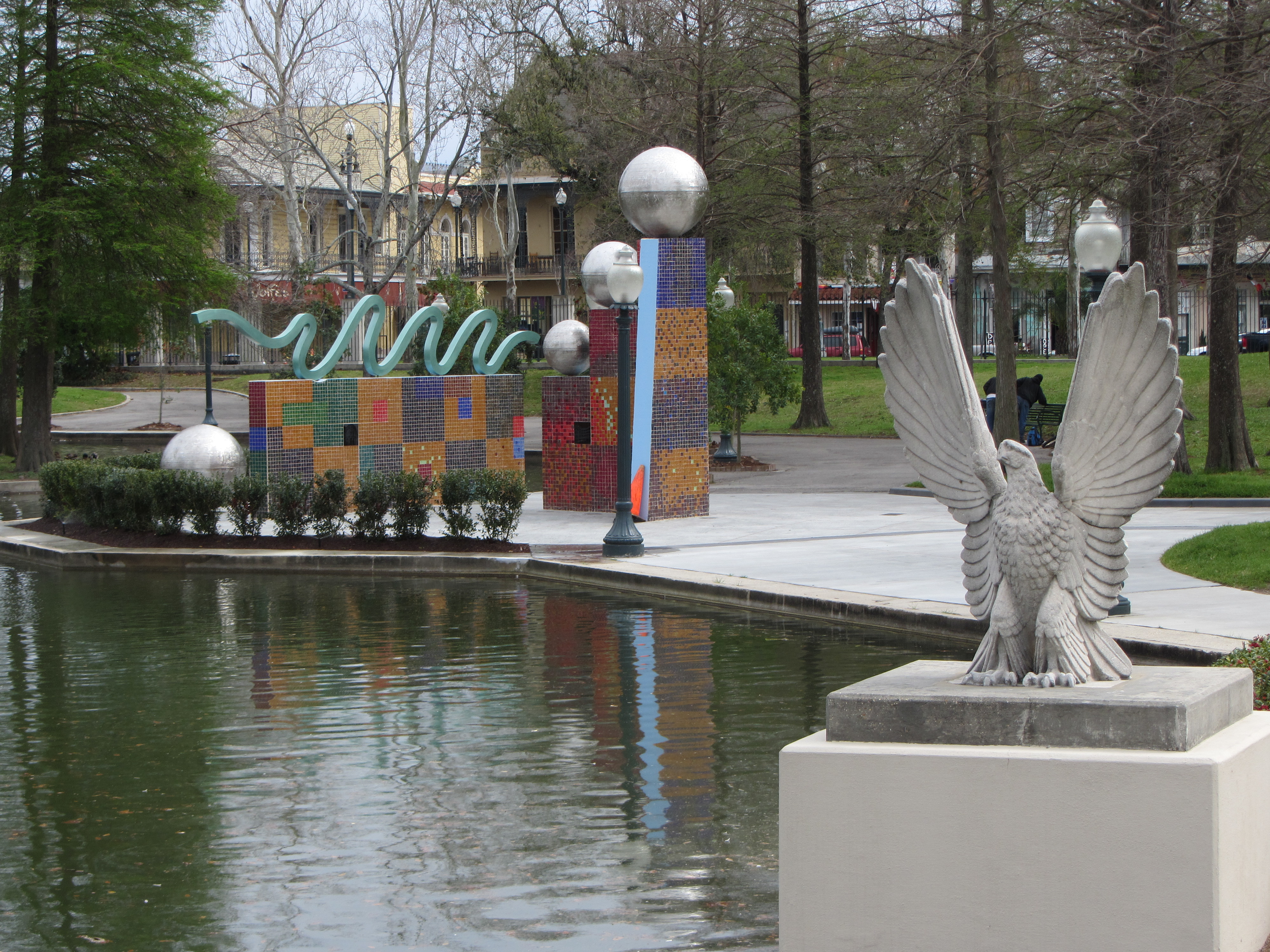
In the early 1960s, an urban renewal project—later judged a catastrophic mistake by most analysts—demolished a large portion of central Tremé. The land stood vacant for years until the city created Louis Armstrong Park in the 1970s, incorporating Congo Square within its grounds. In 1994, the New Orleans Jazz National Historical Park was established on the site. The Storyville red-light district had already been carved from the upper part of Tremé at the end of the 19th century, then torn down in the 1940s and replaced with public housing. Claiborne Avenue, once shaded by towering live oaks and lined with Black-owned businesses, was devastated when the elevated Interstate 10 was built overhead. These wounds reshaped the neighborhood's geography but could not erase its identity.
Sacred Ground, Living Culture
St. Augustine Church, founded in Tremé, stands as the oldest African-American Catholic parish in the United States. The New Orleans African American Museum, housed in a restored Creole cottage, preserves the history and art of the diaspora community. Both are listed on the Louisiana African American Heritage Trail. David Simon, creator of The Wire, set his HBO drama Treme in this neighborhood in 2010, centering its story on residents rebuilding after Hurricane Katrina. The storm itself treated Tremé comparatively gently—many of its old raised homes escaped the worst flooding—but gentrification and short-term rentals have since reshaped demographics, dropping the population from 8,853 in 2000 to 4,590 by 2020. The second lines still roll through on Sundays, brass bands still blow at the Candlelight Lounge, and the spirit of Congo Square endures in every note.
From the Air
Tremé is located at 29.968°N, 90.074°W, immediately north of the French Quarter in New Orleans. From the air, look for the distinctive green rectangle of Louis Armstrong Park and the adjacent Congo Square, bordered by Rampart Street to the south. The neighborhood sits between the French Quarter and the elevated I-10 corridor along Claiborne Avenue. Nearest airports: Louis Armstrong New Orleans International (KMSY, 11 nm west) and New Orleans Lakefront (KNEW, 5 nm northeast). Best viewed at 2,000–3,000 ft AGL on approach from the east, with the Mississippi River curving to the south.