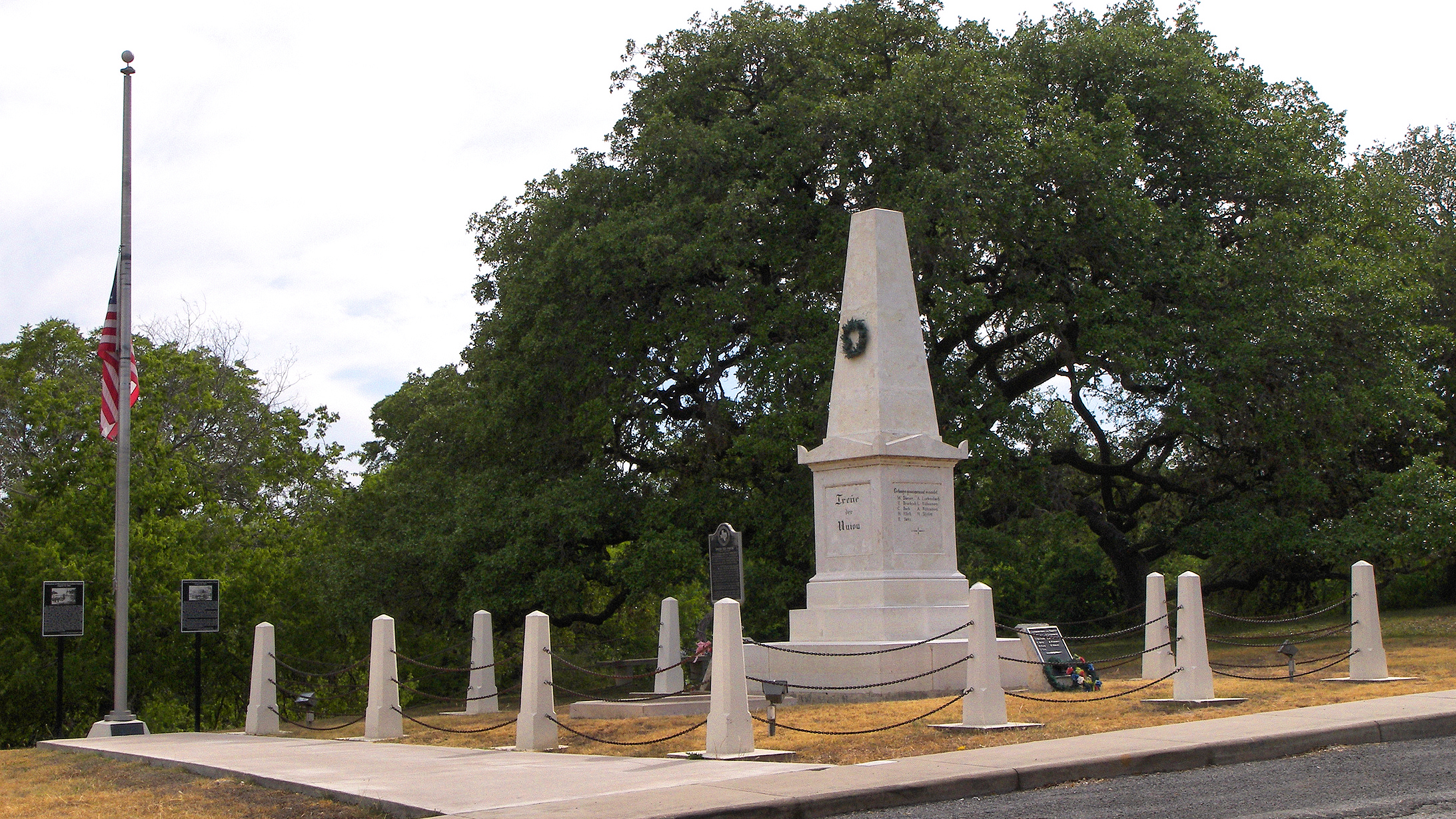
Treue der Union Monument
A United States flag flies at half-staff in Comfort, Texas -- not for a recent death, but for thirty-four men killed in 1862. The flag bears thirty-six stars, the count when the monument beneath it was dedicated in 1866. The Treue der Union Monument -- "Loyalty to the Union" -- stands twenty feet tall in native limestone, an obelisk raised by grieving families over a mass grave. It honors the German-Texan settlers who were hunted down and slaughtered at the Nueces River for refusing to pledge allegiance to the Confederate States of America. In a region that was part of the Confederacy, this was an act of defiance carved in stone.
The Free-Thinkers of the Hill Country
German immigrants had settled heavily in the Texas Hill Country during the 1840s and 1850s, drawn by cheap land and a climate suited to farming. Many were political refugees -- educated free-thinkers who had fled the failed revolutions of 1848 in Europe. They brought with them a deep skepticism of slavery and authoritarian government. When Texas seceded from the Union in 1861, these communities found themselves on the wrong side of their neighbors' politics. Gillespie County and surrounding areas became pockets of Unionist sentiment in an otherwise Confederate state. The Confederate authorities responded with force, imposing martial law and deploying Duff's Partisan Rangers to enforce loyalty oaths.
Slaughter at the Nueces
In the summer of 1862, a group of German-Texans attempted to flee to Mexico rather than serve the Confederacy. Duff's Partisan Rangers pursued them and caught up with the group at the Nueces River. Thirty-four men were killed, some in the fighting and others executed after being taken prisoner. The cruelty of the massacre shocked the people of Gillespie County and the surrounding region. Two thousand residents took to the hills to escape Duff's reign of terror. The bodies of those who drowned attempting to cross the Rio Grande were never recovered. The remains of the others lay where they fell until local residents could safely retrieve them for burial.
A Monument Born of Grief
On August 19, 1865 -- just months after the war's end -- Eduard Degener, Eduard Steves, and William Heuermann paid $20 for a lot in Comfort. Degener's own sons, Hugo and Hilmar, were among the dead. The following day, three hundred people attended a funeral for the recovered remains, with Federal troops firing a salute over the mass grave. Degener delivered the eulogy. With donations from local residents and victims' families, the Treue der Union Monument was dedicated on August 10, 1866. Local stonemasons carved the obelisk from native limestone. Four name tablets in German were placed on the lawn at its base. Inside the second course of the monument, the builders sealed a time capsule. In 1994, the Comfort Heritage Foundation oversaw a restoration by Boerne stonemason Karl H. Kuhn.
Myth and Monument
Over the decades, the Treue der Union monument accumulated layers of legend. It has been widely called the first Civil War monument and the only Union monument on Confederate soil. Multiple books and the Texas State Historical Association have repeated these claims. In reality, the 1861 August Bloedner Monument at Cave Hill National Cemetery in Kentucky and the 1863 Hazen Brigade Monument at Stones River in Tennessee both predate it. Historian Frank Wilson Kiel traced the misinformation back to at least 1938. The persistent claim that Congress granted special permission for the flag to fly at half-staff in perpetuity also turns out to be unfounded -- it stems from personal correspondence between a congressman and monument supporters, but no legislation was ever passed. The Comfort Heritage Foundation simply chooses to keep it lowered. None of this diminishes what the monument actually is: a mass grave and a declaration of conscience, built by immigrant families who buried their dead and refused to be silent about how they died.
From the Air
Located at 29.97N, 98.91W in the small community of Comfort, Kendall County, Texas, in the Hill Country northwest of San Antonio. The nearest airports include Boerne Stage Field (5C1) and San Antonio International Airport (KSAT). The monument sits in the town center and would not be individually visible from altitude, but Comfort itself is identifiable where Cypress Creek meets the Guadalupe River along Interstate 10. Best appreciated from the ground after landing, but the surrounding Hill Country terrain -- rolling limestone hills and cypress-lined creeks -- is striking from 2,000-4,000 feet AGL.