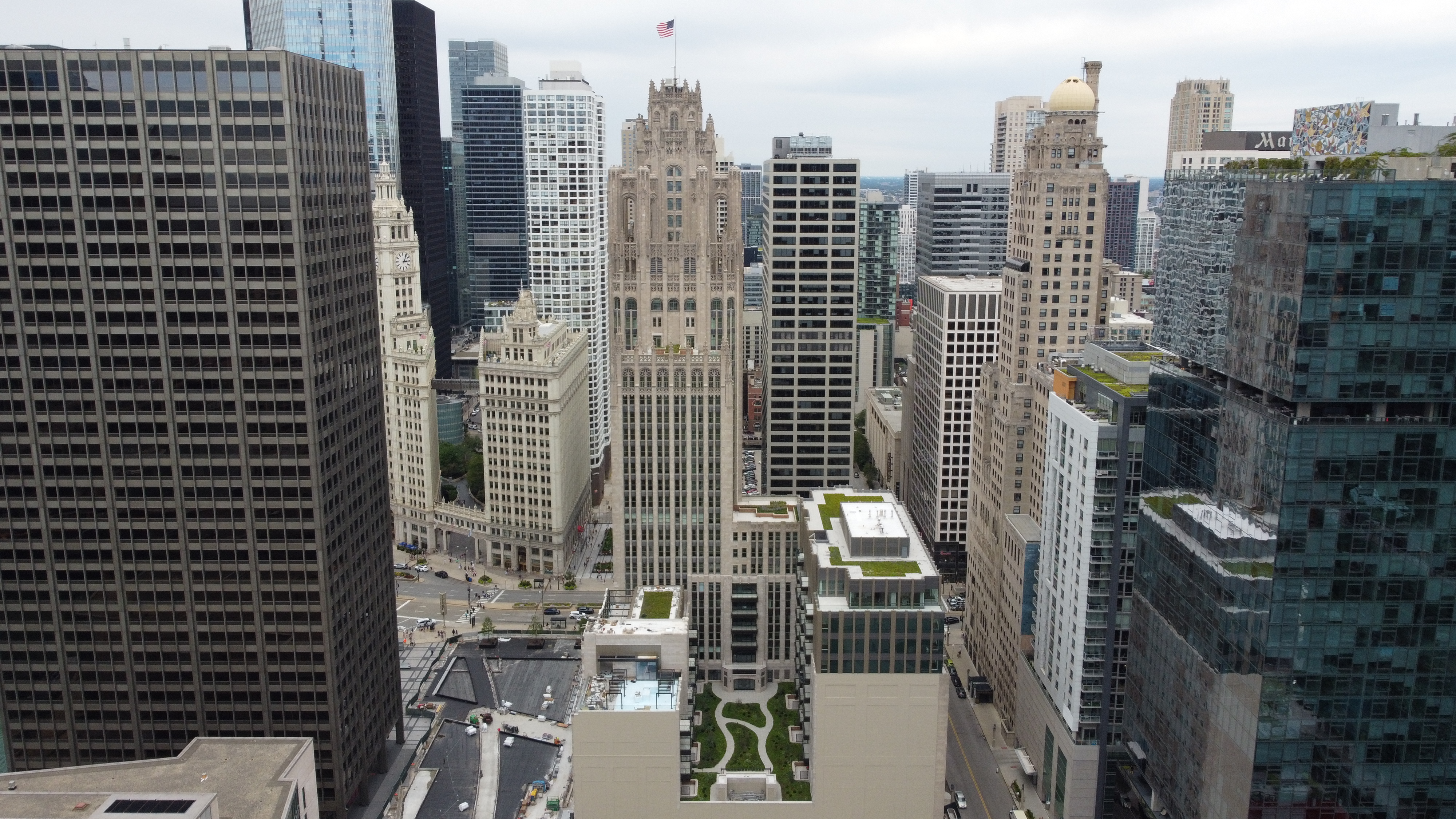
Tribune Tower
The competition asked for 'the most beautiful and distinctive office building in the world,' and 263 architects from around the globe took the challenge seriously. In 1922, the Chicago Tribune announced a $100,000 international design competition for its new headquarters, timed to celebrate the newspaper's 75th anniversary. The winner was a neo-Gothic tower by New York architects John Mead Howells and Raymond Hood, bristling with ornamental buttresses near its crown. But the entry that architects actually preferred - a sleek, setback design by Finnish architect Eliel Saarinen - took second place and went on to influence a generation of skyscrapers, including Hood's own later work. The Tribune Tower, completed in 1925 at 435 North Michigan Avenue, stands as a monument to the power of architectural ambition and the strange truth that the contest's loser may have mattered more than its winner.
A Competition That Changed Everything
The Tribune Tower competition was a publicity stunt that accidentally became a watershed moment in architectural history. More than 260 entries arrived from architects worldwide, offering wildly varied visions of what a skyscraper could be. Walter Gropius submitted a modernist design. Bertram Goodhue proposed his own interpretation. Adolf Loos, the Viennese provocateur, submitted a building shaped like a massive Doric column. One anonymous entrant topped their design with an enormous sculptured head of a Native American. The winning design by Howells and Hood drew on the Gothic vocabulary that had proven successful at Cass Gilbert's Woolworth Building in New York, completed in 1913. But Saarinen's second-place entry, with its elegant massing and graduated setbacks, captured the imagination of architects like Louis Sullivan. It proved to be a direct influence on Raymond Hood's subsequent McGraw-Hill Building and the Rockefeller Center in New York. The 1929 Gulf Building in Houston is widely recognized as a close realization of Saarinen's original vision.
Stone, Gargoyles, and Secret Jokes
The Tribune Tower rises 462 feet above Michigan Avenue, its crown modeled after the Tour de Beurre - the 'butter tower' - of Rouen Cathedral in France, a Late-Gothic structure crowned not with a spire but with an ornamental cap. The sculptor Rene Paul Chambellan created the building's elaborate ornamentation, including gargoyles, carved figures, and an Aesop's Fables screen above the main entrance doors. Chambellan embedded personal jokes in the stonework: a carved image of Robin Hood commemorates architect Raymond Hood, while a howling dog honors his partner John Mead Howells. Among the gargoyles, one depicts a frog - Chambellan's self-portrait, a nod to his French ancestry. Chambellan went on to work with Hood again on the American Radiator Building and Rockefeller Center in New York. The building's lobby doubles as a hall of inscriptions, with quotations about liberty and press freedom carved into the walls, drawn from Benjamin Franklin, James Madison, Euripides, Voltaire, and Thomas Jefferson.
Pieces of the World Embedded in the Walls
Robert R. McCormick, the Tribune's powerful owner, had a collector's instinct and a global reach. Over the decades, fragments from famous structures around the world were embedded in the exterior walls of Tribune Tower at street level - pieces of the Parthenon, the Great Wall of China, Westminster Abbey, the Taj Mahal, and dozens of other landmarks. Correspondents and foreign bureau chiefs brought back stones from their postings, creating an accidental museum of world architecture pressed into the base of a Chicago skyscraper. McCormick also commissioned a bronze statue of Nathan Hale for the building's plaza in 1940, a replica of a work by sculptor Bela Pratt originally made for Yale University in 1899. The statue depicts Hale with his wrists and ankles bound, and the pedestal carries his famous last words: 'I only regret that I have but one life to lose for my country.' A piece of steel recovered from the World Trade Center was later added to the collection, and tiles from the Sydney Opera House were incorporated in 2006.
From Newsroom to Residences
The Tribune Tower served as the headquarters of the Chicago Tribune and its related media enterprises for nearly a century. WGN Radio broadcast from the building until June 2018. CNN maintained a Chicago bureau there. The building was designated a Chicago Landmark and contributes to the Michigan-Wacker Historic District. Its predecessor - the original Tribune Tower of 1868 - was destroyed in the Great Chicago Fire of 1871. In June 2018, the Chicago Tribune moved out of the building to make way for a conversion to luxury condominiums, a project costing more than $500 million. In 2023, the renovation earned a Driehaus Prize for architectural preservation and adaptive reuse from Landmarks Illinois. The neo-Gothic tower now houses residents instead of reporters, but the buttresses still glow when lit at night, and the fragments of the Parthenon and the Great Wall remain embedded in the walls at street level for anyone walking Michigan Avenue to examine.
A Design That Echoes Worldwide
The Tribune Tower's influence extended far beyond Chicago. In Australia, both the Grace Building in Sydney and the Manchester Unity Building in Melbourne incorporated elements drawn from Howells and Hood's design. The Title Guarantee and Trust Building in Los Angeles took direct inspiration from the Tribune Tower, and the architects of One Atlantic Center in Atlanta acknowledged its influence on their design. The 1922 competition entries were published by the Tribune Company in 1923 and have been studied by architecture students ever since. In a playful footnote, architects Robert A. M. Stern and Stanley Tigerman published 'late entries' to the competition in a 1980 book. The Tribune Tower stands on the Magnificent Mile as both a finished building and a permanent question: What if Saarinen had won? The answer shaped the next fifty years of skyscraper design anyway.
From the Air
Located at 41.890°N, 87.624°W at 435 North Michigan Avenue on Chicago's Magnificent Mile, on the north bank of the Chicago River. The neo-Gothic tower is 462 feet tall and identifiable from altitude by its ornate buttressed crown, which is illuminated at night. It sits at the prominent bend where Michigan Avenue crosses the Chicago River, near the Wrigley Building. Nearby airports include Chicago O'Hare International (KORD, 14 nm northwest) and Chicago Midway International (KMDW, 9 nm southwest). Best viewed at altitudes below 3,000 feet AGL in clear conditions.