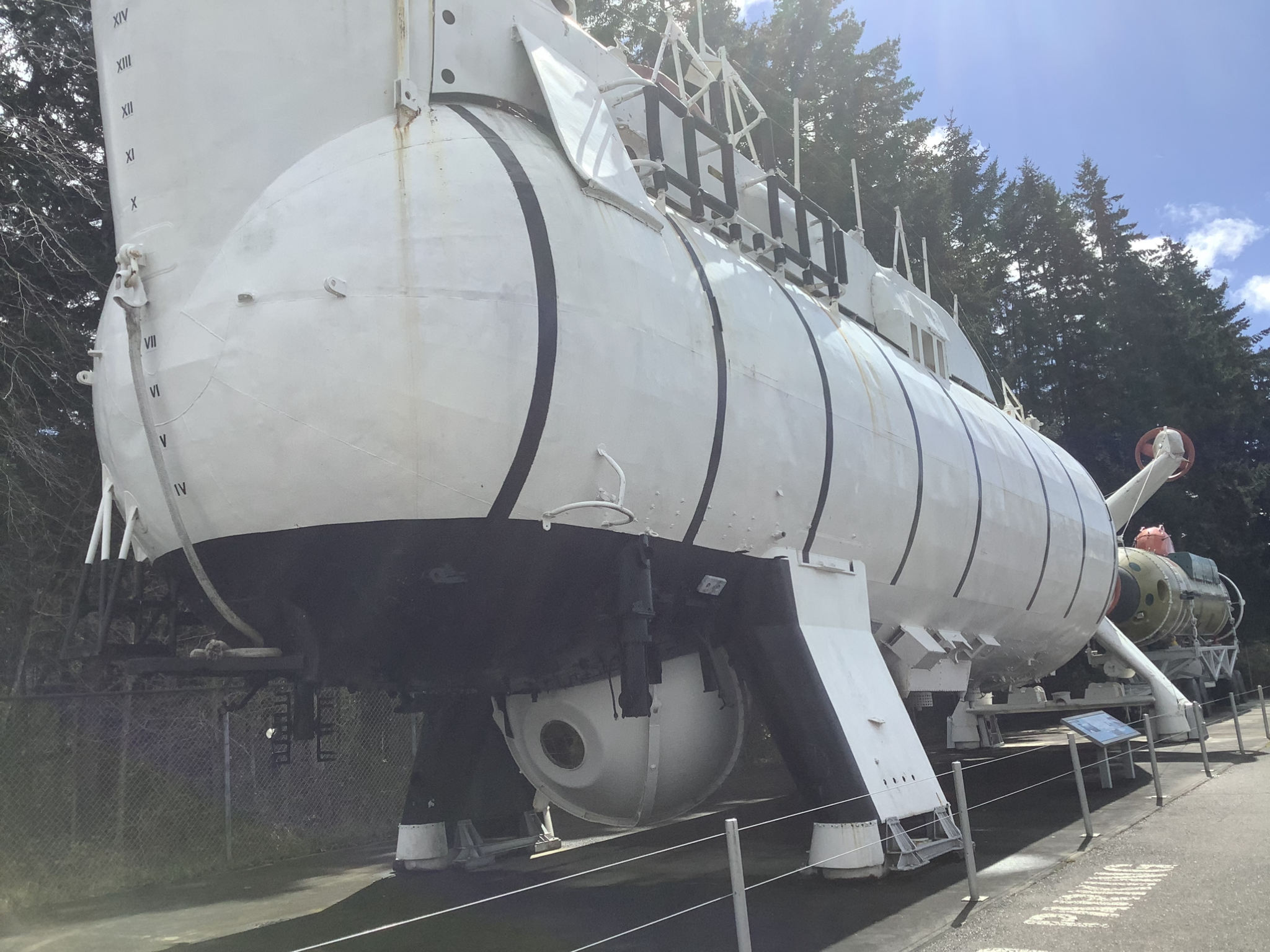
Trieste II (Bathyscaphe)
For most of her working life, the Navy did not even classify Trieste II as a vessel. She was listed as "equipment" -- a piece of gear, like a wrench or a radar set, that happened to weigh several tons and could descend to depths where the ocean would crush a conventional submarine like a paper cup. The bathyscaphe spent sixteen years doing work the Navy preferred not to discuss in detail, from locating a lost nuclear submarine to plucking a secret satellite capsule off the ocean floor at 16,000 feet. Today she sits on dry land in Keyport, Washington, looking every bit as strange as the missions she performed.
Swiss Design, American Purpose
Trieste II was born from spare parts and Cold War necessity. Her predecessor, the original Trieste, had been designed by Swiss physicist Auguste Piccard and carried to the deepest point in the ocean in 1960. When the Navy decided it needed a more capable deep submergence vehicle, engineers at the Naval Electronics Laboratory in San Diego took the original Terni-built Italian pressure sphere from Trieste -- made redundant by a new high-pressure sphere cast by Germany's Krupp Steelworks -- and suspended it from an entirely new float. The hull was more streamlined and more seaworthy than its predecessor, but it operated on the same elegant principle: a large tank of gasoline, lighter than water, provided buoyancy, while iron shot ballast controlled the descent. Completed in early 1964, Trieste II was loaded aboard USNS Francis X. McGraw and shipped through the Panama Canal to Boston, where the real work would begin.
Finding the Thresher
On April 10, 1963, the nuclear submarine USS Thresher had disappeared during deep-diving tests east of Cape Cod, killing all 129 men aboard. The original Trieste began searching the wreck site that same year; Trieste II took over in 1964. Commanded by Lieutenant Commander John B. Mooney Jr., with co-pilot Lieutenant John H. Howland and Captain Frank Andrews, the bathyscaphe descended repeatedly to the debris field on the ocean floor. In September 1964, she recovered fragments of wreckage that positively identified the remains as those of the lost submarine. It was grim, painstaking work -- each dive lasting hours, visibility near zero, the pressure sphere creaking under thousands of pounds per square inch of ocean bearing down on it. But the confirmation mattered to the Navy and to the families of the men who had died. Knowing where was the first step toward understanding why.
The Bucket from Outer Space
Trieste II underwent multiple reconfigurations over the following years, gaining a new pressure sphere rated for 20,000 feet and, in 1969, finally earning official status as a Navy vessel with the hull number X-1. She was reclassified as a deep submergence vehicle in 1971. But her most remarkable feat came on April 25, 1972, when she recovered what the Navy called a "bucket" -- a satellite film-return capsule weighing several hundred pounds -- from a depth exceeding 16,000 feet. It was the deepest object recovery ever performed at the time, a Cold War operation conducted in the vast silence of the Pacific abyss. The capsule contained reconnaissance film from a spy satellite, intelligence too valuable to leave on the ocean floor. Four officers earned the designation "hydronaut" during Trieste II's operational career, and the experience gained from her deep submergence work informed the design of successor vehicles like the Alvin class.
A Strange Retirement
Trieste II served with the Pacific Fleet through 1980 before the Alvin-class vehicles, smaller and more maneuverable, rendered her obsolete. The Alvins could not match her depth rating, but they could do nearly everything else better. Retirement brought her to Keyport, Washington, a quiet community on the Kitsap Peninsula where the Naval Undersea Warfare Center has operated since the early twentieth century. She sits now outside the Naval Undersea Museum, white-hulled and peculiar, a craft that looks less like a submarine than like a dirigible that took a wrong turn and sank. Visitors walk around her and try to imagine three men sealed inside a metal sphere no larger than a closet, dropping through miles of black water toward a task so secret the Navy would not admit the vehicle existed. The Navy Unit Commendation with star pinned to her service record says what the mission logs cannot.
From the Air
Located at 47.70N, 122.62W at the Naval Undersea Museum in Keyport, Washington, on the Kitsap Peninsula. The museum complex sits adjacent to the Naval Undersea Warfare Center along the shore of Liberty Bay. Nearest airport is Bremerton National Airport (KPWT), approximately 6 nm southwest. The distinctive shape of Liberty Bay and the naval facilities along its shore are visible landmarks. Best viewed from 2,000-3,000 ft AGL.