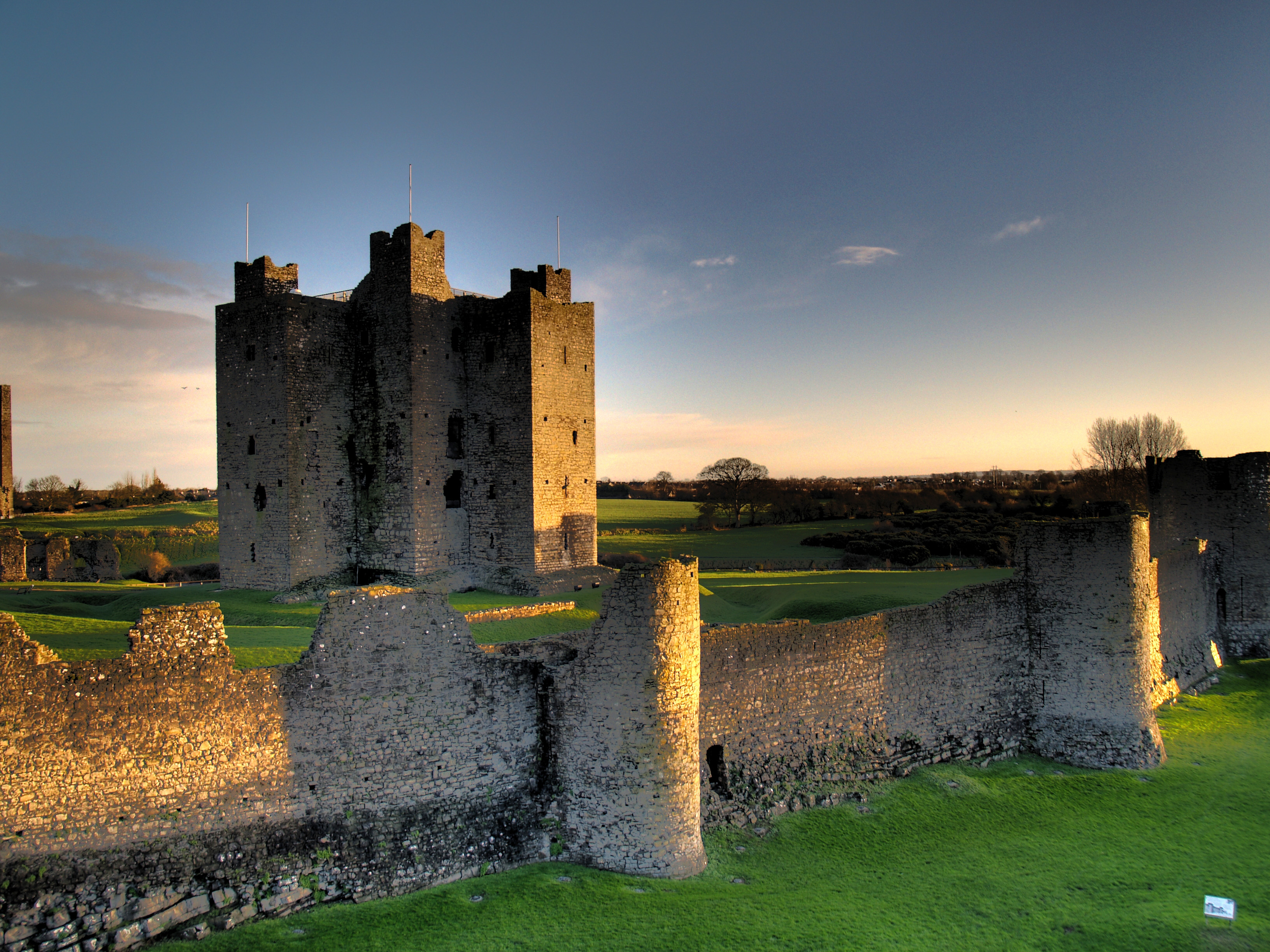
Trim Castle
Mel Gibson needed a medieval English city for Braveheart, and he found it in County Meath. Trim Castle -- its massive walls, its curtain towers, its sheer imposing bulk -- stood in for both York and London in the 1995 film. The casting was apt. With an area of 30,000 square meters, Trim is the largest Cambro-Norman castle in Ireland, and its central three-story keep is unique among Norman fortifications: a cruciform structure with twenty corners, a geometric puzzle in limestone that has dominated the south bank of the River Boyne since the 1170s.
The Hill Above the Ford
Hugh de Lacy received the land of Meath from Henry II of England in 1172 and immediately recognized the defensive potential of raised ground overlooking a fording point on the River Boyne, about 25 miles from the Irish Sea. He built a massive ringwork castle with a double palisade and external ditch. But de Lacy had to leave Ireland, and entrusted the fortress to his lieutenant Hugh Tyrrel, Baron of Castleknock. The Gaelic High King of Ireland, Ruaidri Ua Conchobair, attacked and burned the ringwork. Tyrrel fled. Ua Conchobair withdrew, and de Lacy or Raymond FitzGerald rebuilt the castle in 1173. Hugh's son Walter continued the work after his father's death in 1186, and the stone castle was completed around 1224 -- a 50-year construction project spanning two generations and multiple conflicts.
A Castle of Parliaments and Mints
Trim became the administrative heart of Norman Ireland. During the 15th century, the Irish Parliament met within its walls seven times. A royal mint operated inside the castle -- in 1461, King Edward IV appointed a London goldsmith named Germyn Lynch as his representative at Trim to oversee the coining of money. The castle marked the outer northern boundary of the Pale, that shrinking zone of English control around Dublin. Its Dublin Gate, a round-towered structure with an external barbican, was the first of its type built in Ireland. Through the De Lacy, Geneville, and Mortimer families, the castle's ownership traced some of the most tangled inheritance lines in medieval Anglo-Irish history, eventually reaching Richard of York, who died at the Battle of Wakefield in 1460.
From Cromwell to Wellington
The castle fell into decline in the 16th century but was refortified during the Irish Confederate Wars of the 1640s. In 1649, after Cromwell's brutal sacking of nearby Drogheda, the Trim garrison fled rather than face the same fate. Cromwell's army occupied the castle without a fight. After the wars of the 1680s, the property passed to the Wellesley family -- the same dynasty that produced Arthur Wellesley, the Duke of Wellington, who sold it to the Leslies. Through the Encumbered Estates Court, it landed with the Dunsany Plunketts, who left the grounds largely open. Part of the castle field was rented by the town council as a municipal dump. A meeting hall for the Royal British Legion was erected. It was an inglorious period for Ireland's greatest Norman fortress.
Twenty Corners
Lord Dunsany sold the castle to the Irish state in 1993, retaining only river access and fishing rights. The Office of Public Works spent approximately 4.5 million euros on conservation, including partial restoration of the moat and a protective roof on the keep. The castle reopened to the public in 2000. Its cruciform keep remains architecturally unparalleled -- three stories of limestone with rectangular projections on each face creating those twenty corners, built in stages by Hugh and Walter de Lacy between the 1170s and 1205. The surviving curtain walls show three distinct construction phases, with rectangular towers on the north and west, and round towers on the south. Inside, the great hall, undercroft, water gate, and possible mint building trace the full life of a castle that served as fortress, parliament house, treasury, barracks, and film set across eight centuries.
From the Air
Located at 53.55°N, 6.79°W on the south bank of the River Boyne in Trim, County Meath. The castle's massive keep and curtain walls are clearly visible from moderate altitude. Nearest airport: Weston Airport (EIWT), approximately 40 km to the southeast near Dublin. The River Boyne provides a visual approach corridor. Trim Cathedral and Talbot Castle are visible adjacent landmarks.