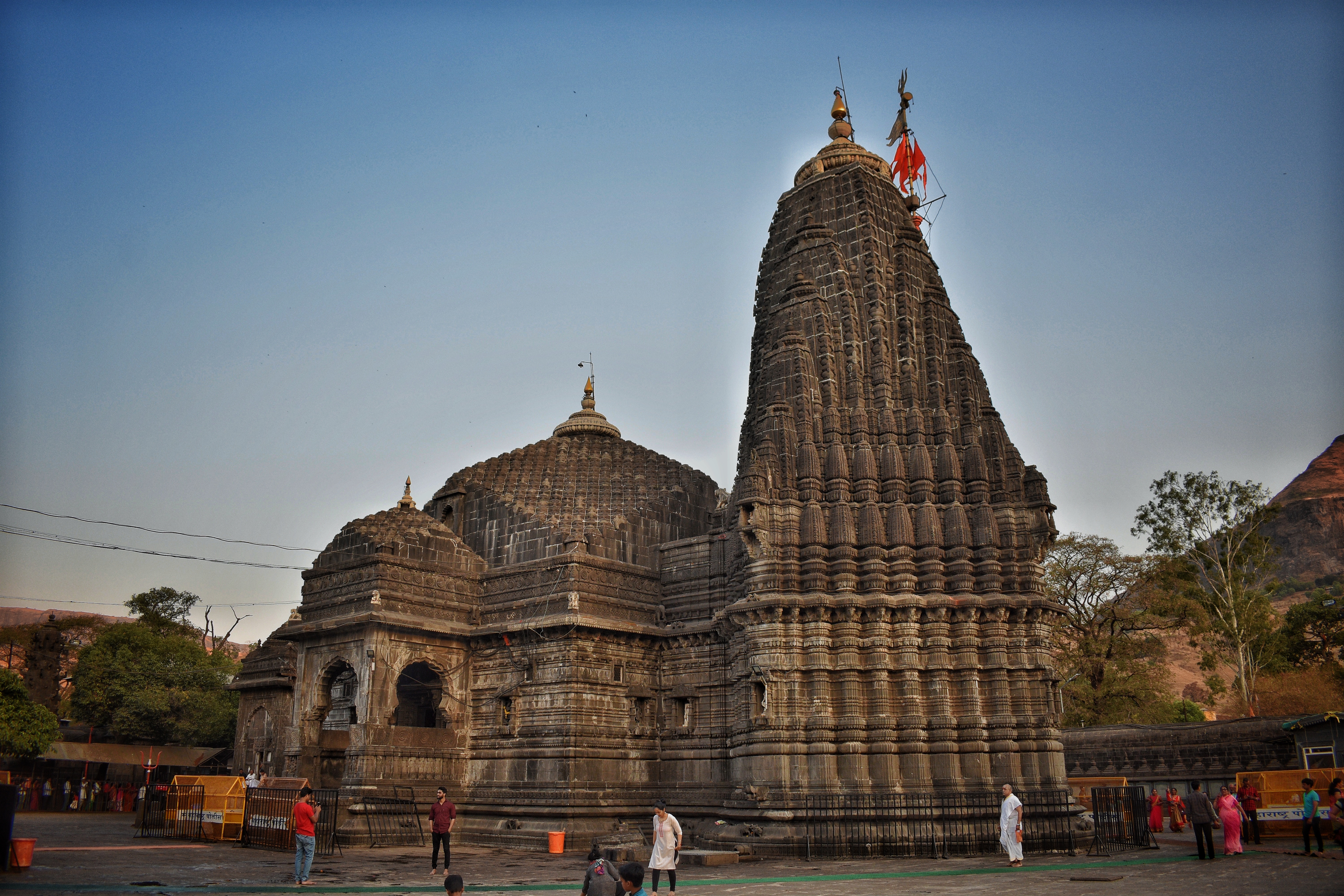
Trimbakeshwar Shiva Temple
The Nassak Diamond once sat on the linga inside this temple. Weighing 43 carats, it had adorned the sacred stone for centuries before British forces seized it during the Third Anglo-Maratha War in 1818. The diamond passed through auction houses and private collections across Europe and America, eventually landing with Edward J. Hand, a trucking firm executive in Greenwich, Connecticut. The temple that lost it still stands at Trimbakeshwar, 28 kilometers from Nashik, between three hills called Brahmagiri, Nilagiri, and Kalagiri. It remains one of the twelve jyotirlingas, the holiest Shiva shrines in Hinduism, and every Monday afternoon between four and five o'clock, a jeweled crown studded with diamonds and emeralds is placed over the golden mask of the Trideva for public display.
Three Faces in One Stone
What makes Trimbakeshwar unique among the twelve jyotirlingas is its linga's three faces, embodying Brahma, Vishnu, and Shiva together. Every other jyotirlinga in India represents Shiva alone. Here, the Hindu trinity shares a single shrine, carved from black basalt. The linga has been eroding over centuries from the constant flow of water poured in ritual worship, and devotees say this erosion symbolizes the eroding nature of human society itself. The jeweled crown placed over it is said to date to the age of the Pandavas, the heroes of the Mahabharata, though the temple structure visitors see today is considerably newer. The Peshwa Balaji Baji Rao commissioned the current basalt temple after the Mughal emperor Aurangzeb destroyed the earlier one, an act of reconstruction as much political as devotional.
Where the Godavari Is Born
Three streams descend from Brahmagiri Hill above the temple and converge at the Kushavarta Kund, a sacred tank within the temple premises built by Sardar Raosaheb Parnerkar, the Fadnavis of Indore State. This tank is considered the source of the Godavari River, India's second longest after the Ganges. The mythology behind the river's origin involves Sage Gautama, who performed intense penance on the peak of Brahmagiri, praying for the Ganges to flow southward during a devastating drought. Lord Shiva directed the celestial river to descend through the hills at Trimbak, where it emerged as the Godavari. Hindus consider this act of divine intervention so significant that the Godavari earned the title Dakshina Ganga, the Southern Ganges. From this modest origin, the river flows 1,465 kilometers eastward across five states to the Bay of Bengal.
Pillars of Infinite Light
The concept of the jyotirlinga traces to the Shiva Purana. Brahma and Vishnu once argued over who was supreme. To settle the dispute, Shiva manifested as an endless pillar of fire, a jyotirlinga, and challenged both gods to find its end. Vishnu dug downward. Brahma flew upward. Neither found a limit, though Brahma falsely claimed he had. Shiva cursed Brahma to have no place in Hindu ceremonies and blessed Vishnu to be worshipped for eternity. The twelve jyotirlinga temples across India, from Somnath in Gujarat to Rameswaram in Tamil Nadu, mark places where Shiva appeared as this fiery column. Trimbakeshwar's claim to this cosmic geography gives the town an importance far beyond its modest size, drawing pilgrims from across the subcontinent year-round.
A Town Built on Ritual
Trimbakeshwar is not simply a temple with a town around it. It is a town that exists because of the temple. Hindu genealogy registers maintained by pandits here trace family lineages across generations of pilgrims. The town hosts numerous Vedic gurukuls, traditional boarding schools where students study Sanskrit scriptures, and ashrams devoted to Ashtanga Yoga. Rituals performed only at Trimbakeshwar include Narayan Nagbali, a three-day ceremony believed to cure illness, resolve financial crises, and atone for the killing of a cobra. The temple tank, Amritavarshini, measures 28 by 30 meters and is surrounded by three other sacred water bodies. During monsoon season, the surrounding hills turn vivid green, and the streams feeding the Godavari swell with rain. The architecture, the landscape, and the rituals all converge on the same idea: that this place is where the divine touches the ground.
From the Air
Located at 19.93N, 73.53E, 28 km from Nashik in western Maharashtra, at the foot of Brahmagiri Hill. The temple complex and town of Trimbak are visible between the three hills of Brahmagiri, Nilagiri, and Kalagiri. Nearest airport: Nashik Airport (VANR), approximately 35 km to the east. Mumbai (VABB) is roughly 180 km to the southwest. Best viewed at 5,000-8,000 feet; the three surrounding hills and the temple's dark stone architecture provide orientation. The monsoon season (June-September) produces the most dramatic scenery with green hillsides and swollen streams.