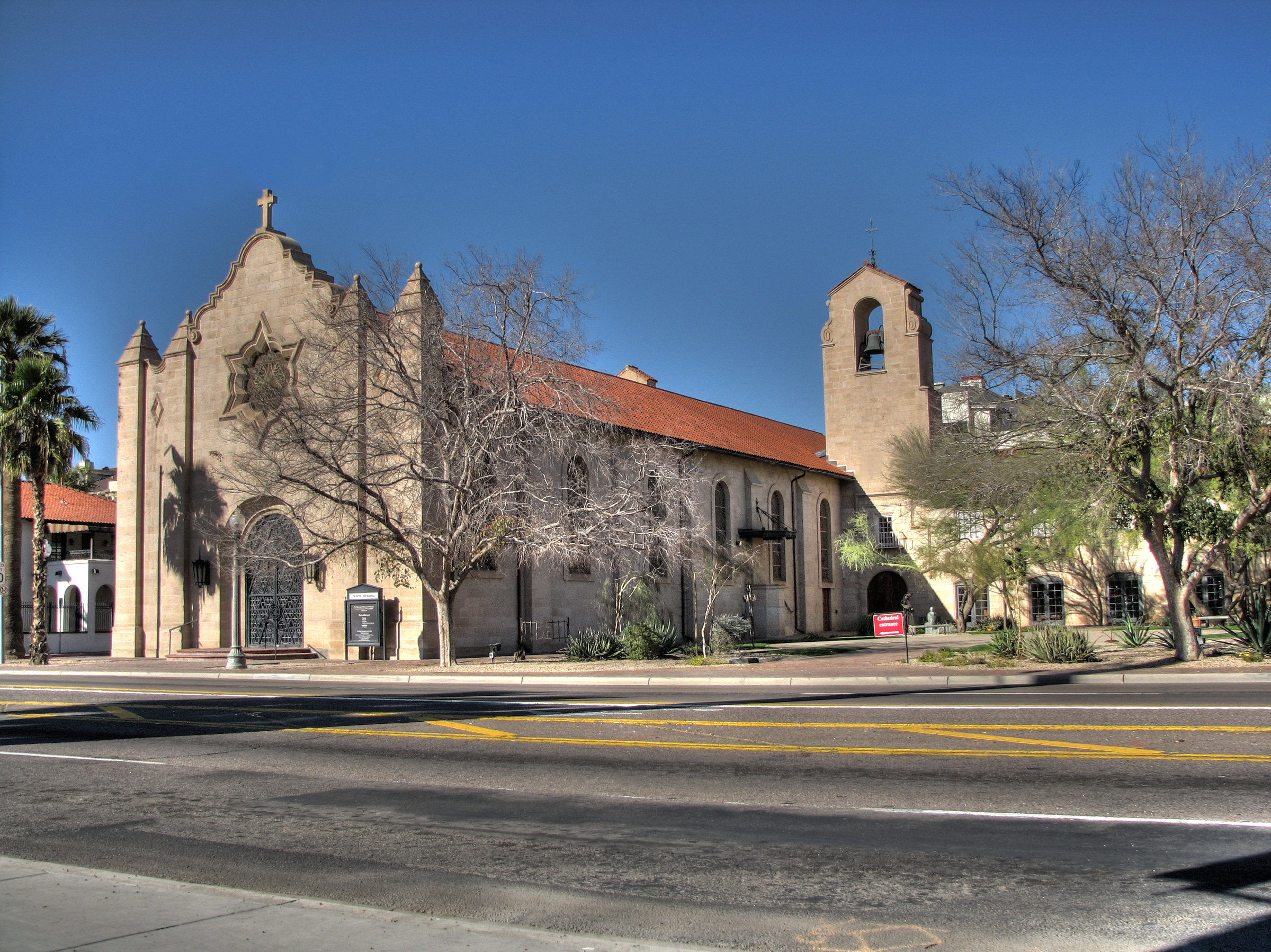
Trinity Cathedral (Phoenix, Arizona)
A match in a trash can nearly destroyed a century of faith. On October 10, 2002, flames consumed the north rose window, the organ, and the recently restored redwood ceiling of Trinity Cathedral in downtown Phoenix. But this was not the first time the congregation had faced a crossroads. Four decades earlier, they had considered abandoning their aging sanctuary for the suburbs, as so many Phoenix churches had done. Instead, they chose to stay, to renovate, to install stunning stained glass windows designed by Glidden Parker of Scottsdale. That fire took those windows. It also revealed something remarkable: a community that would rebuild twice rather than retreat once.
Boston Plans in the Desert
The story begins in 1885, when construction of the original Trinity Church was announced at 2nd Avenue and Washington Streets. By 1914, the congregation had outgrown their space and purchased new property on West Roosevelt Street. The architectural firm Shepley, Rutan and Coolidge of Boston drew up the plans, with Charles Allerton Coolidge himself donating the designs. They envisioned something rare in the Southwest: a proper cathedral close, a quadrangle of buildings arranged in the European tradition. The Cathedral House came first, completed in late 1915, followed by the nave in 1920. The congregation held their first service in the new structure on Christmas Day that year. V.O. Wallingford designed the final piece, Atwood Hall, completed in 1931. All three buildings wear the same distinctive tufa limestone facing, their pale surfaces glowing against Arizona's relentless blue sky.
From Missionary Outpost to True Cathedral
In 1914, Trinity Parish was designated to serve as the pro-cathedral for the Missionary Jurisdiction of Arizona. A pro-cathedral is essentially borrowed space, a parish church temporarily serving as the bishop's seat. Most Episcopal cathedrals in America function this way. But in 1988, Trinity achieved something extraordinary: it became only the fourth true cathedral of the Episcopal Church in the United States, fully controlled by the bishop and chapter. It joined an elite company: Grace Cathedral in San Francisco, the Cathedral of St. John the Divine in New York City, and the Washington National Cathedral. For a desert city that barely existed when Trinity's story began, this recognition marked Phoenix's coming of age as a spiritual center.
Light Through Glass
By the 1960s, Trinity Cathedral had fallen into disrepair. The decision to remain downtown rather than follow the population to the suburbs demanded investment. The parish commissioned Glidden Parker of the Glassart Studio in Scottsdale to design stained glass windows, including two magnificent rose windows depicting theological concepts in brilliant color. Parker installed them in 1966-67, then returned to create new cathedral doors of wrought iron and glass, their triangular patterns representing the tree of life. These windows transformed the interior, filtering Arizona's harsh light into something transcendent. When the 2002 fire destroyed the north rose window, the community turned to parishioner and local artist Vada Roseberry, who designed a new rose window faithful to the spirit of what was lost.
A Living Arts Center
Today, Trinity Cathedral houses a four-manual, 71-rank pipe organ built by the Schantz Organ Company of Orrville, Ohio, replacing the instrument destroyed in the fire. Arizona State University organ students practice here, their music filling a space designed for worship but open to all forms of beauty. A hand-crafted Bosendorfer concert grand piano from Vienna sits nearby. The Olney Gallery in the lower floor of Cathedral House participates in Phoenix's First Friday Art Walk, bringing contemporary creativity into this historic quadrangle. Trinity continues to serve as the mother church for Episcopal missions across metropolitan Phoenix, from Glendale to Paradise Valley, just as it has for more than a century.
From the Air
Trinity Cathedral sits at 33.4586N, 112.0747W in downtown Phoenix's historic Roosevelt district. From the air, look for the distinctive quadrangle of pale tufa limestone buildings just north of downtown's high-rises. The cathedral is approximately 4 nautical miles east of Phoenix Sky Harbor International Airport (KPHX). Best viewed at 2,000-3,000 feet AGL during morning hours when the limestone catches the light. The Roosevelt Row arts district extends east from the cathedral along Roosevelt Street.