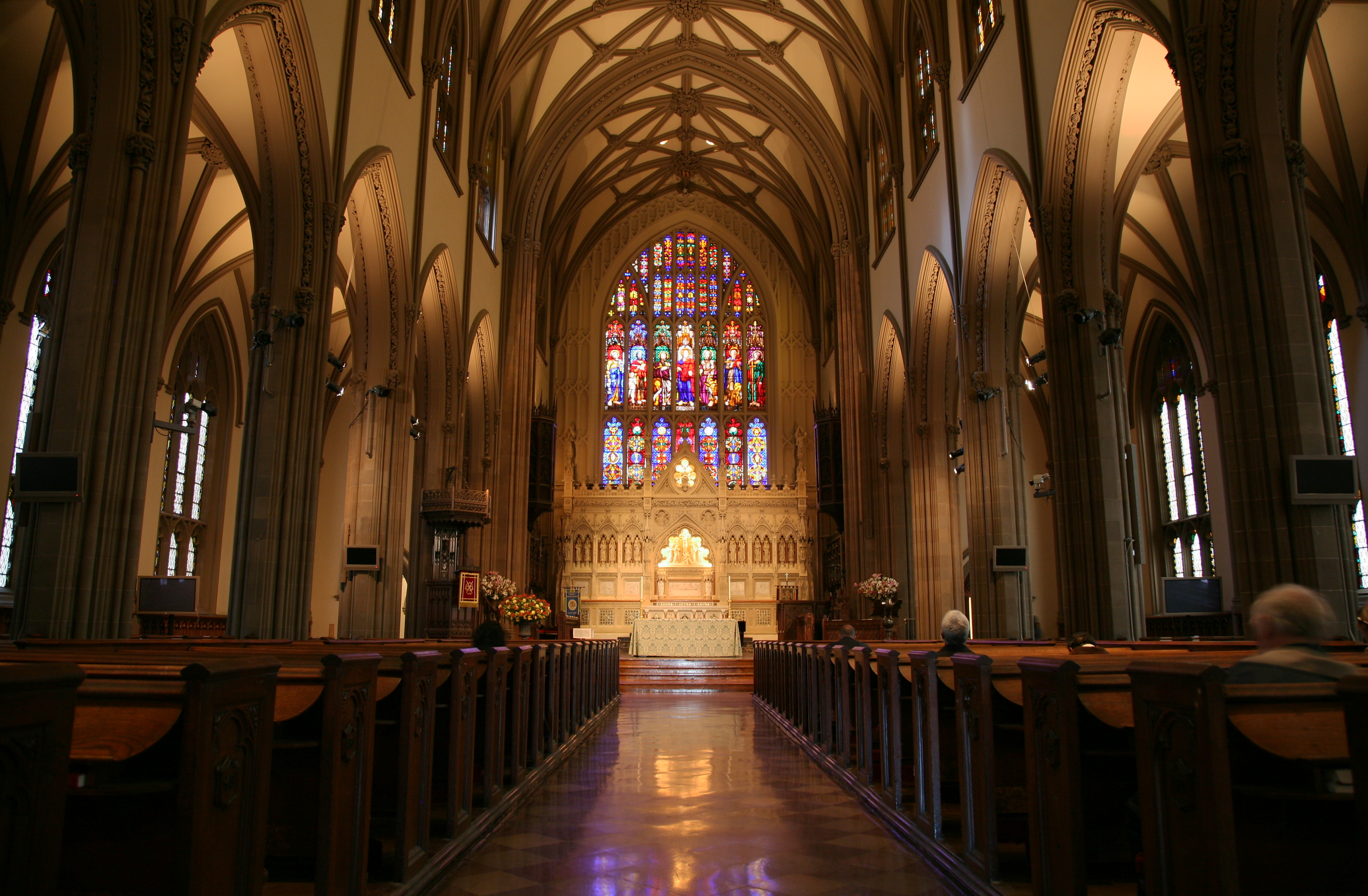
Trinity Church (Manhattan)
Captain William Kidd — the pirate — lent his runner and tackle to help raise the walls of Trinity Church's first building in 1698. That fact alone says something about the neighborhood. Broadway and Wall Street have always attracted complicated figures, and Trinity Church has stood among them for more than three centuries, its spire rising from a churchyard where revolutionary heroes are buried, beside the street where some of the most consequential financial decisions in American history were made.
Three Buildings, One Parish
The first Trinity Church stood from 1698 until the Great Fire of New York in 1776 destroyed it. The second church, completed in 1790 and built facing Wall Street rather than the Hudson River, was used by George Washington for inaugural prayers and served the growing city until the winters of 1838–39 weakened it beyond repair. The current building — the third — was designed by architect Richard Upjohn in the Gothic Revival style, constructed between 1839 and 1846, and dedicated in 1846. For several decades after its completion it was the tallest structure in New York City. Queen Elizabeth II and Prince Philip visited on July 10, 1976, during the American Bicentennial celebrations.
The Churchyard at Broadway and Wall
Trinity Churchyard is one of the oldest surviving burial grounds in Manhattan, and its roster of occupants reads like a footnote to American history made flesh. Alexander Hamilton is here, along with his wife Elizabeth Schuyler Hamilton and his son Philip, who was killed in a duel three years before his father died in the same way. Robert Fulton, the steamboat pioneer, is buried here. So are Hercules Mulligan, the Revolutionary War spy who operated a tailor shop on Broadway; Albert Gallatin, who served as Secretary of the Treasury under two presidents; and Horatio Gates, who commanded at Saratoga. The churchyard has been surrounded by Lower Manhattan's vertical growth for generations, but it remains open, accessible, and uncrowded — a quiet place a few steps from one of the noisiest intersections in the city.
Land, Money, and Contested Wealth
Trinity's influence on New York was never limited to the spiritual. The church once owned enormous tracts of Manhattan real estate, granted to it in the colonial era, and for generations those landholdings generated income that made the parish one of the wealthiest institutions in the city. The question of who, if anyone, had rightful claim to those holdings was litigated for decades, with claimants losing each time they brought the matter to court. As recently as 2011, disclosure from a parishioner's lawsuit revealed total church assets of approximately $2 billion. The parish has historically funded missionary work, maintained chapels, and supported congregations throughout Manhattan — St. Paul's Chapel nearby, and the Chapel of St. Cornelius on Governors Island among them.
Witness to American History
Trinity has been close to events that shaped the nation simply by virtue of its location. Washington Street and Broadway were the arteries of New Amsterdam, then New York Colony, then the young republic. The churchyard received the dead of the Revolutionary War era. The 1835 Great Fire of New York destroyed buildings within sight of the steeple. The September 11, 2001 attacks struck less than a quarter mile away; the churchyard and the still-standing St. Paul's Chapel on Fulton Street became gathering points in the aftermath. St. Paul's served as a relief center for recovery workers for months. Trinity itself, in its current form, has now stood for nearly 180 years — longer than any other building in the financial district.
From the Air
Trinity Church is located at 40.708°N, 74.012°W at Broadway and Wall Street in Lower Manhattan. The Gothic spire is a distinctive landmark visible from the air amid the surrounding cluster of skyscrapers. The churchyard to the south is a small green rectangle adjacent to Broadway. The tip of Manhattan, Battery Park, and the Staten Island Ferry terminal are approximately half a mile south. Nearest airports: KEWR (Newark) approximately 9 miles west, KLGA (LaGuardia) approximately 8 miles northeast.