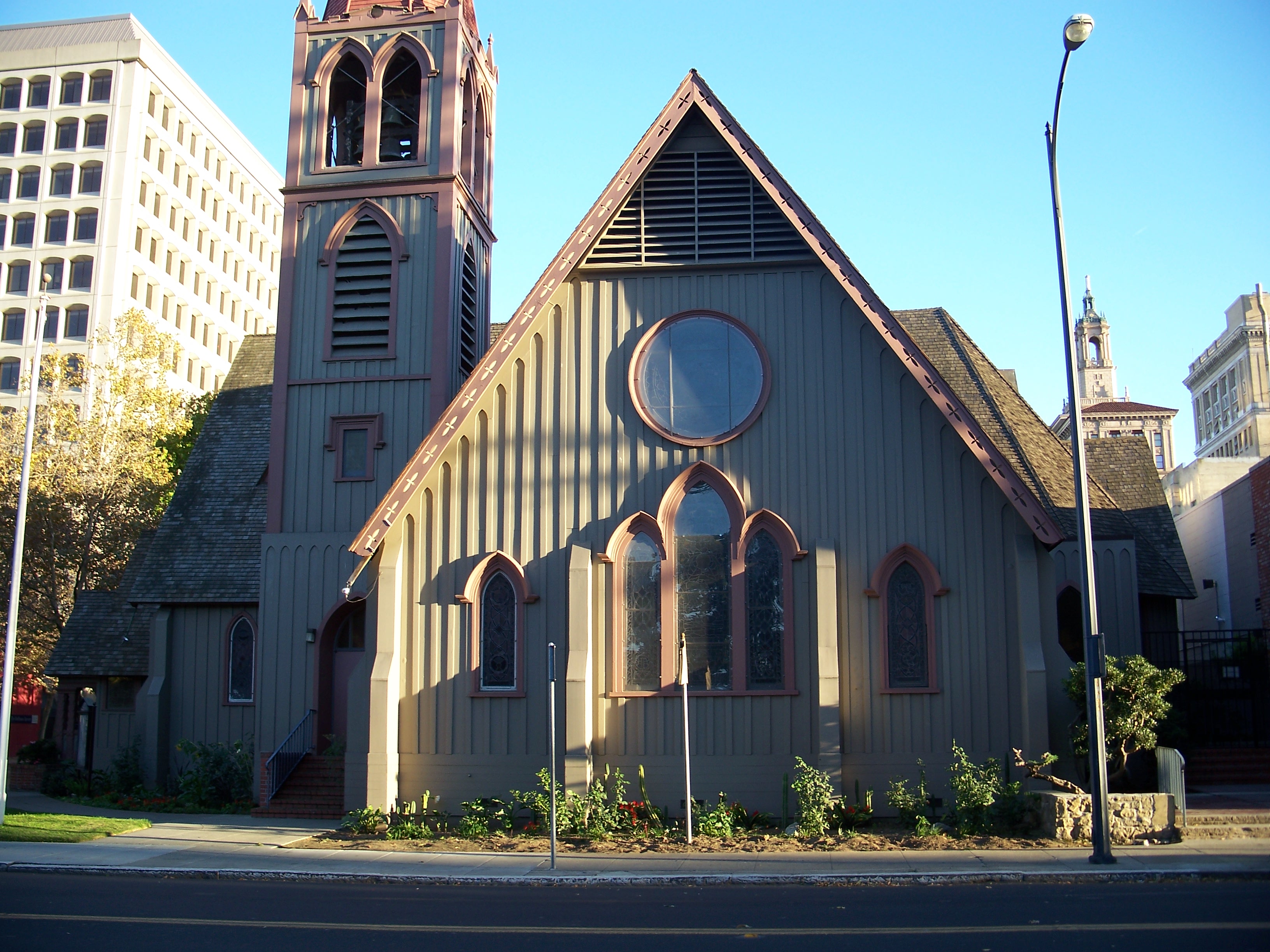
Trinity Episcopal Cathedral (San Jose, California)
John W. Hammond knew how to move heavy things. A retired sea captain and shipbuilder, he had spent his career hauling cargo across oceans and fitting timber into hulls designed to withstand storms. So when Trinity Episcopal Church in San Jose needed more room in the 1870s, Hammond did not propose tearing the building down. He proposed cutting it in half. A team of horses pulled the two halves apart. The front section was rotated to face North Second Street, new arms were added to form a cruciform plan, and the congregation had its expansion -- without losing a single original beam of Santa Cruz Mountains redwood.
Bishop Kip's First Service
The story begins in 1854, when the Right Reverend William Ingraham Kip arrived in San Francisco as the first Episcopal bishop of the Diocese of California. He soon traveled south to San Jose and conducted the city's first Episcopal service at the Independent Presbyterian Church, borrowing another denomination's building the way a newcomer borrows a neighbor's tools. Kip returned occasionally over the next six years, but it was not until the Reverend Sylvester S. Etheridge arrived in late 1860 that the congregation began to take permanent shape. In 1861, they organized formally as Trinity Church. Services moved from the firehouse on North Market Street to City Hall before a dedicated church building was completed in 1863 and consecrated by Bishop Kip four years later.
A Shipbuilder's Ingenuity
John Hammond was not a trained architect. He was a member of Trinity's vestry who happened to know more about structural engineering than most credentialed professionals of his era. The original building he designed was rectangular, with a steep hipped roof and walls of redwood logged in the Santa Cruz Mountains -- timber that had survived coastal fog and wind for centuries before being felled and hauled down to the valley floor. When growth demanded expansion, Hammond's shipbuilder instincts took over. Rather than demolishing and rebuilding, he treated the church the way he might have treated a vessel in dry dock: he separated the structure, repositioned the bow, and added new sections amidships. The bell tower rose at the same time. A spire followed in 1884, giving downtown San Jose a vertical punctuation mark that has endured through more than a century of surrounding change.
Ten Congregations from One
Trinity's influence extends far beyond its own walls. Over the years, ten Episcopal congregations in the surrounding area were formed from Trinity, making the cathedral something of a mother church for the region's Episcopalian community. When the Episcopal Diocese of El Camino Real was established, Trinity became its seat -- the formal home of the bishop and the symbolic center of a diocese stretching along California's central coast. Today, Sunday services are offered in both English and Spanish, a reflection of the multilingual community that downtown San Jose has become. The cathedral's long roster of rectors, stretching from Etheridge in 1861 to the present, reads like a quiet chronicle of American religious life -- each tenure shaped by the social currents of its era, from the Gold Rush afterglow to the tech boom.
Redwood Standing
Renovations in 1958 brought the cathedral to its present appearance, but the bones remain Hammond's work. The redwood walls still carry the grain of trees that grew on ridgelines above the Pacific, and the cruciform plan still traces the outline Hammond scratched out when he decided that horses could do what dynamite could not. The bell tower, silent for years, was restored and rang out again over downtown San Jose in 2017. Standing in St. James Park across the street, you can see the spire rise above the surrounding low-rise buildings -- a reminder that this city had a spiritual life long before it had a startup culture. The cathedral occupies its corner with the quiet confidence of something that was built to last by a man who understood what waves and wind could do to lesser structures.
From the Air
Located at 37.3377N, 121.891W in downtown San Jose, near St. James Park. The bell tower and spire are visible from lower altitudes among the surrounding low-rise buildings. Nearest airport: San Jose International (KSJC), approximately 3 nm northwest. Reid-Hillview Airport (KRHV) lies 5 nm east. Best viewed at 1,500-2,500 ft AGL. The cruciform plan of the building is discernible from directly overhead.