Trinity (Nuclear Test)
Enrico Fermi was taking side bets. As 425 scientists, soldiers, and technicians lay in bunkers and trenches across the Jornada del Muerto desert, the Italian physicist offered wagers on whether the bomb would ignite the atmosphere and, if so, whether it would destroy just New Mexico or the entire world. It was gallows humor — Edward Teller's calculations had shown the probability was near zero — but it captured something real about what was happening at 5:29 a.m. on July 16, 1945. Nobody was entirely sure what would come next. What came next was a flash of light visible in Amarillo, Texas, 280 miles away, and the birth of the atomic age.
The Gadget
They called it "the Gadget" — a five-foot sphere of explosive lenses surrounding a plutonium core, wired to a nest of detonators, hoisted to the top of a 100-foot steel tower in the desert 35 miles southeast of Socorro, New Mexico. It was the product of the Manhattan Project, two and a half years of work by some of the finest physicists alive, and it represented an engineering problem of extraordinary delicacy: 32 shaped charges had to fire within microseconds of each other, compressing a sphere of plutonium from subcritical to supercritical mass before the whole thing blew itself apart.
The site was chosen for its remoteness. The Jornada del Muerto — "Journey of the Dead Man" — is a flat, arid basin between mountain ranges, far from population centers and difficult to observe. The test had been postponed once already due to weather. Director J. Robert Oppenheimer, who had lost 30 pounds over the previous months and chain-smoked through the final countdown, watched from a bunker 10,000 yards south.
Five Twenty-Nine
The detonation produced a yield of roughly 25 kilotons — equivalent to 25,000 tons of TNT. The 100-foot steel tower was vaporized entirely; not a fragment was ever found. The fireball expanded to 600 feet in the first second, and the mushroom cloud rose to 7.5 miles. The blast wave knocked men off their feet at base camp, 10 miles away.
Fermi, characteristically, conducted his own measurement. He dropped small pieces of paper from shoulder height as the blast wave passed and measured how far they were displaced — about two and a half meters. From this he estimated the yield at roughly 10 kilotons, which was low but remarkable for an experiment conducted with scraps of paper in a trench. Isidor Isaac Rabi, who had guessed 18 kilotons in the betting pool, won $102.
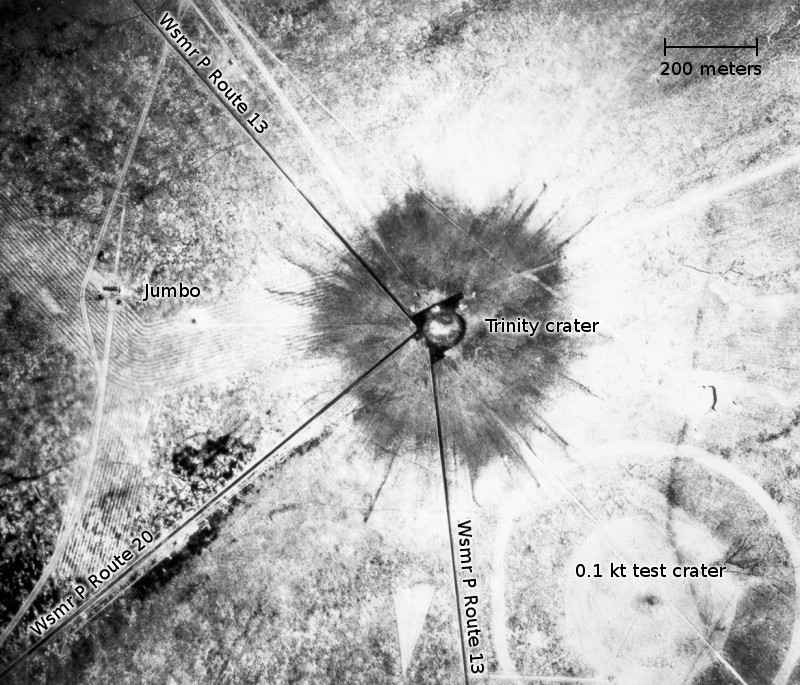
The sand beneath the tower melted into a mildly radioactive green glass that was later named trinitite. It carpeted the desert floor in a thin, glittering sheet across the shallow crater — 4.7 feet deep and 88 yards wide. Trinitite would become one of the most collected and studied artifacts of the nuclear age.
The Words They Chose
Kenneth Bainbridge, the Harvard physicist who directed the test, turned to Oppenheimer as the mushroom cloud climbed and said: "Now we are all sons of bitches." Oppenheimer later recalled that a line from the Bhagavad Gita passed through his mind: "Now I am become Death, the destroyer of worlds." Whether he thought this in the moment or refined it afterward has been debated, but the words became the test's most enduring legacy — a scientist's recognition that knowledge, once gained, cannot be returned.
The official cover story was that an ammunition magazine had exploded at the Alamogordo Bombing Range. The Alamogordo Air Base commander issued a press release citing a remotely located ammunition magazine containing high explosives and pyrotechnics. The light, the sound, and the mushroom cloud were explained away in a few sentences. Three weeks later, a bomb of the same design — the implosion-type plutonium weapon called Fat Man — was dropped on Nagasaki.
What the Desert Remembers
The Trinity site was declared a National Historic Landmark in 1965 and is open to the public twice a year — the first Saturdays of April and October. Visitors drive through the White Sands Missile Range to reach a fenced enclosure around ground zero, where a rough obelisk of black lava rock marks the spot where the tower stood. Fragments of trinitite can still be found in the soil, though collecting them is prohibited.
The crater was filled in shortly after the test for security reasons, so the landscape is flat and unremarkable — scrub brush, sand, distant mountains. A replica of the Fat Man casing sits near the monument. The McDonald ranch house, two miles south, where the plutonium core was assembled, has been restored to its 1945 condition. It is an ordinary adobe house, and the juxtaposition of its domestic modesty with what was assembled inside it is the most unsettling thing at Trinity — more so than the monument, more so than the trinitite. The desert remembers in glass what the rest of the world remembers in dread.
From the Air
Located at 33.68°N, 106.48°W in the northern Jornada del Muerto basin, within the White Sands Missile Range in south-central New Mexico. The site is 35 miles southeast of Socorro and 60 miles north of Las Cruces. From altitude, the terrain is flat desert basin flanked by the San Andres Mountains to the east and the Oscura Mountains to the north. The ground zero monument and fenced enclosure are small and difficult to spot — look for the access road branching east from the range road. Note: this is an active military installation; flight restrictions (R-5107) apply. Check NOTAMs before overflying. Nearest civilian airport: Socorro Municipal (KONM), 30 nm northwest; Truth or Consequences Municipal (KTCS), 40 nm south. Albuquerque International Sunport (KABQ) is 100 nm north. Recommended viewing altitude: 5,000-8,000 ft AGL — high enough to appreciate the basin's isolation.