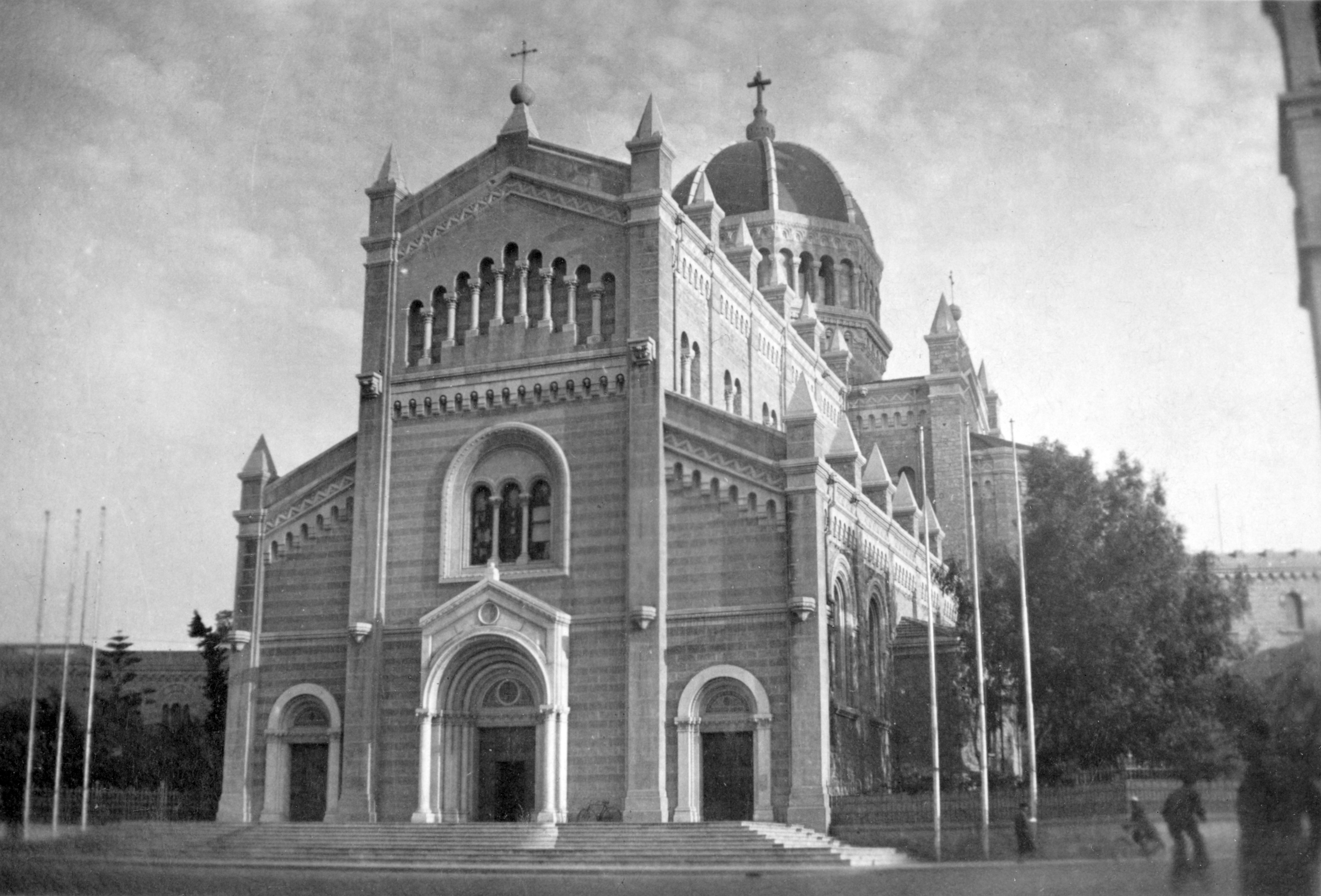
Tripoli Cathedral
The bell tower is still there. Stand back far enough in what is now Algeria Square in central Tripoli, and you can trace the unmistakable silhouette of a Catholic campanile rising above the roofline. The dome is still there too, the cupola of a Romanesque basilica, though the cross that once crowned it is long gone. Completed in 1928 as the cathedral of Italian colonial Tripoli, this building was designed by architect Saffo Panteri to project Roman Catholic permanence onto a North African city. It lasted forty-two years as a church. It has now spent more than half a century as a mosque.
Colonial Ambition in Stone
Italy's colonization of Libya, which began with the invasion of Ottoman Tripolitania in 1911, brought with it an ambitious program of architectural assertion. The Tripoli Cathedral was the most visible expression of that program. Panteri designed it in the Romanesque Revival style, with a basilica plan and a dome that reached a commanding height above the surrounding cityscape. The bell tower was decorated with Venetian-style engravings and statuettes, an aesthetic choice that tied the building visually to the Italian peninsula rather than to its North African setting. The cathedral was inaugurated and consecrated over three days, from November 24 to 26, 1928, by Monsignor Giacinto Tonizza, the Apostolic Vicar of the Holy See in Tripolitania. For the Italian colonial community, it was a statement of belonging. For the Libyan population, it was a statement of something else entirely.
The Revolution Arrives
In September 1969, a 27-year-old army officer named Muammar Gaddafi overthrew King Idris and established a revolutionary government. The consequences for Tripoli's Italian institutions came swiftly. In July 1970, the Revolutionary Council ordered the confiscation of all Italian and church property in Libya. By September, the Vicar Apostolic of Benghazi had been expelled, and the cathedral was closed. The Italian community, many of whom had lived in Libya for generations, lost their central place of worship in a matter of months. The closure was part of a broader campaign to erase the physical and cultural traces of Italian colonialism from Libyan public life.
From Cathedral to Mosque
The transformation of the cathedral into a mosque did not happen all at once. The building was renamed the Gamal Abdel Nasser Mosque, after the Egyptian president whom Gaddafi admired, and the square was renamed Algeria Square. But the physical conversion appears to have proceeded in stages, with certain architectural elements modified over the following decades and the exterior visibly completed only around the late 1990s to 2000. The Gaddafi regime's approach to historical record-keeping makes precise dating difficult. What is clear is that the building's overall form, the basilica plan, the separate bell tower, the dome, survived the conversion largely intact. The facade and interior underwent major changes, but the structural bones of Panteri's design remain legible to anyone who knows what they are looking at.
A Building Between Identities
Today the former cathedral, now the Algeria Square Mosque, is open to the public and active as a place of Muslim worship. The St. Francis Pro-Cathedral, a smaller church elsewhere in the city, has served as the temporary seat of the Apostolic Vicariate of Tripoli since the conversion. The building's dual identity, cathedral in form and mosque in function, makes it one of the most architecturally distinctive religious structures in North Africa. It belongs to a small category of buildings worldwide that have been converted from one faith to another without demolition, places where the original architects' intentions remain visible beneath the new purpose. The bell tower, the dome, and the basilica plan continue to assert an Italian colonial past that no amount of renaming can fully overwrite, even as the call to prayer now fills the same space where Latin hymns once echoed.
From the Air
Located at 32.89N, 13.19E in the city center of Tripoli, Libya. The cathedral-turned-mosque is identifiable from the air by its distinctive bell tower and dome, which stand out from the surrounding urban fabric in Algeria Square (formerly Piazza della Cattedrale). Mitiga International Airport (HLLM) is approximately 8 km east. Tripoli International Airport (HLLT) is about 34 km south. Best viewed from 3,000-5,000 ft, where the Romanesque tower and dome are visible among the flat-roofed buildings of central Tripoli.