The Sign He Was Carrying
Elang Mulia Lesmana was carrying a sign that read "Lower the price of photocopies and perfume!" It was the kind of message a nineteen-year-old architecture student would write -- wry, a little absurd, grounded in the everyday frustrations of campus life rather than the grand language of revolution. He was not calling for the overthrow of a government. He was not storming a barricade. He was standing in a university parking lot on a Tuesday afternoon, and within hours he would be dead, shot by soldiers of his own country's army. His death, along with those of three fellow students, would set Indonesia on fire.
When the Rupiah Fell
The crisis arrived as numbers on a screen before it arrived as hunger in the streets. In mid-1997, the Asian financial crisis struck Indonesia with devastating force. The rupiah, which had traded at roughly 2,500 to the dollar, began a freefall that would eventually see it lose more than 80 percent of its value. Prices for basic goods -- rice, cooking oil, fuel -- soared beyond the reach of ordinary families. President Suharto, who had ruled since 1967 and built his legitimacy on economic growth, suddenly had no growth to point to. Across the archipelago, students began to organize. At the University of Indonesia, at Gadjah Mada University in Yogyakarta, at the Bandung Institute of Technology, demonstrations grew larger through the early months of 1998. The demands were remarkably consistent: Suharto must resign. The economy must reform. The students, many of whom had never known another president, were asking for something Indonesia had never peacefully achieved -- a transfer of power.
Six Thousand in the Parking Lot
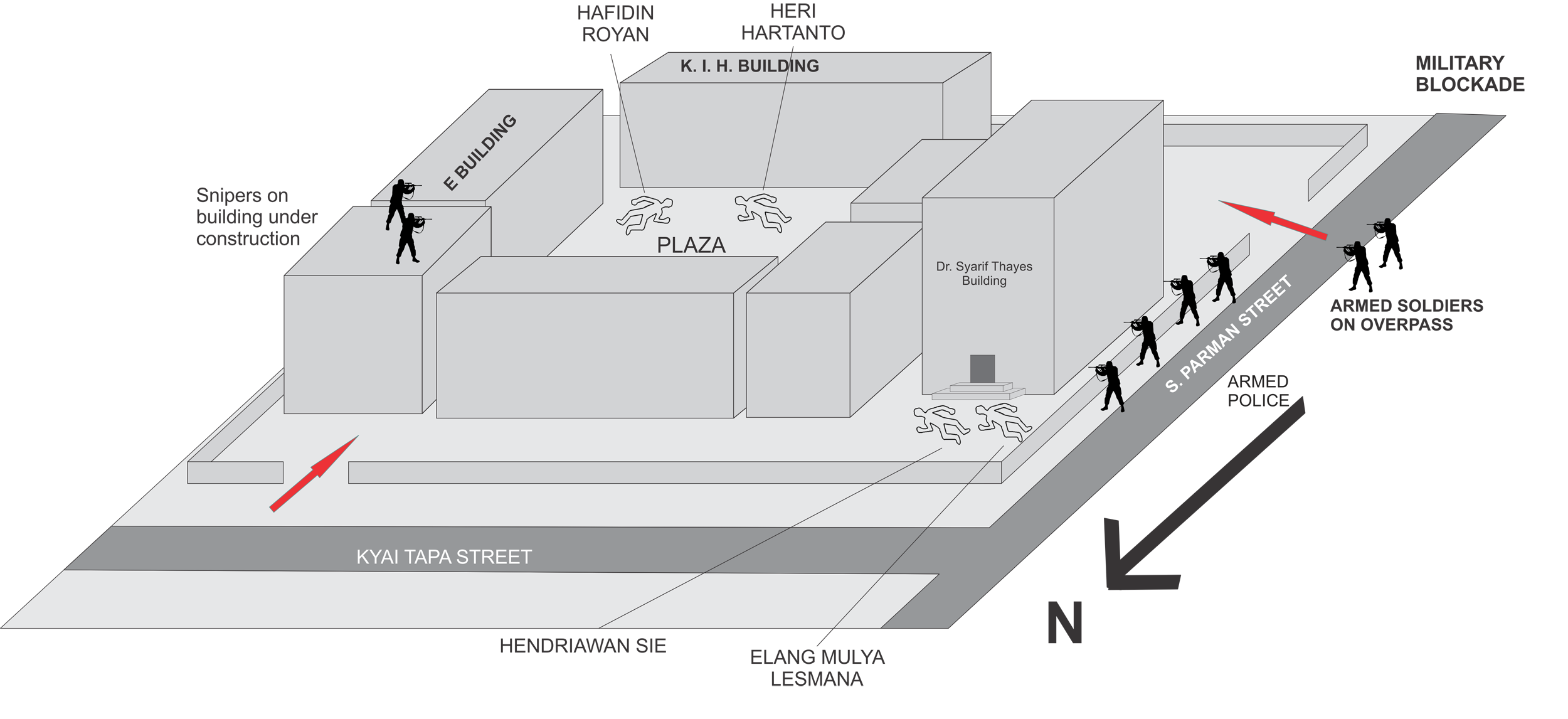
By 10 a.m. on May 12, 1998, over six thousand students, lecturers, and staff had gathered in the parking lot of Trisakti University in West Jakarta. The protest was planned as nonviolent. Organizers lowered the Indonesian flag to half-mast and prepared for a "long march" to the People's Representative Council Building, where they intended to deliver their demands directly to parliament. They made it only a few hundred meters before police blocked them in front of the West Jakarta Mayor's Office. What followed was a tense standoff. The students sat down in the road, blocking Letjen S. Parman Avenue entirely. Military reinforcements arrived. At 3:30 p.m., the dean of the Faculty of Law, Adi Andojo, convinced the demonstrators to return to campus. Most complied. The confrontation appeared to be ending. Then, around 5 p.m., with the students back on university grounds, insults were heard from the military and police lines surrounding the campus. Moments later, they opened fire.
Four Names
Elang Mulia Lesmana was nineteen, an architecture student known for his humor. Heri Hertanto, Hafidin Royan, and Hendriawan Sie -- all were students at Trisakti, all were unarmed, all died that afternoon. Elang and Hendriawan were shot while trying to reach the rectorate building for cover. Dozens more were wounded. The soldiers who fired into the crowd were never punished. Suharto's successor, B. J. Habibie, would later call the four dead students "reform heroes," a designation that carried moral weight but no legal consequence. In November 2000, eleven officers suspected of involvement were to be summoned for questioning by military police. By the end of that year, none had been questioned. The Indonesian National Commission on Human Rights reopened the investigation in 2008, submitted findings to the Attorney General's Office, and watched the files returned as "incomplete." The case has never been closed, and no one has ever been held accountable.
The Fire That Followed
The killings at Trisakti did not end the crisis. They accelerated it. Within hours, news of the shootings spread across Jakarta and then across Indonesia. On May 13 and 14, rioting erupted on a scale the capital had not seen in decades. Shopping centers were looted and burned. Ethnic Chinese communities, long scapegoated during periods of instability, were targeted with particular violence. The official death toll from the riots exceeded a thousand. The military's brutal response at Trisakti had achieved the opposite of its intended effect: rather than intimidating the opposition into silence, it had stripped the regime of its last shred of legitimacy. On May 21, nine days after the shootings, Suharto appeared on national television and resigned the presidency. He had held power for thirty-one years. The four students killed at Trisakti did not live to see it.
What the Campus Remembers
Every May 12, students gather at Trisakti University. They lay flowers. They hold banners with the four names. The campus has become a site of national memory, a place where Indonesia confronts the cost of its transition to democracy. A museum on the grounds preserves artifacts from the tragedy. But commemoration coexists with frustration. The investigation remains unresolved -- a wound that successive governments have preferred to leave open rather than heal or close. For the families of the dead, the designation "reform heroes" rings hollow without justice. The Trisakti campus sits in West Jakarta, a concrete university in a dense urban landscape, unremarkable in its architecture. Nothing about the buildings themselves suggests what happened there. The parking lot where six thousand people gathered is just a parking lot. The significance is carried entirely by memory -- by the people who return, year after year, to say the names aloud.
From the Air
Located at 6.17S, 106.79E in West Jakarta. The Trisakti University campus sits in a dense urban area along Jalan Letjen S. Parman, one of West Jakarta's major thoroughfares. From the air, the campus is identifiable as a cluster of institutional buildings amid Jakarta's sprawl. Nearest major airport is Soekarno-Hatta International Airport (WIII), approximately 18 km to the northwest. Halim Perdanakusuma International Airport (WIIH) is about 18 km to the southeast. At lower altitudes, the wide Letjen S. Parman Avenue provides a visual reference.