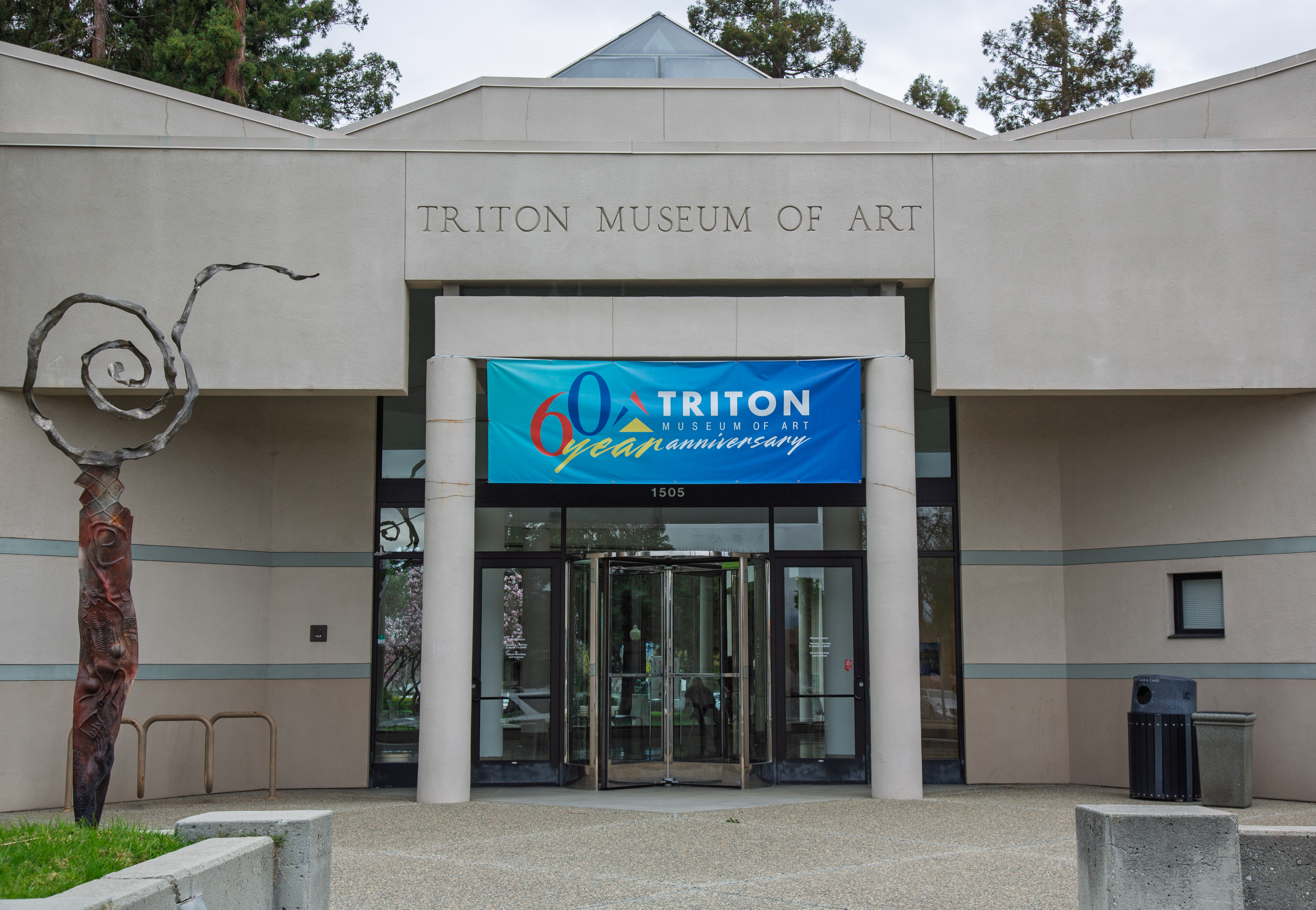
Triton Museum of Art
A rancher, a lawyer, and a painter walk into a museum -- except the rancher and the lawyer are the same person, and he built the museum himself. W. Robert Morgan was not the kind of art patron you picture when you hear the word. He raised cattle. He practiced law. And in 1965, he and his wife June opened a contemporary art museum in San Jose because they believed Silicon Valley needed something to look at besides orchards and semiconductor plants. Within two years, the collection had outgrown its original home, and the Morgans moved it across the street from the Santa Clara Civic Center, where it became the oldest non-university art museum in Santa Clara County.
The Rancher Who Collected Art
W. Robert Morgan did not fit the mold of museum founders in the mid-1960s. California's art world was centered in San Francisco and Los Angeles, and the south Bay was still mostly fruit trees and nascent tech companies. Morgan saw the gap not as a limitation but as an invitation. The museum he and June established was designed from the start for versatility -- its spacious galleries could accommodate everything from massive canvases to sculptural installations. The building's architecture prioritized the visitor's experience of the art, an approach that felt ahead of its time in a region where culture was usually an afterthought to industry. That a rancher-turned-lawyer created the space speaks to something particular about Santa Clara County: the conviction that you don't need anyone's permission to build what's missing.
Theodore Wores and the Permanent Collections
The museum's most distinctive holding is the largest public collection of paintings by Theodore Wores, a San Francisco-born artist who spent decades traveling and painting scenes from Japan, Samoa, Hawaii, and the American Southwest in the late nineteenth and early twentieth centuries. Wores studied at the Royal Academy in Munich and became one of the first Western artists to paint in Japan, arriving in 1885 when the country was still opening to outside visitors. His canvases capture light and landscape with a specificity that photography of the era could not match. The Triton also houses the Austen D. Warburton collection of Indigenous American art and artifacts, named for the street the museum calls home. Together, these permanent collections anchor the museum's identity in a dual commitment -- celebrating the art of the Bay Area while honoring the broader cultural traditions that shaped the region.
Across the Street from Power
The museum's location, directly across Warburton Avenue from the Santa Clara Civic Center, is more than convenient geography. It places art in daily proximity to the machinery of local government -- council members, residents paying utility bills, and municipal workers on lunch breaks all pass within a few hundred feet of the galleries. Over 50,000 people visit the museum on-site each year, drawn by rotating exhibitions that emphasize contemporary and historical works from Greater Bay Area artists. Another 90,000 encounter its satellite galleries and traveling exhibitions in other venues. For a nonprofit institution sustained by member contributions and community support rather than a large endowment, those numbers represent something earned rather than assumed. The museum functions as a civic asset in the most literal sense: it belongs to the community because the community chose to sustain it.
Contemporary Art in the Heart of Silicon Valley
Santa Clara County is home to some of the wealthiest corporations on the planet, but corporate campuses are not the same thing as cultural institutions. The Triton occupies a space that tech money has been slow to fill -- a public venue where art exists for its own sake, without a product launch attached. Its exhibition program cycles through solo shows by provocative contemporary artists alongside retrospectives that connect the Bay Area's visual arts history to its present. Educational programs bring school groups and families into the galleries, building the kind of audience that sustains a museum across generations. In a valley that celebrates disruption, the Triton's quiet persistence since 1965 is its own kind of statement. Some things are worth building slowly and keeping around.
From the Air
Located at 37.356N, 121.955W in Santa Clara, California, directly across Warburton Avenue from the Santa Clara Civic Center. The museum sits in a residential-civic area approximately 2 miles southwest of the San Jose International Airport (KSJC). Nearest airports: San Jose International (KSJC, 2nm NE), Moffett Federal Airfield (KNUQ, 5nm NW), Reid-Hillview (KRHV, 7nm SE). Best viewed at 1,500-2,000 feet AGL to see its position relative to the Civic Center campus.