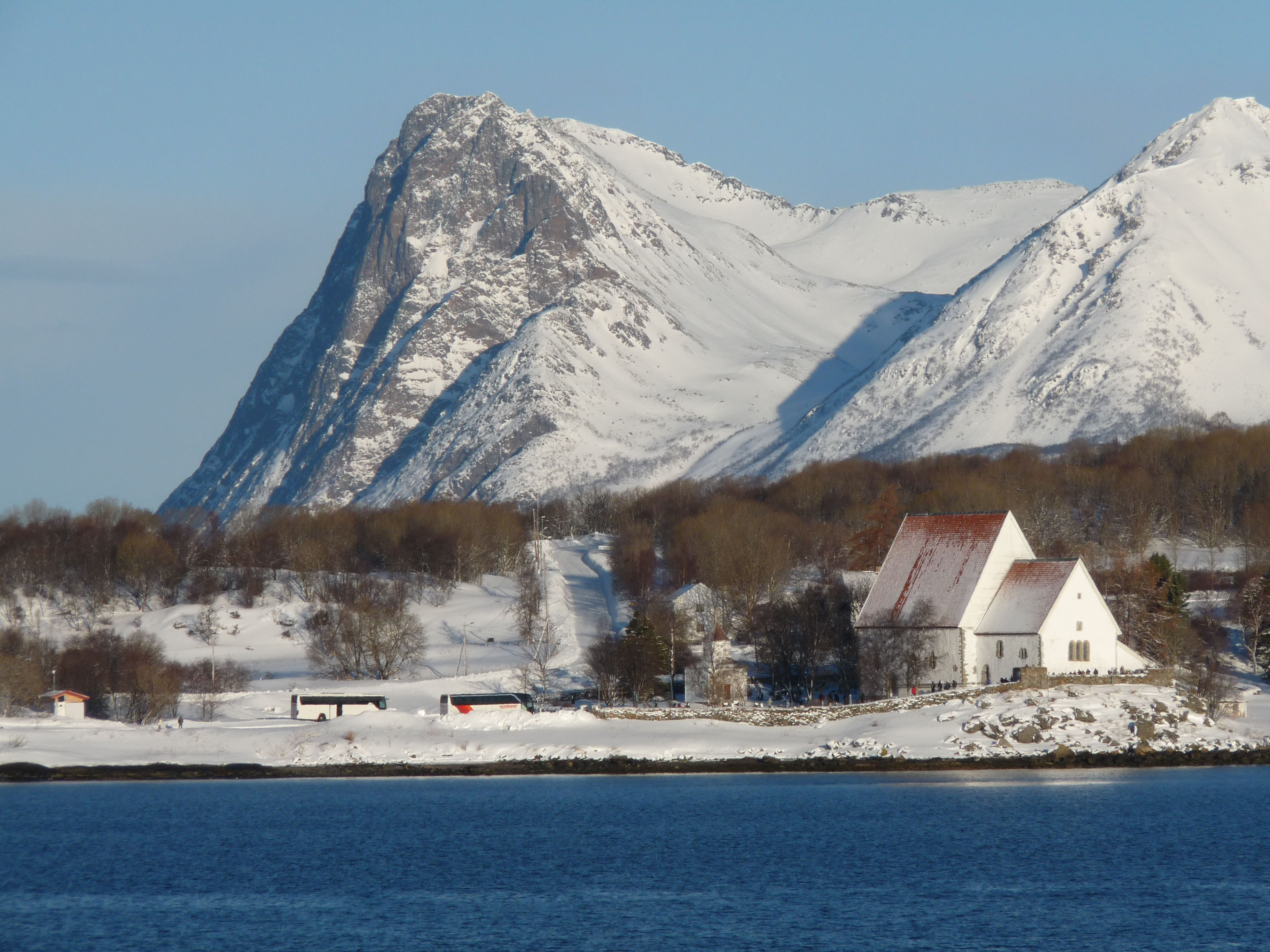
Trondenes Church
The pulpit has an hourglass built into it. That detail -- practical, slightly absurd, deeply human -- says more about Trondenes Church than any superlative. The minister turns the glass, and the congregation knows exactly how long the sermon will last. It is a baroque addition to a medieval church, a concession to the reality that even the faithful have limits. Trondenes Church stands on the northern edge of Harstad in Troms county, Norway, and it holds a distinction that no other building on Earth can claim: it is the world's northernmost surviving medieval structure, completed around 1435 at a latitude where winter daylight lasts barely a few hours and the aurora borealis writes across the sky overhead.
Three Churches, One Sacred Ground
The present stone church is the third to stand on this promontory. The first was likely a stave church, raised during the 11th century when Christianity was still new to northern Norway and the old Norse gods had not yet entirely released their hold. A second church followed in the 12th century, and this one the builders fortified -- stone walls and ramparts encircled it, remnants of which are still visible in the grounds today. The fortifications hint at the strategic importance of Trondenes during the medieval period, when it served as the main church center of all northern Norway. This was not a parish church in any quiet sense. It was a seat of ecclesiastical power at the edge of the known Christian world, and its builders intended it to endure.
Stone and Light at the Arctic Frontier
The church that stands today was completed shortly after 1434, a date established through dendrochronology -- the science of reading tree rings in the timber used during construction. Built in the long church style from white stone, it is surprisingly large for a rural Norwegian church: the nave stretches 22.6 meters, and the chancel extends another 13.5 meters. Inside, the decorations are richer than you would expect this far north. Three Gothic triptychs dominate the interior, their gilded panels depicting saints and biblical scenes with the meticulous detail of late medieval craftsmanship. One was long attributed to Bernt Notke, the celebrated Hanseatic artist whose work graced churches across the Baltic, though modern art historians now question that connection. In the choir, fragments of medieval frescoes survive beneath layers of later paint -- ghosts of color that once covered the walls.
A Polling Station for a Nation
Trondenes Church's most dramatic secular moment came in 1814, when Norway was writing its constitution. The church served as an election polling station -- one of more than 300 parish churches across the country pressed into democratic service. Parishioners gathered to choose electors who would travel to their county seat and, from there, select representatives for the Constituent Assembly at Eidsvoll Manor. It was Norway's first national election, and the fact that even this remote Arctic parish participated speaks to the ambition of the democratic project. The building that had anchored religious life at the top of the world for four centuries briefly became a cornerstone of the nation's political identity.
Where the Bells Ring from the Graveyard
The church bells once hung from a turret on the building itself, but the turret was demolished long ago. Now the bells ring from a small freestanding tower in the graveyard -- an arrangement that gives Trondenes an appearance unlike any other medieval church in Scandinavia. The graveyard surrounds the building on all sides, its headstones tracing the lives of generations who worshipped here through centuries of Norwegian history. Visitors arriving by the road from Harstad see the white church rising against a backdrop of fjord and mountain, its walls catching the low Arctic light. In summer, that light barely fades. In winter, the church stands in a landscape of snow and blue twilight, as it has since before Columbus sailed. The guided tours run by the Trondenes Historical Center bring thousands of visitors each year, but Trondenes is at its most powerful when the tourists have gone and the building sits in silence -- a stone monument to faith at the frontier, older than the Reformation, older than the printing press, still counting out sermons with its hourglass.
From the Air
Located at 68.82N, 16.56E on the Trondenes peninsula at the northern edge of Harstad, Norway. The white stone church is visible from the air against the darker landscape, especially in winter. Harstad/Narvik Airport, Evenes (ENEV) is approximately 20 nm to the southeast. Approach from the west over the fjord for the best view of the church on its promontory. The area features mountainous terrain with peaks to 600 meters. Weather is highly variable; cloud cover is common.