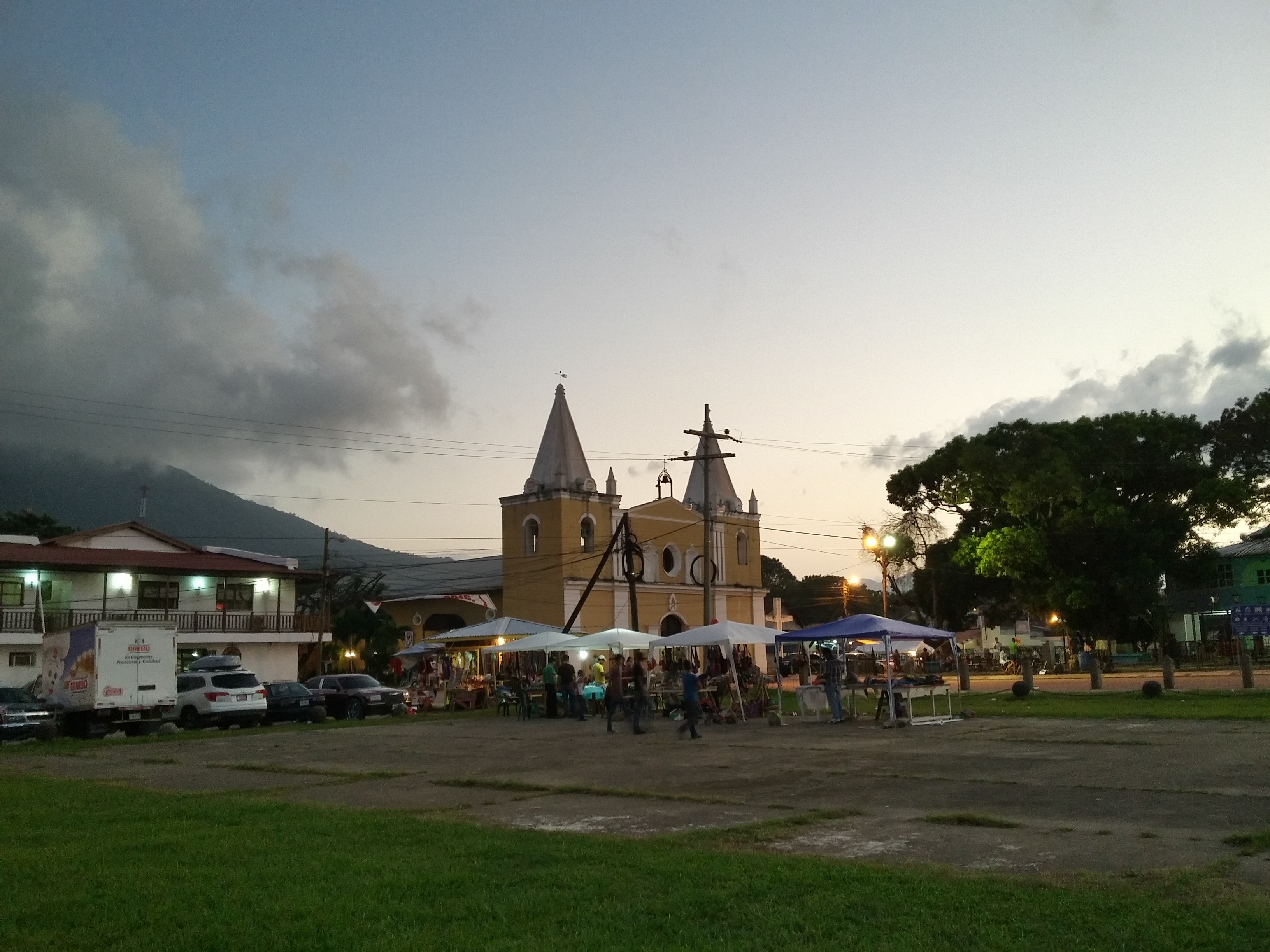
Trujillo, Honduras
On August 14, 1502, Christopher Columbus stepped ashore at a place he called Punta de Caxinas, the first time his feet touched the Central American mainland. He noticed the water was extraordinarily deep and named the surrounding gulf accordingly -- Golfo de Honduras, the Gulf of the Depths. The town that eventually grew here sits on a bluff above the Bay of Trujillo, flanked by Mount Capiro and Mount Calentura, with three Garifuna fishing villages strung along the beach below. Trujillo has been a capital, a pirate target, and a literary backdrop, though never for very long in any single role.
Conquest, Betrayal, and a Better Harbor
The modern settlement traces to 1524, when Hernan Cortes -- fresh from toppling the Aztec Empire -- sent Cristobal de Olid to establish a Spanish outpost in the region. Olid founded a town called Triunfo de la Cruz, then promptly began carving out his own independent domain. Cortes dispatched Francisco de las Casas to rein him in. Las Casas lost most of his fleet in a storm but managed to defeat Olid anyway, then relocated the entire settlement to its present site because the natural harbor was larger. The town was renamed Trujillo. As it grew into a shipment point for gold and silver mined in the Honduran interior, its sparse population and exposed coastline made it irresistible to pirates. The fortress of Santa Barbara, built around 1550 on the bluff overlooking the bay, was never quite enough.
The Pirate Magnet
Trujillo served as the capital of Honduras under Spanish rule, but its vulnerability eventually forced the colonial administration to retreat inland to Comayagua. The Fortaleza de Santa Barbara, with its cannons pointed seaward, could not defend against every threat that arrived by water. In 1683, the largest gathering of pirates in recorded history assembled in the vicinity of Trujillo -- a fact that speaks less to the town's strategic importance than to its inability to repel boarders. Between 1633 and 1797, the town was destroyed multiple times by pirates and rival colonial powers: Dutch, French, and English. By the eighteenth century, the Spanish had largely abandoned it, deeming the place indefensible. The fortress that failed to protect Trujillo from history is now one of its main tourist attractions.
The Mercenary's Last Stand
In 1860, the American filibuster William Walker sailed into Trujillo with plans to cross Honduras and recapture Nicaragua, from which he had been expelled three years earlier. Walker had already declared himself president of Nicaragua once; he intended to do it again. Instead, the Honduran Army and local volunteers held firm. The British Royal Navy intervened, and Walker was captured and executed by firing squad on orders of President Jose Santos Guardiola. His tomb remains in Trujillo, an unlikely tourist stop that draws visitors curious about the audacity of a man who tried to conquer Central American nations with private armies and lost everything in a town built on a bluff above deep water.
Cabbages, Kings, and Fictional Countries
The American writer O. Henry -- born William Sydney Porter -- spent roughly six months living in Honduras, mostly in Trujillo, during a period when he was evading embezzlement charges back in the United States. The experience produced a collection of short stories set in the fictional town of Coralio, in a fictional Central American republic called Anchuria, published in his 1904 book Of Cabbages and Kings. The phrase "banana republic," now a cliche, traces to this very book and this very place. Today Trujillo's population stands at about 22,750, with the Garifuna communities of Santa Fe, San Antonio, and Guadalupe maintaining fishing traditions along the coast. The city has drawn modern attention as a potential site for a charter city project inspired by economist Paul Romer, though the proposal has generated controversy over its implications for Garifuna land and culture.
From the Air
Located at 15.92N, 85.95W on the northern Caribbean coast of Honduras, Trujillo sits on a bluff overlooking the Bay of Trujillo. Mount Capiro and Mount Calentura rise prominently behind the city. The Fortaleza de Santa Barbara is visible from the air on the bluff. Nearest airports: Trujillo Airport (MHTJ) serves the city directly. La Ceiba (MHLC) is approximately 100 km to the west. Best viewed from 2,000-3,000 feet AGL approaching from the sea, where the bay, bluff, and mountain backdrop are all visible.