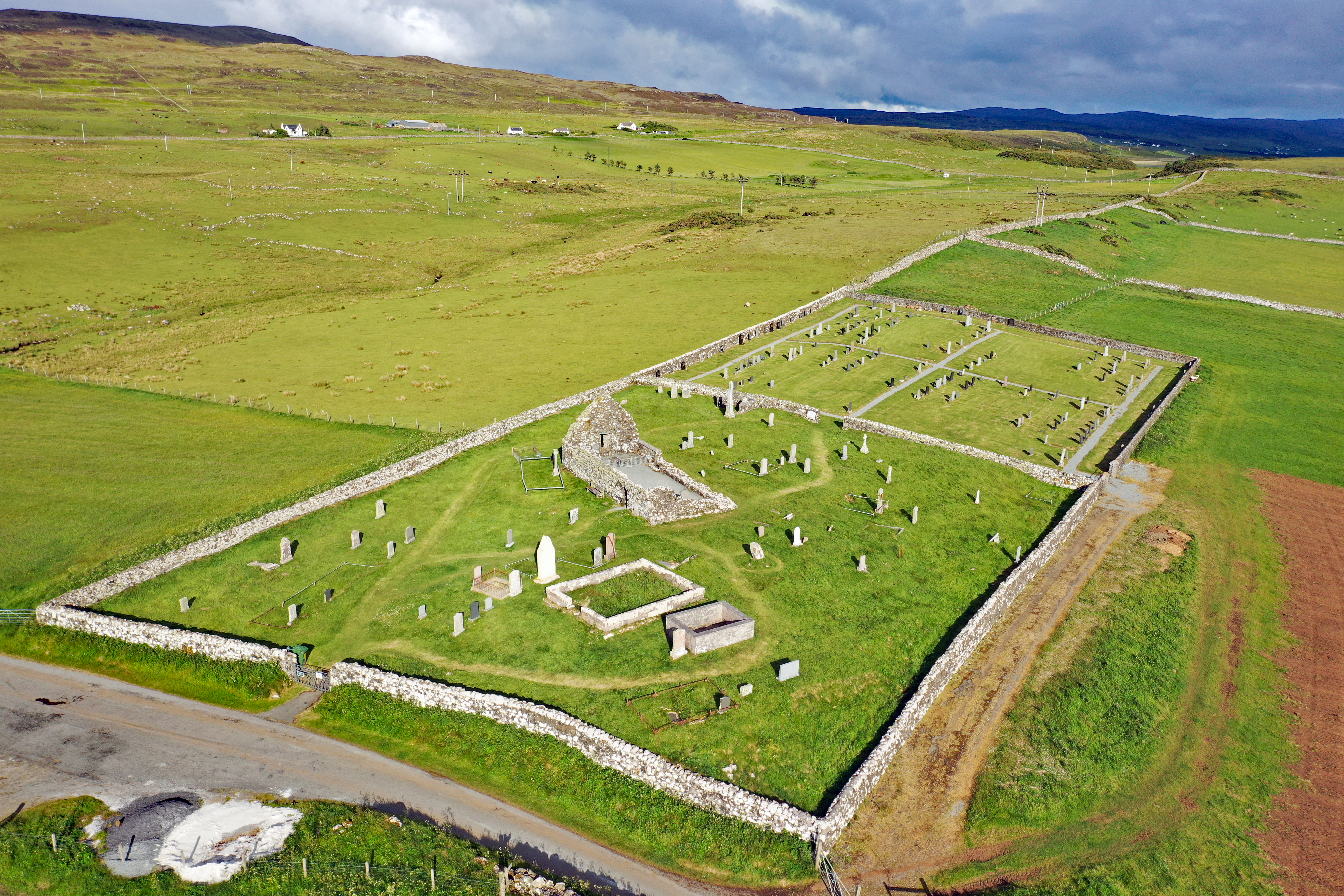
Trumpan Church
One girl survived. She was mortally wounded, but she lived long enough to raise the alarm. In 1578, a raiding party of MacDonalds from South Uist sailed to the Waternish peninsula on the Isle of Skye, found the local MacLeod congregation gathered for Sunday worship inside Trumpan Church, barred the doors, and set the building on fire. Every person inside perished except that single girl, who managed to escape through a window or gap in the wall. Her warning reached the MacLeod chief at Dunvegan Castle. What followed was not justice in any modern sense. It was the next turn in a cycle of retaliatory violence between two clans that had been killing each other's people for years.
Cille Conain
Trumpan Church -- also known by its Gaelic name Cille Conain -- is a 13th-century structure on the northern end of the Waternish peninsula, overlooking Ardmore Bay on Skye's west coast. The rectangular building measures approximately fifteen metres by seven metres. Its north wall, arched doorway, and east gable have survived undamaged. The south wall has largely collapsed. Inside the ruin, late medieval gravestones remain, one inscribed with a claymore surrounded by carved animals and foliage. A stone basin believed to be the holy water font sits among the remains. Historic Environment Scotland designated the church and its surrounding burial ground a scheduled monument in 1936. The church was in use until the 16th century -- until the day the MacDonalds came.
The Burning
The MacDonalds' attack on Trumpan Church was not unprovoked. It was retaliation for the massacre of MacDonalds on the Isle of Eigg the previous year, when MacLeods had suffocated hundreds of people in the Cave of Frances by lighting a fire at the cave's entrance. The Eigg massacre was itself a response to earlier MacDonald aggression. Neither clan could claim innocence; both were trapped in a spiral of retribution that consumed the Hebrides throughout the 16th century. At Trumpan, the MacDonalds barred the church doors and set the thatched roof alight. The congregation -- men, women, and children at worship -- had no escape. The single survivor, a young girl, was badly burned but reached the coast and gave warning before she died. Word travelled to Dunvegan, where the MacLeod chief gathered his clansmen and set out immediately for Ardmore Bay.
The Spoiling of the Dyke
The MacDonalds had expected to raid and withdraw before any response could reach them. The tide betrayed them. As the MacLeod force arrived at Ardmore Bay, the receding water had left the MacDonald galleys beached. The raiders could not escape. The battle that followed was short and savage. The MacLeods killed the MacDonalds almost to a man. The bodies were dragged to a nearby turf dyke, and the wall was toppled over them as a mass grave. The incident became known as the Battle of the Spoiling Dyke -- Blar Milleadh Garaidh. Today, Trumpan Church stands open to the sky on the edge of the Waternish peninsula, its graveyard dotted with medieval carved stones. The north wall still holds its arched doorway. Sheep graze among the headstones. The site is quiet in a way that churches burned to the ground with their congregations inside should not be quiet, but three and a half centuries of grass and wind have done their work. What remains is stone, silence, and the knowledge that the people inside had no warning and no way out.
From the Air
Trumpan Church sits at 57.556N, 6.641W on the northern end of the Waternish peninsula on the Isle of Skye, overlooking Ardmore Bay. The ruins are on the coast and may be difficult to spot from altitude. Dunvegan Castle lies approximately 8 nm to the south-southeast. Nearest airfield is Broadford Airstrip on Skye (no ICAO code), approximately 25 nm southeast, or Plockton on the mainland. Oban Airport (EGEO) lies approximately 70 nm south. The Outer Hebrides are visible to the west across the Little Minch.