Tsavo West National Park
In 1898, two lions brought the construction of the Kenya-Uganda Railway to a halt. For nine months, the pair stalked and killed construction workers in the Tsavo region with a persistence that defied every trap, every ambush, every night guard. Lieutenant Colonel John Henry Patterson finally shot them both, and the story became legend, eventually reaching Hollywood as the 1997 film The Ghost and the Darkness. The land where those lions hunted is now Tsavo West National Park, and it remains a place where the wild does not feel tamed. The bush is thick, the terrain is volcanic, and the animals are harder to see than in Kenya's more manicured parks. That is precisely the point.
A Landscape Born of Fire
Tsavo West looks nothing like the flat, golden savannas that define most people's mental image of an African safari. The terrain is arid and hilly, studded with volcanic cones and slashed by dark lava flows that hardened into jagged black rivers of rock. Rocky outcrops jut from the red earth at unpredictable angles. The Tsavo River bisects the park, its green corridor of vegetation standing in vivid contrast to the dry landscape on either side. The Kitchwa Tembo cliffs offer some of East Africa's most dramatic rock formations, their sheer faces catching the dawn light in ways that make the landscape feel primordial. This is geology you can feel underfoot, a land still shaped by the volcanic forces that built it.
The Other Tsavo
Tsavo West hosts fewer visitors than its slightly larger sibling, Tsavo East, and the reason is simple: thicker vegetation means animals are harder to spot. Where Tsavo East offers open plains and long sightlines, Tsavo West demands patience. Leopards, cheetahs, wild dogs, Cape buffalo, rhinos, elephants, giraffes, zebras, lions, and crocodiles all live here, along with smaller residents like mongooses, hyraxes, dik-diks, lesser kudus, and nocturnal porcupines. But the bush does not give them up easily. The reward for that patience is a sense of discovery that more heavily visited parks cannot match: every sighting feels earned rather than guaranteed.
Springs in the Desert
Mzima Springs is the park's most improbable feature: a series of four natural springs that produce an estimated 250 million liters of water daily, bubbling up from volcanic rock into crystal-clear pools surrounded by palm trees and fever acacias. The water originates as rainfall and snowmelt on the Chyulu Hills to the north, filtering through porous volcanic rock for years before emerging here. Hippos and crocodiles inhabit the pools, and an underwater observation chamber allows visitors to watch them from below the surface. In a landscape defined by aridity and volcanic harshness, Mzima Springs is a pocket of lush abundance that feels almost tropical, a reminder that even the driest terrain holds its secrets.
Wings Over Tsavo
Over 600 bird species have been recorded in Tsavo West, a staggering count for any single protected area. The diversity reflects the park's range of habitats: riverine forest along the Tsavo, open scrubland, rocky hillsides, and the lush microhabitats around the springs. Raptors ride the thermals above the lava fields, while smaller species fill the bush with calls that carry in the dry air. For birders, Tsavo West is a destination in its own right, separate from the mammal-watching that drives most safari traffic. The best viewing conditions come between August and September, when the vegetation thins and lines of sight open up through the bush.
Divided by the Railway
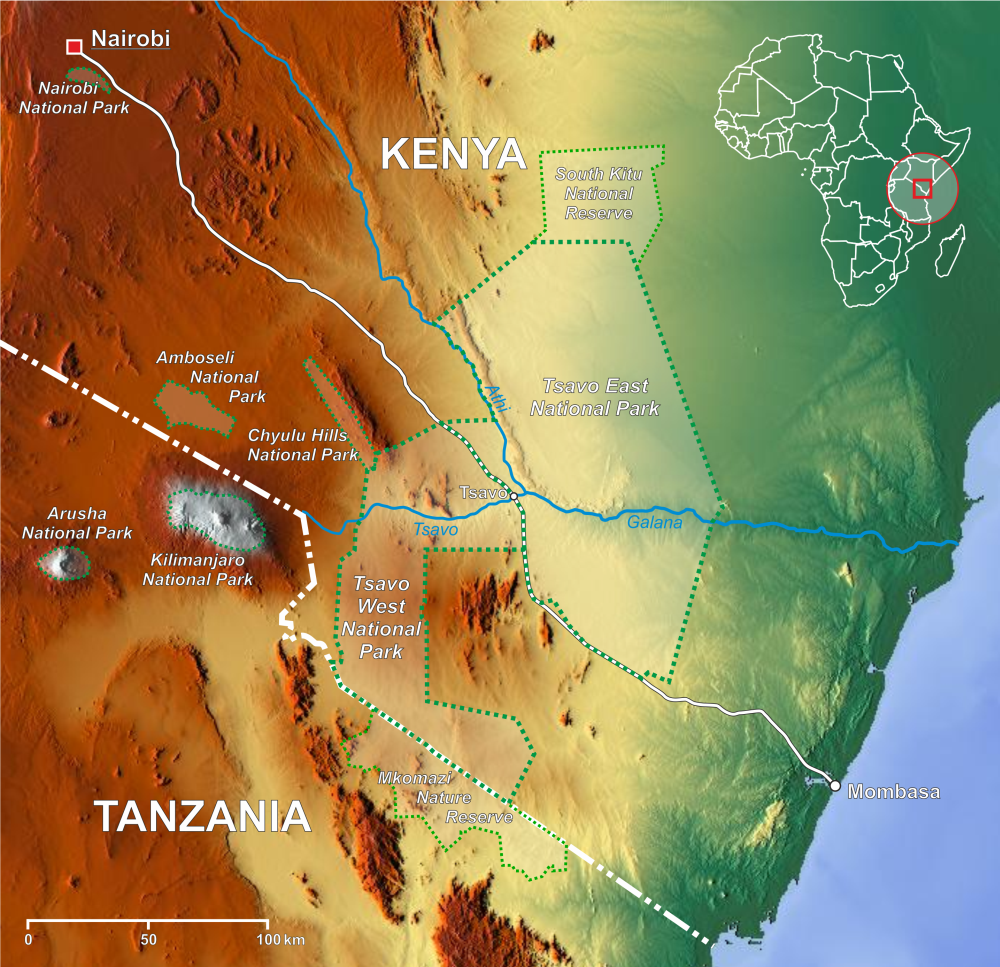
The original Tsavo National Park was established on April 1, 1948, covering 21,812 square kilometers and making it the largest park in Kenya. It held that title for exactly one month. The vast expanse proved too difficult to administer as a single unit, so it was split into Tsavo East and Tsavo West along the line of the Nairobi-Mombasa railroad, the very railway whose construction the man-eating lions had disrupted half a century earlier. The railroad that once brought terror now serves as an administrative boundary, a neat irony in a park where history and wildness are never far apart. Today, Tsavo West is considered the more scenic of the two parks, its rugged volcanic terrain trading the easy visibility of the east for a landscape that rewards those willing to look harder.
From the Air
Located at 3.32S, 38.13E in southern Kenya's Rift Valley region. The park's volcanic landscape, including cones and lava flows, is distinctive from the air. Moi International Airport (HKMO) in Mombasa is approximately 200 km to the east. Jomo Kenyatta International Airport (HKJK) in Nairobi is roughly 300 km to the northwest. The Nairobi-Mombasa railroad bisects the area, dividing Tsavo West from Tsavo East. The Chyulu Hills are visible to the north. Best viewed at 3,000-8,000 ft AGL to appreciate the volcanic terrain and river corridors.