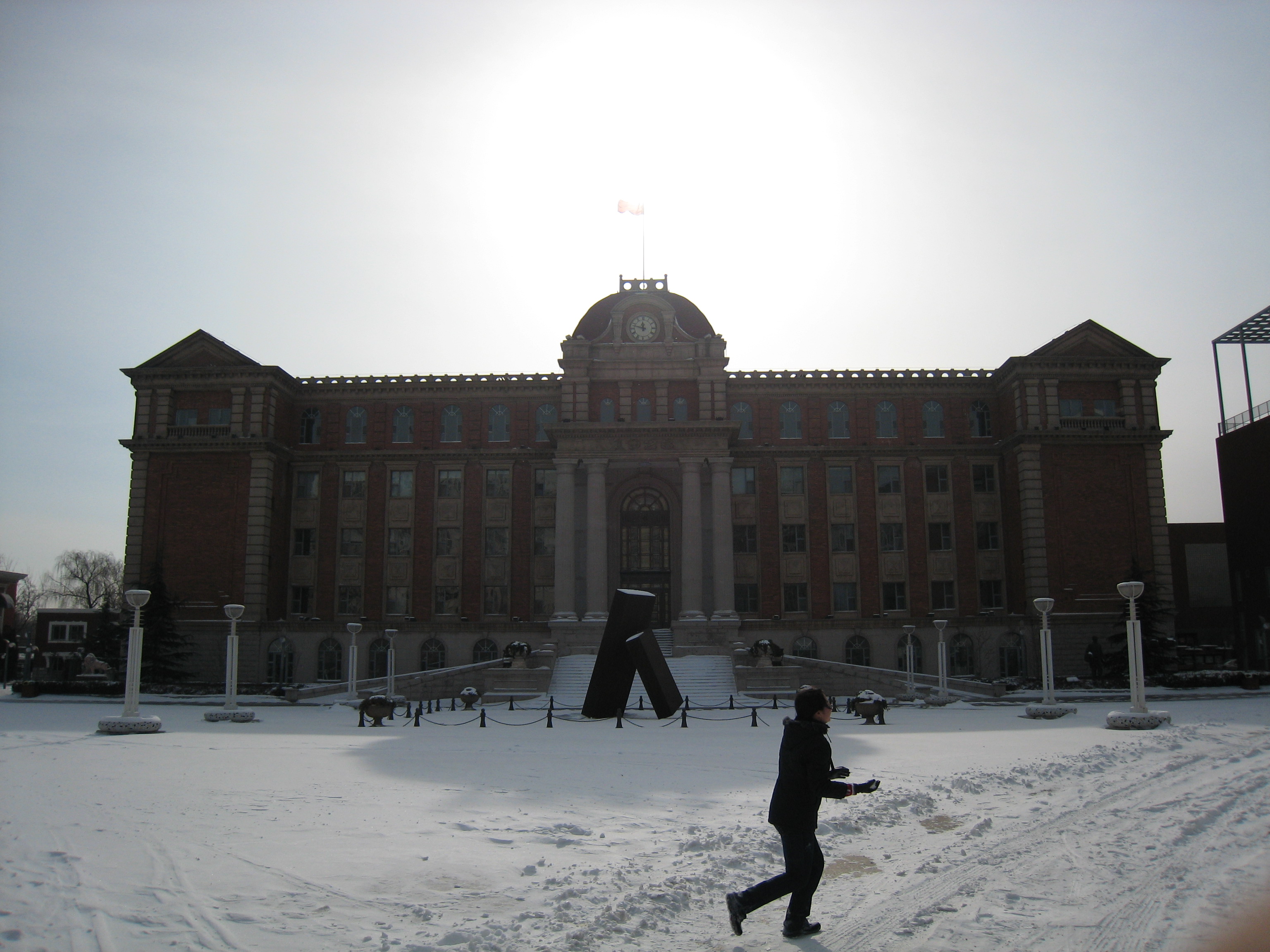
Tsin Ku University
The university no longer exists, but its descendants are everywhere. Tianjin University's School of Architecture, Nankai University's economics and business programs, Hebei University, Tianjin Foreign Studies University, and Tianjin University of Finance and Economics all trace some part of their lineage to a single institution: Tsin Ku University, a French Jesuit school that operated in Tianjin for just three decades before it was dissolved in 1952. Founded in 1921 as a Catholic university at the junction of the German and British Concessions, it became one of the earliest institutions in modern China to teach architecture, and its motto was startlingly direct for a religious school: 'Seek truth from facts.'
Sixty Years of Failed Attempts
The French had been trying to build a university in Tianjin since the 1860s. In 1861, the secretary of the French Legation instructed the Jesuits to establish a school there, but the Lazarists, who already had a presence in the city, resisted. The plan was shelved. In 1909, a Jesuit priest acquired 100 acres of barren land between the German and British Concessions, but Li Hongzhang, the Governor-General of Zhili Province, rejected the proposal under British and American influence. It was not until after World War I that the Holy See, prompted by reports from local bishops about the importance of education in China, finally gave the go-ahead. In July 1920, instructions went out to establish a university. By 1921, Tsin Ku opened its doors, initially as the Tianjin University of Commerce.
Renaissance on the Concession Border
The campus architecture reflected its hybrid origins. Situated near the boundary of the British Concession, the buildings adopted the European classical style prevalent in the surrounding treaty-port district. The main teaching building, completed in 1926, was considered a replica of French classical architecture, with Renaissance-style elements that would not have looked out of place in a provincial French city. In May 2013, the State Council designated this building as a nationally significant historical site. Adjacent to the campus, the Jesuits also built the Hoangho Paiho Museum in 1922, a natural history collection that would eventually become the Tianjin Natural History Museum. The architect Paul Muller from France and Rolf Geyling from Austria were among the faculty who shaped both the buildings and the curriculum.
Architecture and the Art of Dissolution
By 1937, the school had added an architecture department under Chen Yanzhong, making it one of the first institutions in China to offer formal architectural education. The school grew through the war years, attracting displaced scholars from Yenching University and Nankai University who could not relocate. By 1950, Tsin Ku had three colleges with ten departments and a total of 1,184 graduates over its twenty-five years of operation. Then came the restructuring of Chinese higher education in 1952. The government dissolved Tsin Ku entirely: engineering went to Tianjin University, finance and economics to Nankai, and the teachers' college eventually evolved into Hebei University. When Hebei University relocated to Baoding in 1970, nearly half its staff refused to move. They stayed on the original campus and founded what is now Tianjin Foreign Studies University.
The Ghost in Six Institutions
Vice Premier Yao Yilin counted himself among the alumni. So did physicist Yuan Jialiu. Over its brief life, the school graduated just over a thousand students, but its influence radiated outward through the institutions that absorbed its people and its programs. The entrance examinations alone suggested the school's rigor: engineering applicants sat for twelve subjects, including written and oral English, geometry, and higher algebra. The school anthem, referenced in a 2010 monograph titled 'In the Sunshine of Jugu,' has been nearly forgotten. But the buildings still stand, protected as cultural relics since 1997, and in 2016 Tianjin Foreign Studies University and the city's municipal archives held a symposium commemorating the ninety-fifth anniversary of the institution that no longer exists but whose genetic material runs through half a dozen of China's universities.
From the Air
Located at 39.06N, 117.12E in western Tianjin, near the former boundary of the British Concession. Tianjin Binhai International Airport (ZBTJ) is approximately 25 km to the east. The preserved campus buildings with European classical architecture are in the urban core. Best viewed at 3,000-5,000 feet altitude.