TSMC
Morris Chang was 55 years old and had spent a quarter century at Texas Instruments when the Taiwanese government offered him a blank check. Li Kwoh-ting, representing the Executive Yuan, wanted Chang to build a semiconductor industry for Taiwan from almost nothing. Texas Instruments and Intel had already turned down partnership offers. Only Philips was willing to invest, putting up $58 million, transferring production technology, and licensing intellectual property in exchange for a 27.6 percent stake. The Taiwanese government supplied 48.3 percent of the capital. Eight private Taiwanese companies - plastics manufacturers, textile firms, chemical producers - were directly "asked" by the government to provide most of the rest.
From this unlikely coalition of a Dutch electronics company, a former Texas Instruments executive, and Taiwan's wealthiest industrialists emerged TSMC: the Taiwan Semiconductor Manufacturing Company. Founded in 1987 in the Hsinchu Science Park, it pioneered a concept that no one had attempted at scale - a company that manufactured chips but designed none of them, serving as a pure foundry for other firms' creations.
The Foundry Model Nobody Wanted
The idea seemed backwards. Every major semiconductor company in the 1980s designed and manufactured its own chips. The notion that a company could thrive by manufacturing other people's designs challenged the industry's vertically integrated orthodoxy. Chang's insight was that the cost of building and maintaining fabrication plants - fabs - was rising so steeply that most companies would eventually find it cheaper to outsource manufacturing. He was building for a future that had not arrived yet.
TSMC's first CEO was James E. Dykes, a Philips executive, who departed after a year. Chang took over the role himself and held it for decades. The company listed on the Taiwan Stock Exchange in 1993, and in 1997 became the first Taiwanese firm listed on the New York Stock Exchange. Growth was not smooth - the semiconductor industry is fiercely cyclical, with peaks of overwhelming demand followed by troughs of excess capacity - but the trajectory was relentless. Since 1994, TSMC has maintained a compound annual growth rate of 17.4 percent in revenue.
Chipmaker to the World
The list of companies that depend on TSMC reads like a roll call of the technology industry. Apple. Nvidia. AMD. Qualcomm. Broadcom. MediaTek. ARM. Even Intel, which built its reputation on manufacturing its own processors, outsources some production to TSMC. The company's global capacity reached approximately thirteen million 300-millimeter-equivalent wafers per year by 2020, produced across process nodes ranging from two microns down to three nanometers.
TSMC was the first foundry to bring 7-nanometer and 5-nanometer chips to market - the processors inside modern iPhones, iPads, and Mac computers. It was the first to commercialize extreme ultraviolet lithography, the most advanced patterning technology in semiconductor manufacturing, in high volume production. By late 2022, TSMC began producing 3-nanometer chips, and its 2-nanometer technology entered production in late 2025, marking a fundamental architectural shift from FinFET to Gate-All-Around nanosheet transistors. Each generation pushes physics closer to its limits and pushes TSMC further from any competitor's reach.
A Company That Is Also a Country's Shield
TSMC is not merely a corporation. It is a geopolitical fact. Taiwan's exports of integrated circuits reached $184 billion in 2022 - nearly 25 percent of the island's GDP. TSMC alone constitutes roughly 30 percent of the Taiwan Stock Exchange's main index. The company consumes about five percent of Taiwan's total electricity. When analysts debate whether China would ever invade Taiwan, the conversation inevitably turns to TSMC's fabs, which produce chips that the global economy - including China's - cannot function without.
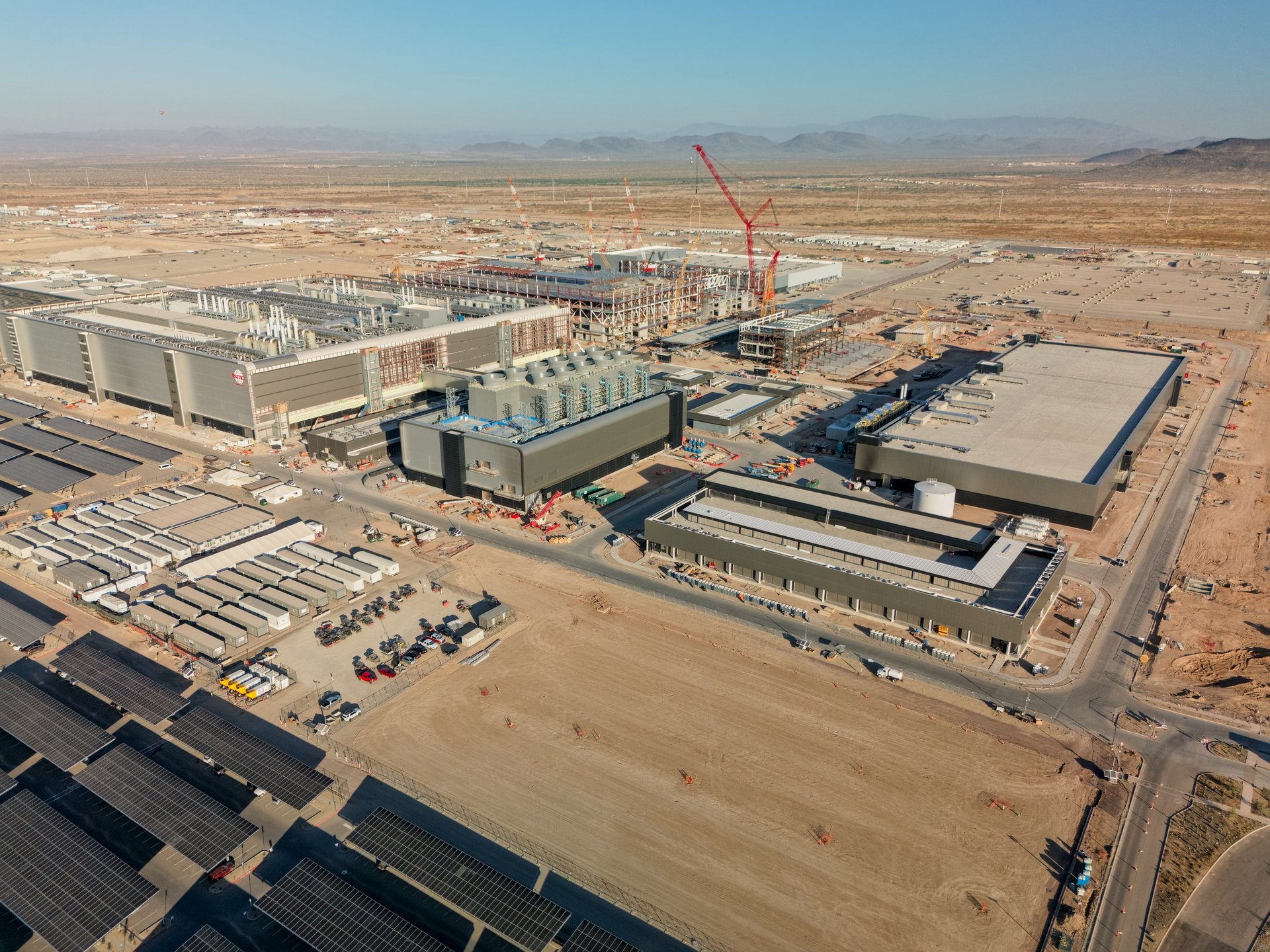
This concentration of strategic importance has driven TSMC to diversify geographically. A $12 billion fabrication plant in Phoenix, Arizona was announced in 2020 and expanded to a projected $35 billion multi-fab investment. A subsidiary named Japan Advanced Semiconductor Manufacturing opened in Kumamoto, Japan in 2024, jointly funded with Sony and Denso. A plant in Dresden, Germany is planned for 2029 through a joint venture with Bosch, Infineon, and NXP. The company that was born as a Taiwanese government project is now distributing its capabilities across three continents.
After the Founder
Morris Chang retired in 2018 after 31 years of leadership, handing the chairman role to Mark Liu and the CEO position to C. C. Wei. The transition tested whether TSMC's dominance was a product of Chang's personal genius or of the institutional machine he built. The answer came in the financial results: in January 2026, TSMC reported a 35 percent increase in fourth-quarter profit, driven by insatiable demand for artificial intelligence chips. The company that Chang built from a government mandate and a Philips partnership had become the indispensable manufacturer of the AI era.
The Hsinchu Science Park headquarters, where Chang once walked the fabrication floors, now anchors a company valued at over half a trillion dollars. Its fabs run around the clock, producing the silicon that powers smartphones, data centers, autonomous vehicles, and military systems. The blank check that Li Kwoh-ting offered Morris Chang in 1986 has been repaid many times over - not just to Taiwan's treasury, but to the global economy that TSMC's existence makes possible.
From the Air
TSMC's headquarters and primary fabrication facilities are located at 24.78°N, 121.01°E within the Hsinchu Science Park in Hsinchu City, northwestern Taiwan. The campus includes multiple large fab buildings (notably Fab 12 and Fab 15) identifiable from the air by their massive rectangular footprints and clean-room ventilation systems on the rooftops. Additional TSMC fabs are located at the Central Taiwan Science Park near Taichung. Hsinchu Air Base (RCPO) is approximately 5km west. Taiwan Taoyuan International Airport (RCTP/TPE) is about 50km north. The area is relatively flat industrial terrain on the Hsinchu coastal plain. Multiple TSMC facilities are visible as large, white-roofed buildings clustered in the eastern portion of the science park.