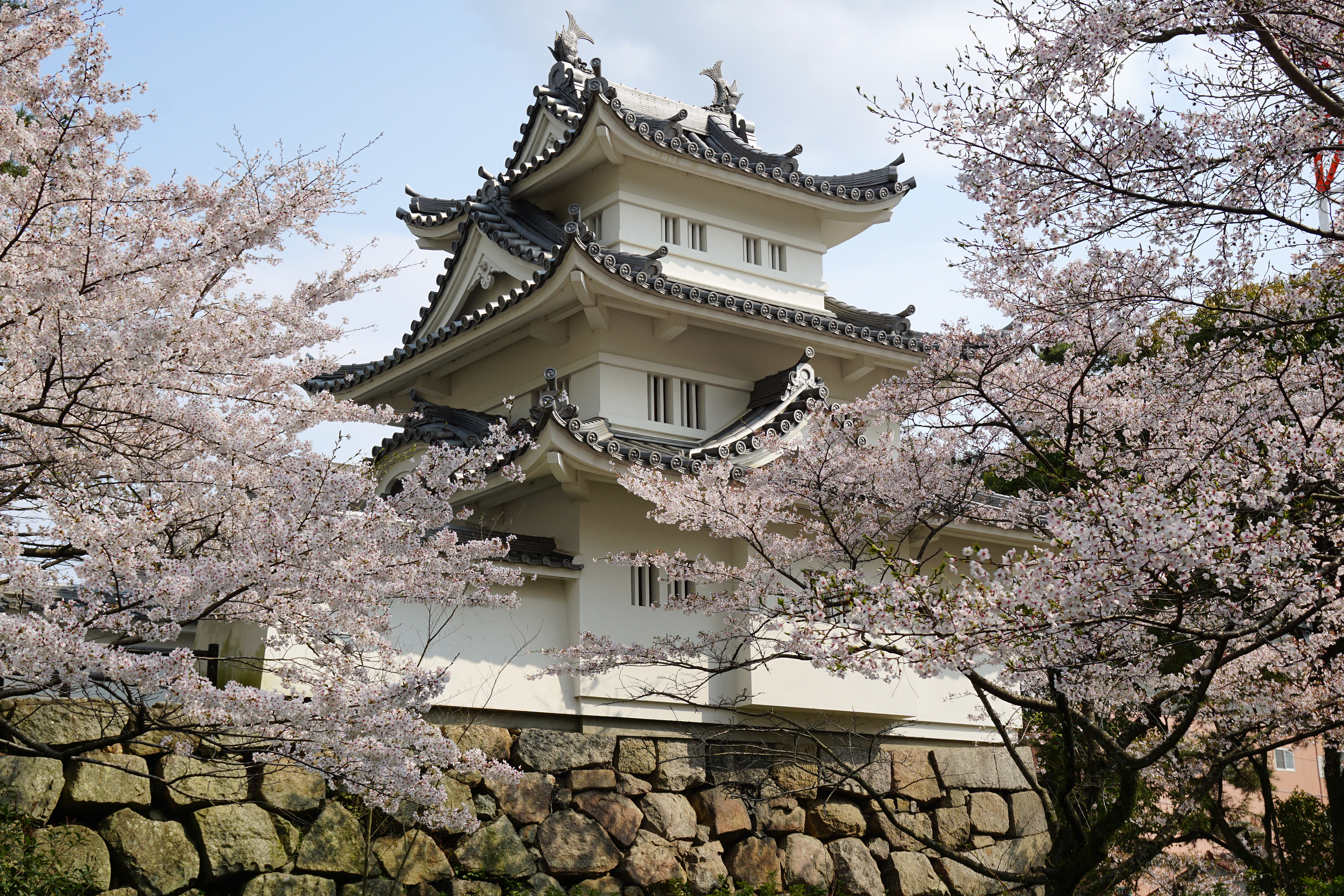
Tsu Castle
Thirteen hundred defenders held Tsu Castle against 30,000 attackers in the autumn of 1600 -- and won. The western armies under Mori Terumoto and Chosokabe Morichika burned most of the fortress around them, but Tomita Nobutaka and his wife Yuki no Kata refused to yield. Their stand during the Battle of Sekigahara earned the Tomita clan the shogunate's gratitude and a larger domain. Two and a half centuries later, Tsu Castle would make history again -- this time by betraying the shogunate entirely, defecting to the imperial forces at a pivotal moment in the Boshin War and helping bring down the Tokugawa order it had once defended.
Rivers for Moats
The castle began modestly in 1558 when Hosono Fujiatsu built a fortification at the junction of the Ano and Iwata rivers, using the waterways as natural moats. The port of Anotsu had once been a vital stop on Japan's eastern coastal trade routes, but an earthquake at the end of the 15th century destroyed the harbor, and commercial traffic gradually shifted to Kuwana and Matsusaka. Oda Nobunaga seized the castle in 1568 and installed his younger brother Oda Nobukane there in 1577 to lock down control of the Ise region. Under Nobukane, the castle expanded dramatically: primary, secondary, and third baileys were completed, crowned by a five-story tenshu and a secondary keep. When Toyotomi Hideyoshi consolidated power, Nobukane was transferred to Tanba Province and the castle passed to Hideyoshi's retainer Tomita Nobuhiro along with a 50,000-koku domain.
The Siege That Forged a Legacy
The Battle of Sekigahara in 1600 was the contest that decided Japan's future, and Tsu Castle became one of its fiercest side engagements. The Tomita clan sided with Tokugawa Ieyasu's eastern coalition. The western alliance responded by sending an overwhelming force against the castle. The attackers outnumbered the defenders by more than twenty to one. They burned structures, breached defenses, and pressed the garrison relentlessly. But Tomita Nobutaka and Yuki no Kata -- whose stand together was later immortalized in Tsukioka Yoshitoshi's woodblock prints -- held out long enough for Sekigahara's outcome to render the siege moot. The Tokugawa rewarded the Tomita's loyalty with increased revenues and helped them rebuild parts of the battered castle before transferring them to Uwajima Domain in Iyo Province in 1608.
The Master Builder's Touch
The clan that replaced the Tomita would define Tsu Castle for the next 260 years. The Todo clan arrived with Todo Takatora at their head -- a man widely regarded as the finest castle architect of his generation. Takatora had already helped design Edo Castle, Nagoya Castle, and Zeze Castle, among others. He renovated Tsu Castle with a three-story and a two-story tenshu, revitalized the castle town, and expanded the domain's revenues to 323,000 koku. The Todo ruled Tsu Domain, commanding both Ise and Iga provinces, until the end of the feudal era. When the tenshu burned in 1662, the Tokugawa shogunate denied permission to rebuild it -- a common restriction to keep domain lords from growing too powerful. A two-story yagura watchtower replaced the lost keep.
The Betrayal That Changed Japan
When the Boshin War erupted in 1868, Tsu Domain tried to stay neutral. That attempt collapsed after the Battle of Toba-Fushimi, when the domain abruptly defected to the Satcho Alliance and attacked the retreating shogunate forces. The shock of Tsu's betrayal -- from a domain that had been a Tokugawa loyalist since Sekigahara -- demoralized the shogunate's armies and helped the imperial forces secure a decisive advantage. Tsu Domain's troops marched in the vanguard of the imperial advance along the Tokaido road. After the Meiji Restoration, the new government ordered the castle dismantled in 1873. Moats were filled, buildings torn down, and the site passed through Imperial Army control before being sold back to former lord Todo Takakiyo in 1889. It became a city park. One corner yagura was reconstructed in 1958 -- though not as a faithful reproduction -- and the gate to the Japanese garden within the Inner Bailey survives from the domain's Edo-period han school. Tsu Castle was named to the Continued Top 100 Japanese Castles list in 2017.
From the Air
Located at 34.718N, 136.508E in central Tsu city, Mie Prefecture, at the confluence of the Ano and Iwata rivers. From the air, the castle site is identifiable by the remaining inner moat and green parkland amid the urban grid of Tsu. The city sits on the western shore of Ise Bay, with the Suzuka Mountains to the west. Nearest major airport: Chubu Centrair International Airport (RJGG), approximately 60nm northeast across the bay. Tsu-shimmachi Station on the Kintetsu Nagoya Line is visible nearby. Expect good visibility along the coastal Ise Plain.