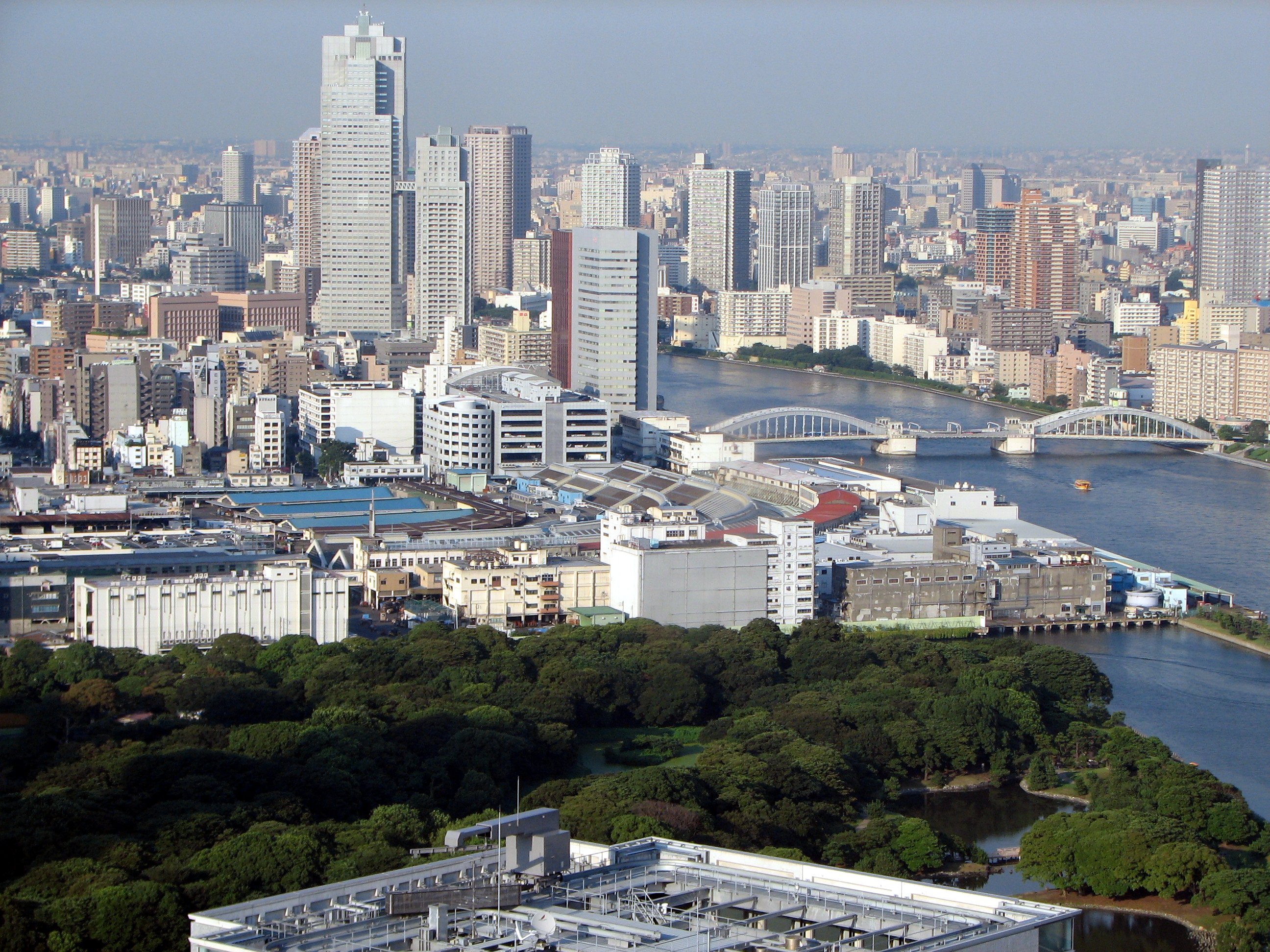
Tsukiji
The name tells the whole story if you know the kanji. Tsukiji -- 築地 -- means 'constructed land' or 'reclaimed land,' and every layer of this Tokyo district's history confirms it. The ground beneath your feet was once Sumida River marsh, filled in with rubble from a fire that destroyed two-thirds of a city. The temples that rose on this new earth were themselves burned and rebuilt. A foreign settlement was planted here, withered, and was absorbed back into the city. A naval academy trained officers for wars that hadn't been imagined yet, then relocated and left the buildings to a war college. And through it all, the fish kept arriving -- first to a nearby bridge, then to the world's largest seafood market, which operated here for 83 years before packing up and moving two miles across the harbor.
Ash into Earth
In 1657, the Great Fire of Meireki swept through Edo, destroying more than two-thirds of the city's buildings. The Tokugawa shogunate turned catastrophe into infrastructure, using earth from moat and canal excavations to systematically fill in the marshes along the Sumida River delta. The newly constructed ground became Tsukiji. Among the first structures relocated here was Hongan-ji, the massive Kanto headquarters of the Jodo Shinshu Buddhist sect, whose Asakusa temple had burned in the fire. Devotees from nearby Tsukudajima helped reclaim the land and rebuild their temple. Other temples followed, and samurai residences lined the district's southern edge. What had been river delta became a functioning neighborhood, its identity tied from the start to the act of making something from nothing.
Where the World Moved In
In 1869, the Meiji government designated Tsukiji as a foreign settlement, one of several treaty ports opened to Westerners after Japan's long isolation. Canals separated the district from the rest of Tokyo -- a deliberate buffer. But Tsukiji never rivaled Yokohama's thriving commercial settlement, opened a decade earlier. Instead, it became an unlikely campus. Keio University, Rikkyo University, Aoyama Gakuin, and the American School in Japan all established early facilities here. St. Luke's International Hospital set down roots that endure today. The United States legation occupied a site from 1875 to 1890, and ten other foreign legations followed. The Hoterukan, Tokyo's first Western-style hotel, opened in 1870 and became a favorite subject for woodblock print artists before burning down just four years later. Meanwhile, the Imperial Japanese Navy established its technical training facilities in Tsukiji in 1869, later renamed the Imperial Japanese Naval Academy in 1876 before relocating to Etajima in 1888.
The Fish Market Era
The Great Kanto earthquake of September 1, 1923, razed much of the district and destroyed the old Nihonbashi fish market across town. City planners relocated the market to Tsukiji, where it reopened in 1935 as a modern wholesale facility. Over the next eight decades, it grew into the largest seafood market on the planet, processing more than 2,000 tons of 450 varieties of fish daily and employing between 60,000 and 65,000 people. Anthropologist Theodore Bestor called it 'the market at the center of the world.' The inner wholesale market closed on October 6, 2018, its dealers transferring to the new Toyosu Market across the harbor. But the outer market -- the dense warren of sushi counters, knife shops, dried bonito vendors, and restaurant supply stores -- refused to leave. It remains one of Tokyo's premier culinary destinations, its narrow alleys still fragrant with grilled seafood and fresh wasabi.
Copper Tiles and Quiet Lanes
Beyond the tourist crowds at the outer market, Tsukiji reveals a quieter character. Side streets still feature older storefronts clad in copper tiles, a distinctive early Showa-period technique used for both weatherproofing and decoration that gives entire blocks a warm, oxidized green patina. The Sumida River's west bank offers a pedestrian promenade north of the Kachidoki Bridge. St. Luke's Garden, one of Tokyo's tallest building complexes, houses offices, a hotel, and long-term care facilities as part of the hospital campus that has anchored this district since the 1870s. Major Japanese companies -- the Asahi Shimbun newspaper, NTT Data, Shochiku film studio -- keep their headquarters here. The former market site, meanwhile, awaits its next transformation: in 2024, Tokyo announced plans for an entertainment and economic hub anchored by a new stadium for the Yomiuri Giants. Tsukiji's cycle of demolition and reinvention, it seems, never ends.
From the Air
Located at 35.668N, 139.774E in Tokyo's Chuo ward, along the west bank of the Sumida River where it nears Tokyo Bay. From the air, the district is identifiable by its position between the Ginza commercial district to the west and the river to the east, with the distinctive Kachidoki Bridge crossing the Sumida at the district's southern boundary. The cleared former fish market site is a prominent rectangular void in the dense urban fabric. Tsukiji Hongan-ji's Indian-influenced temple roof is visible among the surrounding modern buildings. Nearest major airport: Tokyo Haneda (RJTT), approximately 15 km south. Narita International (RJAA) lies 60 km to the east. Best viewed during approaches to Haneda over Tokyo Bay.