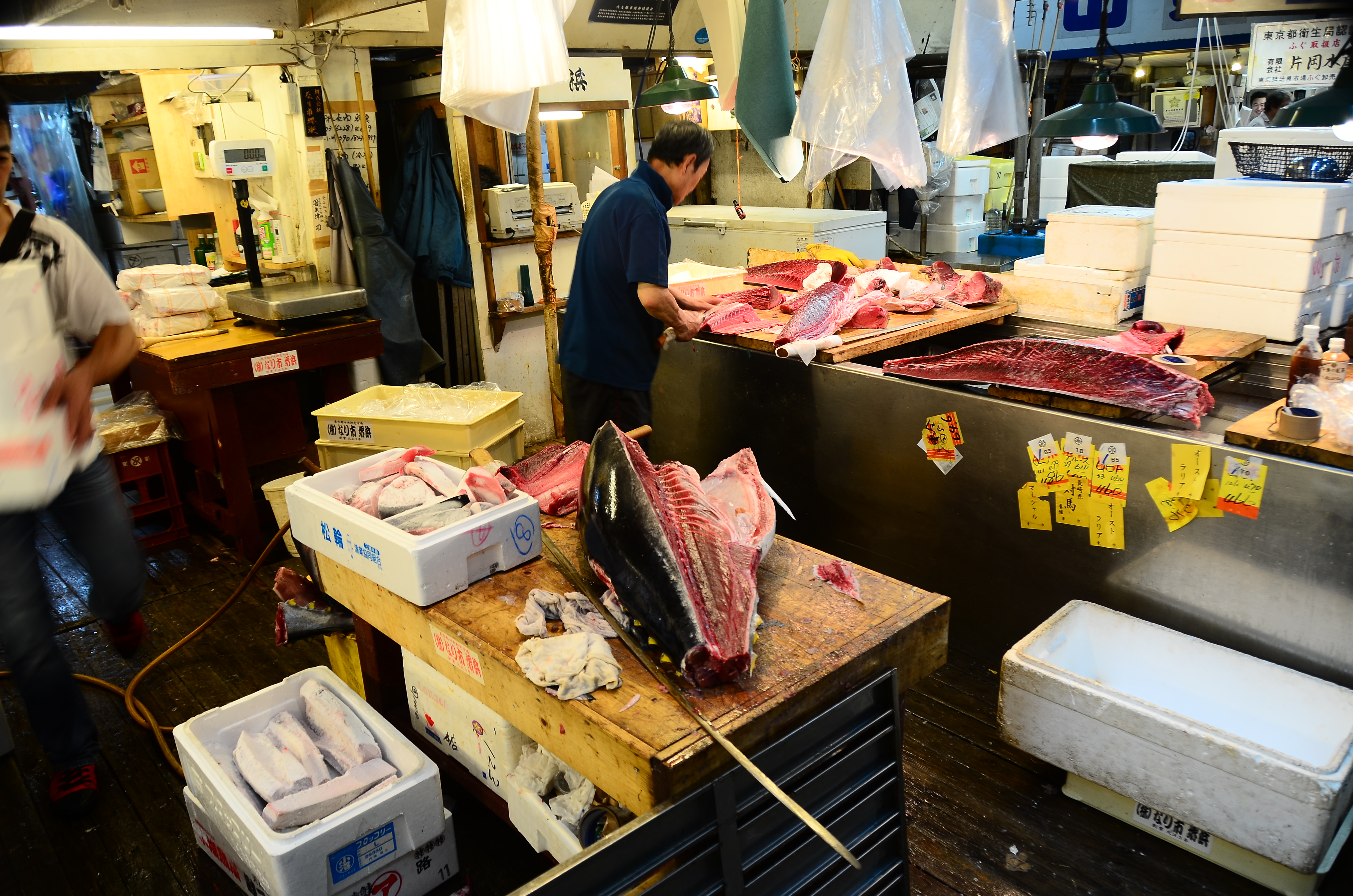
Tsukiji Fish Market
Every morning at 3 a.m., while the neon signs of the Ginza shopping district a few blocks away flickered off for the night, an entirely different economy roared to life. Trucks backed into loading bays. Frozen tuna, stiff as telephone poles and hauled from oceans halfway around the world, slid across wet concrete. Auctioneers warmed their voices. By 5:20 a.m., the bidding floor at Tsukiji fish market was a controlled frenzy -- 900 licensed dealers jostling, signaling, and shouting across rows of glistening bluefin laid out on the floor like silver ingots. For 83 years, this patch of reclaimed land between the Sumida River and central Tokyo was the pulsing heart of Japan's seafood supply chain, handling over 2,000 tons of 450 types of marine life every single day.
Built from Ruins, Twice Over
Tsukiji's story begins with the Great Fire of Meireki in 1657, which consumed two-thirds of Edo. The Tokugawa shogunate used the debris to fill in marshland along Tokyo Bay, literally constructing new ground -- tsukiji means 'reclaimed land' in Japanese. But the fish market itself came from a different catastrophe. For centuries, Tokyo's seafood trade operated at the Nihonbashi fish market, the uogashi or 'fish quay,' where fishermen brought by Tokugawa Ieyasu from Osaka in 1590 had sold their surplus catch near the castle. When the Great Kanto earthquake leveled much of central Tokyo on September 1, 1923, the Nihonbashi market was destroyed. City planners, who had already wanted the market out of the increasingly upscale business district, seized the moment. The relocation to Tsukiji took six years and 419,500 workers. It opened on February 11, 1935, as one of the biggest reconstruction projects in post-quake Tokyo.
The Theater of the Tuna Auction
The inner market operated like a tightly choreographed performance, repeated six days a week. Products arrived by ship, truck, and plane starting at 3 a.m. Auction houses -- oroshi gyosha -- inspected, graded, and arranged the day's offerings. Licensed buyers circulated through the rows, tapping frozen tuna with hooks, examining color and fat content through small core samples. The auctions began at 5:20 a.m., conducted through a system of rapid hand signals incomprehensible to outsiders. By mid-morning the purchased fish moved to the stalls, where it was butchered with specialized tools: frozen tuna cut with industrial band saws, and fresh specimens carved with maguro-bocho knives that stretched well over a meter long. The outer market, a maze of narrow lanes crammed with sushi counters, kitchen supply shops, and grocers, catered to both professionals and the public. By early afternoon, the whole complex fell silent.
Too Famous for Its Own Good
Tsukiji became one of Tokyo's top tourist attractions, which created a peculiar tension. The market was a working wholesale operation, not a theme park, and the growing flood of camera-wielding visitors disrupted the business that made the spectacle worth watching. Authorities repeatedly banned tourists from the pre-dawn tuna auctions -- in late 2008, again in late 2009, and once more in 2010. When access was restored, a cap of 120 visitors per day was enforced on a first-come, first-served basis. The March 2011 earthquake shut the viewing galleries entirely until July. Meanwhile, the market's aging infrastructure strained under decades of use. Facilities built in the 1930s struggled with post-war transaction volumes. Plans to relocate surfaced as early as the late 1950s, but stakeholder disagreements stalled every proposal for decades.
The Long Goodbye
The final move to the new Toyosu Market was supposed to happen in November 2016, timed for the Tokyo Olympics preparations. Then Governor Yuriko Koike froze the plan when soil tests at the Toyosu site revealed groundwater contamination far exceeding safety limits. A cleanup and additional water pumps resolved the issue, and Tsukiji's inner market finally closed on October 6, 2018, its businesses transferring to Toyosu over the following five days. The outer market, however, stayed put. Its sushi restaurants, knife shops, and dried goods vendors remain a culinary destination, drawing visitors who walk the narrow lanes between Ginza and the Sumida River. In April 2024, Tokyo announced the former inner market site would be redeveloped into an entertainment and economic hub centered on a new baseball stadium for the Yomiuri Giants -- another reinvention for land that has been constructed, destroyed, and rebuilt for nearly four centuries.
From the Air
Located at 35.661N, 139.770E in central Tokyo's Chuo ward, wedged between the Sumida River and the Ginza district. From the air, look for the distinctive rectangular footprint of the former inner market site (now a cleared lot awaiting redevelopment) along the river's west bank, just north of the Kachidoki Bridge. The outer market's dense cluster of low-rise buildings remains visible to the northwest. Nearest major airport: Tokyo Haneda (RJTT), approximately 15 km south. Narita International (RJAA) lies 60 km to the east. Best viewed at low altitude over Tokyo Bay on approach to Haneda's runways.