Tsukiji Hongan-ji
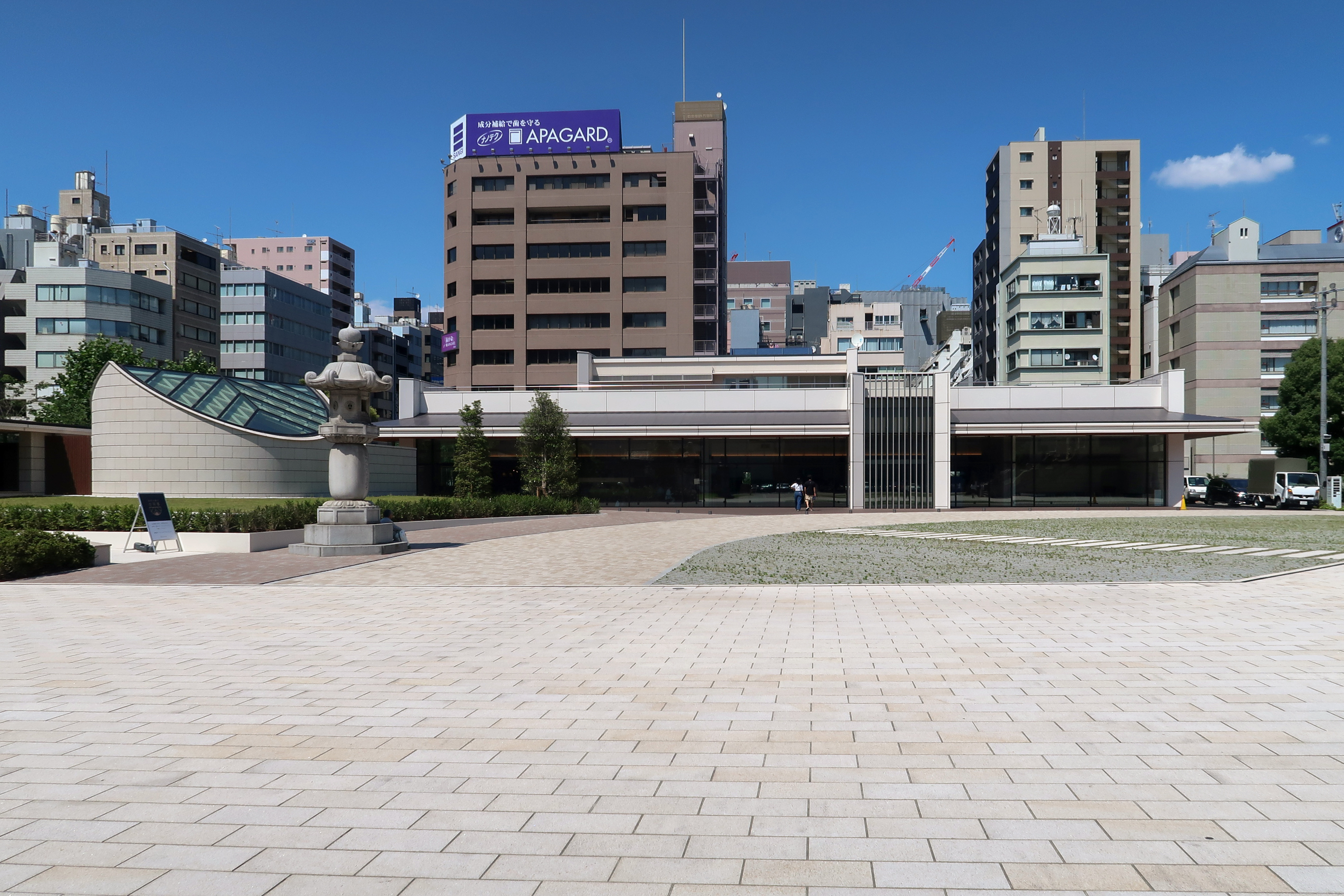
Step off the Tokyo Metro at Tsukiji Station expecting the usual Japanese temple silhouette -- curved wooden eaves, paper screens, a courtyard of raked gravel -- and Tsukiji Hongan-ji delivers a shock. The building that rises across the street looks transplanted from the Indian subcontinent: a heavy stone facade, stupa-capped towers flanking a central hall, and a roofline shaped like a Bodhi tree leaf containing a lotus flower. Stained glass glows above the entrance. A pipe organ sits inside. This is one of the most architecturally singular Buddhist temples in all of Japan, a reinforced concrete monument to one architect's conviction that Japanese Buddhism had forgotten where it came from.
From Asakusa to Reclaimed Land
The temple's lineage stretches back to 1617, when the 12th monshu Junnyo Shonin ordered the construction of Edo-Asakusa Gobo, a Jodo Shinshu temple in Tokyo's Asakusa district. It stood for exactly 40 years before the Great Fire of Meireki in 1657 burned it to the ground along with two-thirds of Edo. The shogunate refused to let the temple rebuild in Asakusa, citing a competing project on the site. Instead, the Jodo Shinshu community was directed to newly reclaimed marshland along the Sumida River -- land that devotees from nearby Tsukudajima had helped fill in themselves. The relocated temple, called Tsukiji Gobo, took its name from the district: tsukiji, meaning 'constructed land.' It served as the Kanto regional headquarters of the Jodo Shinshu sect for over 250 years, until the Great Kanto earthquake of 1923 leveled it completely.
Ito Chuta's Grand Obsession
The man tasked with designing the replacement was Ito Chuta, a University of Tokyo professor and one of Japan's most celebrated architects. Ito had spent years traveling across Asia, sketching Buddhist architecture in India, China, and Turkey, tracing the religion's visual language back toward its origins. For Tsukiji Hongan-ji, built between 1931 and 1934, he created a deliberate fusion: the central worship hall's barrel-vaulted roof echoes the rock-cut Buddhist caves at Ajanta in India, while stupas crown the flanking towers. But the building is not a replica of anything. Ito layered in Western elements -- stained glass windows, a marble interior, a full pipe organ -- alongside Japanese construction techniques, all rendered in earthquake-resistant reinforced concrete. The result is a building that belongs to no single tradition, a physical argument that Buddhism's architectural heritage spans continents.
Pilgrims and Rock Stars
Tsukiji Hongan-ji remains an active Jodo Shinshu temple and pilgrimage site. Devotees come to venerate artifacts associated with Prince Shotoku, the sixth-century regent who championed Buddhism's spread in Japan, and Shinran Shonin, the thirteenth-century monk who founded the Jodo Shinshu school. Enshrined to the left of the main altar is Shonyo Shonin, the 23rd monshu, who was born in 1911, served as Chief Abbot from 1927 to 1977, and dedicated his tenure to spreading Jodo Shinshu teachings internationally before his death in 2002. But the temple also holds a more unexpected memorial. In 1998, the funerary ceremony for Hideto Matsumoto -- the rock guitarist known to millions as hide, former lead guitarist of the band X Japan -- drew tens of thousands of mourning fans to Tsukiji Hongan-ji. A permanent memorial to him now sits inside the main hall, an unlikely fixture in a 400-year-old Buddhist institution that somehow fits perfectly in a building designed to defy expectations.
From the Air
Located at 35.666N, 139.772E in Tokyo's Tsukiji district, adjacent to Tsukiji Station on the Tokyo Metro Hibiya Line. From the air, look for the distinctive non-Japanese temple profile -- the building's Indian-influenced silhouette with stupa towers stands out sharply among the surrounding modern commercial buildings. Situated just northwest of the former Tsukiji fish market site, near the Sumida River. Nearest major airport: Tokyo Haneda (RJTT), approximately 15 km south. Narita International (RJAA) lies 60 km east. Best spotted at lower altitudes when flying over central Tokyo's Chuo ward.