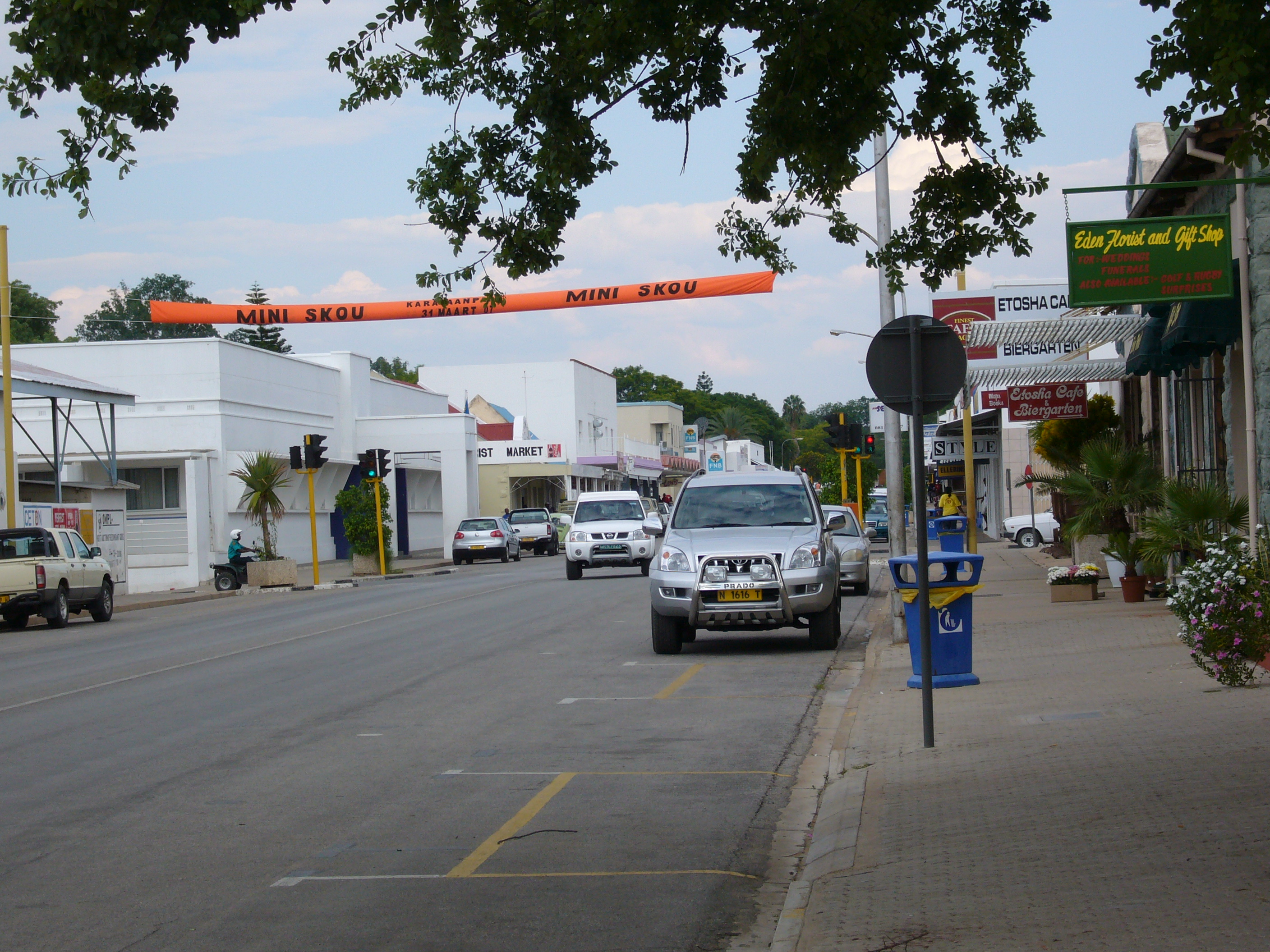
Tsumeb
Pronounced "SOO-meb," the name likely comes from the Nama language and means either "place of the moss" or "place of the frog." Both translations hint at something green, which is fitting: before mining began, a massive natural hill of green oxidized copper ore stood here, visible proof that something extraordinary lay beneath the surface. Founded in 1905 by German colonial authorities, Tsumeb is a town of about 35,000 people in Namibia's Oshikoto Region, known as the "gateway to the north" and the closest town to Etosha National Park. But the real draw for scientists and mineral collectors is underground -- a mineralized pipe that the International Union of Geological Sciences has listed among the 100 geological heritage sites on the planet.
The Pipe
Tsumeb's mineralized pipe is a geological argument that has never been fully settled. It penetrates more or less vertically through Precambrian Otavi dolomite for at least 1,300 meters. One theory holds it was a gigantic ancient cave system, slowly filled with sand that seeped in from above over geological time. Others argue for a volcanic origin, though the rock filling the pipe -- known as the "pseudo-aplite" -- is peculiar enough to make volcanologists uneasy. Prehistoric miners scratched at the surface of the deposit. The 20th century went deeper, extracting millions of tonnes of polymetallic ore that yielded copper, lead, silver, gold, arsenic, and germanium. Some of the ore was so rich it bypassed the enrichment plant entirely, shipped straight to the smelter as "direct smelting ore." At least 243 mineral species have been cataloged from Tsumeb, with 56 first described here. Twenty of those minerals exist nowhere else on Earth.
Crystals and Collectors
For mineral collectors, Tsumeb is a name that needs no introduction. The unique germanium minerals alone -- germanite, krieselite, ovamboite, and others -- are found only in this mine. Gem-quality dioptase crystals, enormous azurite clusters once offered for six-figure prices, cerussite crystals with visible growth zoning, malachite pseudomorphs after azurite: these specimens fill museum cases worldwide. The concentration of rare secondary minerals reflects a sulfide deposit rich in many metals, leached and redeposited by oxygen-rich groundwater into crystalline formations of extraordinary variety. In October 2022, the IUGS formally recognized the Tsumeb Ore Deposit as one of its geological heritage sites, calling it one of the richest ore deposits in the world with respect to variety, rarity, and aesthetics of minerals.
Bottomless Lakes
Near Tsumeb sit two sinkhole lakes, Lake Otjikoto and Lake Guinas, whose true depths no one has measured. Both lakes disappear into lateral cave systems at their bottoms, making it impossible to sound them with a weighted line. Otjikoto is at least 60 meters deep but murky from agricultural runoff. Guinas, about 175 meters in diameter, holds water so clear that divers descending to 80 meters have reported nothing below them but powdery-blue emptiness. Guinas has existed long enough for a unique fish species, Tilapia guinasana, to evolve in its waters. Otjikoto holds a different kind of secret: when South African forces invaded German Southwest Africa in 1914, the retreating Germans dumped their weaponry and supplies into its deep water. Some of this materiel has since been recovered for museum display. A third body of water, one of the world's largest underground lakes, lies on a nearby farm called Harasib. Reaching it requires either rappelling or descending an ancient hand-forged ladder that hangs free of the cave walls for over 50 meters.
The Price of Extraction
Mining has defined Tsumeb since its founding, but that definition cuts both ways. The Tsumeb mine was originally owned by the German OMEG company, later by Tsumeb Corporation Limited, and has changed hands several times since the ore at depth ran out and the deepest shafts flooded. The town's metal smelter, long the biggest employer, has left a legacy that lingers: widespread soil contamination with arsenic and heavy metals. Hair samples from the local population show massive arsenic exposure. An estimated 300,000 tonnes of arsenic waste sit in a landfill -- one of the largest such accumulations in the world. From 1971 to 1972, the mine's operations halted during the Namibian contract workers' strike, when laborers protested the contract labor system and apartheid. Tsumeb's story is not only one of geological wonder but of the human cost that wonder has exacted.
From the Air
Located at 19.25S, 17.72E in northern Namibia. Tsumeb Airport (FYTM) is an airstrip east of town. The town is visible from altitude as a compact urban area surrounded by rolling thorn-bush hills. The smelter complex and mine infrastructure are identifiable landmarks. Lake Otjikoto lies northwest of town and is visible as a dark circular feature. Etosha National Park is to the northwest. Best viewed at 3,000-6,000 ft AGL for town detail.