Tsurphu Monastery
The walls were four meters thick and the complex stretched three hundred meters on each side. At 4,300 meters in the Dowo Lung Valley, 70 kilometers from Lhasa, Tsurphu Monastery was built to endure. It has endured -- but not continuously, and not in the form its founders intended. The traditional seat of the Karmapa, head of the Karma Kagyu lineage of Tibetan Buddhism, Tsurphu has been founded, destroyed, rebuilt, destroyed again, and rebuilt once more. Its most famous recent resident fled in the middle of a winter night in the year 2000.
The Karmapa's Seat
In 1159, Dusum Khyenpa, the 1st Karmapa Lama, visited this site in what is now Doilungdeqen District and made offerings to the local protectors -- the dharmapalas and territorial divinities who, in the Tibetan Buddhist worldview, must be honored before any sacred building can take root. He returned thirty years later, in 1189, and established his main seat here. The monastery grew to hold 1,000 monks. The Karmapa lineage claims to be the oldest system of recognized reincarnation in Tibetan Buddhism, predating even the Dalai Lama lineage by several centuries. Tsurphu became the physical center of that tradition, the place where each new Karmapa was enthroned and from which the Karma Kagyu school's authority radiated across Tibet and into Mongolia.
A Valley Fortress
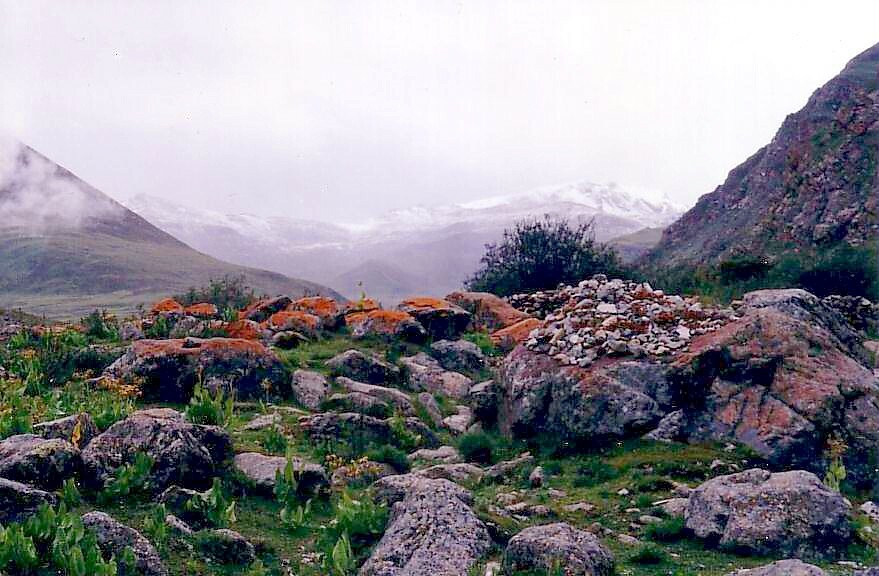
The geography of Tsurphu is defensive by nature. High mountains surround the complex on three sides, and the monastery faces south into the valley, catching whatever warmth the Tibetan plateau offers. The original main building had walls four meters thick enclosing an area of 90,000 square meters -- closer in scale to a small fortress than a typical monastery. The monks' residences occupied the eastern wing. Nomad camps dotted the slopes above, their juniper fires sending fragrant smoke across the valley during ceremonies. Even today, the Dowo Lung Valley above Tsurphu feels remote, a landscape of rock and thin air where yak herders move across hillsides that have barely changed since the 12th century.
Destroyed and Reborn
In 1966, during the Cultural Revolution, the complex was totally destroyed. Not damaged, not partially dismantled -- totally destroyed. What had taken centuries to build was reduced to rubble in months. The 16th Karmapa, Rangjung Rigpe Dorje, who had fled Tibet years earlier, began the reconstruction from exile in 1980. He died the following year, in 1981, never seeing the work completed. The rebuilding continued in stages. Pilgrims who visited in 1993 found a partially reconstructed monastery surrounded by the debris of the original, nomad tents still visible on the ridgelines above. The scale of what was lost is hard to comprehend -- and the scale of what has been rebuilt, stone by stone, is equally difficult to take in.
The Escape of the 17th Karmapa
Ogyen Trinley Dorje, born in 1985, was recognized as the 17th Karmapa by the Tai Situpa, the Dalai Lama, and -- unusually -- China's governmental offices. He was enthroned at Tsurphu and resided there through his childhood and adolescence. Then, in late December 1999, the fourteen-year-old left. The details of his departure from Tibet to India, completed by early January 2000, became one of the most talked-about escapes in modern Tibetan history. His departure left Tsurphu without its principal figure. The monastery remains active, but the absence of the Karmapa -- a living symbol of the lineage's continuity -- is felt in ways that go beyond the merely administrative.
What Remains in the Valley
Tsurphu today is a place of partial restoration and ongoing devotion. Monks chant in rebuilt halls. Elderly pilgrims circumambulate the complex as they have done for centuries. The valley above the monastery stretches toward peaks that carry snow year-round. A branch monastery, Jang Tana in Nangchen, Kham -- itself founded in 1068, nearly a century before Tsurphu -- is considered part of the same network. The lineage persists in exile as well, with the Karmapa based in India. But the physical seat remains here, in the Dowo Lung Valley, 70 kilometers west of Lhasa, at an altitude where breathing requires conscious effort and where eight centuries of religious history are inscribed in stone walls that have been raised, torn down, and raised again.
From the Air
Tsurphu Monastery sits at 29.73°N, 90.58°E in the Dowo Lung Valley, Doilungdeqen District, about 70 km west-northwest of Lhasa. Elevation approximately 4,300 m (14,100 ft). The nearest major airport is Lhasa Gonggar Airport (ZULS), roughly 100 km to the southeast. The monastery complex is visible as a cluster of white-walled buildings nestled in a south-facing valley surrounded by high mountains. Look for the valley extending north from the Tolung Dechen area.