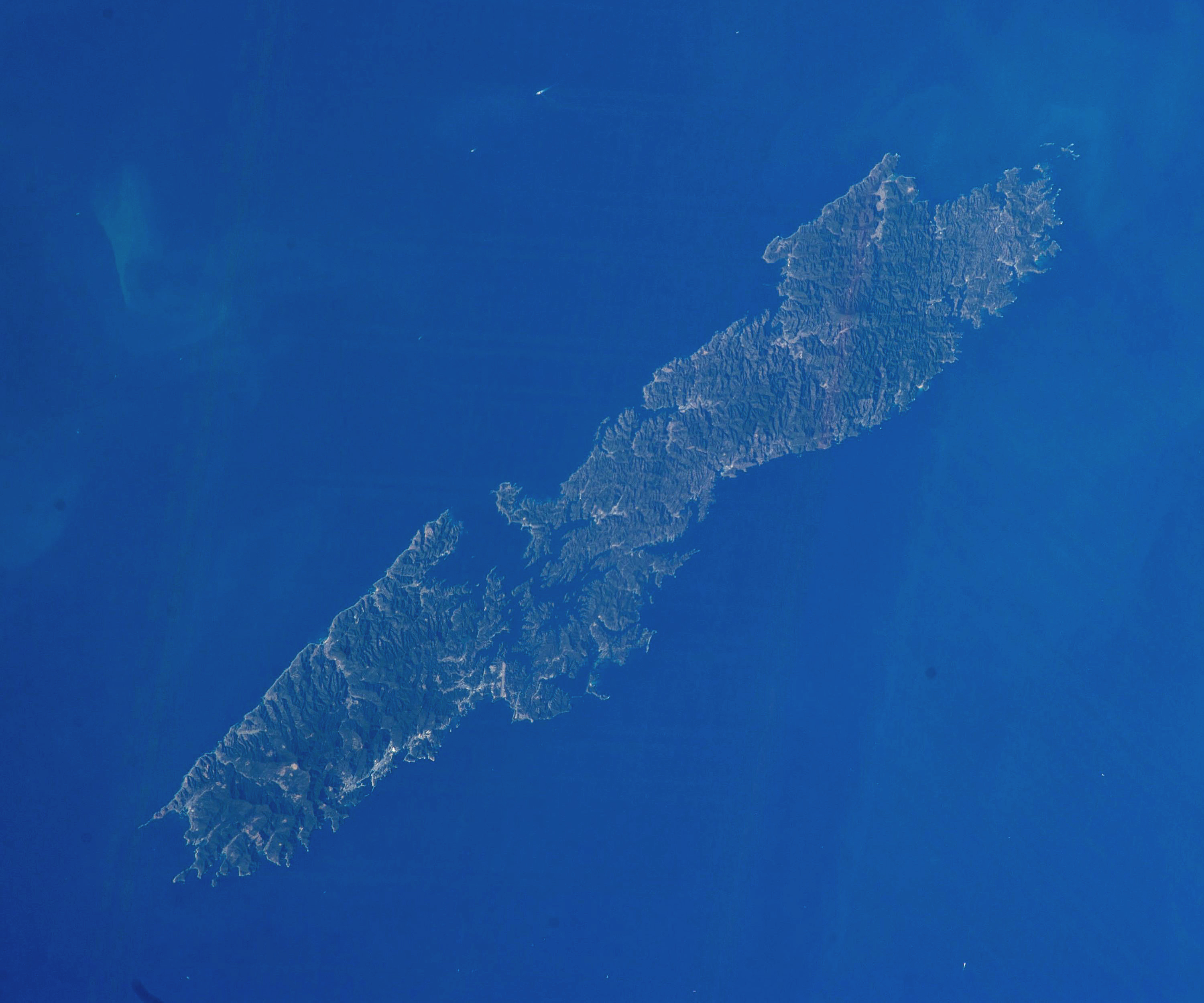
Tsushima Island
Look at a map of the Korea Strait and Tsushima appears as a stepping stone, the obvious waypoint between the Japanese archipelago and the Korean Peninsula. For centuries, that is exactly what it was. Diplomats, traders, invaders, and refugees all passed through this mountainous, forested island, and the people of Tsushima built a culture defined by the tension between two great civilizations pressing from either side. Today, with a population of about 28,500 and forests covering ninety percent of its surface, the island feels remote from both nations it once connected.
The Wildcat's Island
Tsushima's ecology reads like a crossroads of Asian wildlife. The Tsushima leopard cat, a critically endangered subspecies, stalks the island's forests alongside Japanese martens and Siberian weasels. Otters, thought to have vanished from the island entirely, were rediscovered living on Tsushima in February 2017. Hawks, harriers, eagles, and black-throated loons stop over during migration, and BirdLife International has designated the islands an Important Bird Area for their populations of Japanese wood pigeons and Pleske's grasshopper warblers. The Tsushima pitviper, a venomous snake found nowhere else on Earth, adds to the island's biological distinctiveness. Perhaps most remarkably, the bay between Tsushima and Iki Island contains the northernmost coral reef in the world, dominated by cool-tolerant Favia corals but increasingly colonized by tropical Acropora species, a living gauge of rising ocean temperatures.
Bridge Between Empires
Tsushima's strategic position made it impossible to ignore. The So clan governed the island for centuries, maintaining careful diplomatic relations with both Japan and Korea. When Toyotomi Hideyoshi launched his invasions of Korea in 1592, his armies staged through Tsushima, and the island bore the consequences of that proximity to conflict. In 1274 and 1281, Mongol invasion fleets struck Tsushima before crossing to mainland Japan, leaving devastation in their wake. But the island's most famous naval engagement came in May 1905, when Admiral Togo Heihachiro's Imperial Japanese Navy destroyed the Russian Baltic Fleet in the Tsushima Strait during the Russo-Japanese War. The battle, one of the most decisive naval engagements in modern history, cemented Japan's emergence as a world power and turned the strait into a name known to military strategists worldwide.
Ninety Percent Forest
Stand anywhere on Tsushima and you are likely surrounded by trees. The island's terrain is almost entirely mountainous, with peaks reaching up to 649 meters at Mount Yatate, and the few plains that exist are narrow strips along river valleys. Forests of broad-leafed evergreens, conifers, and deciduous trees blanket the slopes, with Yoshino cherry and Chionanthus retusus among the notable species. The island is actually two main landmasses connected by a narrow isthmus that was canalized in the early modern period, creating what appears from the air as a single island split by a thin channel. Honey production thrives here, with the island's abundant wild bee populations supporting a commercial industry. The dense forest cover and limited flat ground have kept development concentrated in a few coastal towns, leaving much of the interior as wild as it was centuries ago.
Between Two Shores
Tsushima sits closer to South Korea than to mainland Japan: roughly 50 kilometers from Busan versus 132 kilometers from Fukuoka. This proximity shaped the island's modern identity in unexpected ways. Korean tourists, drawn by the short ferry ride from Busan, once outnumbered Japanese visitors, creating a tourism economy oriented toward Seoul rather than Tokyo. The island's shrines, hiking trails, and seafood restaurants adapted to serve Korean tastes alongside Japanese traditions. But Tsushima remains unmistakably Japanese in governance, culture, and daily life. Its population has declined nearly two percent between 2015 and 2022, with over a third of residents aged 65 or older, a demographic pattern common to rural Japanese islands. The young leave for cities on the mainland. The forests grow a little thicker each year. And the strait that made Tsushima important continues to churn between two nations, just as it has for millennia.
From the Air
Located at 34.42°N, 129.33°E in the Korea Strait between Japan and South Korea. The island is approximately 50 km from Busan, South Korea and 132 km from Fukuoka, Japan. Tsushima appears from altitude as two mountainous, heavily forested landmasses connected by a narrow isthmus. Nearest airports include Tsushima Airport (RJDT) on the island itself and Fukuoka Airport (RJFF) on the Japanese mainland. The island is roughly 70 km long and varies between 5-18 km wide.