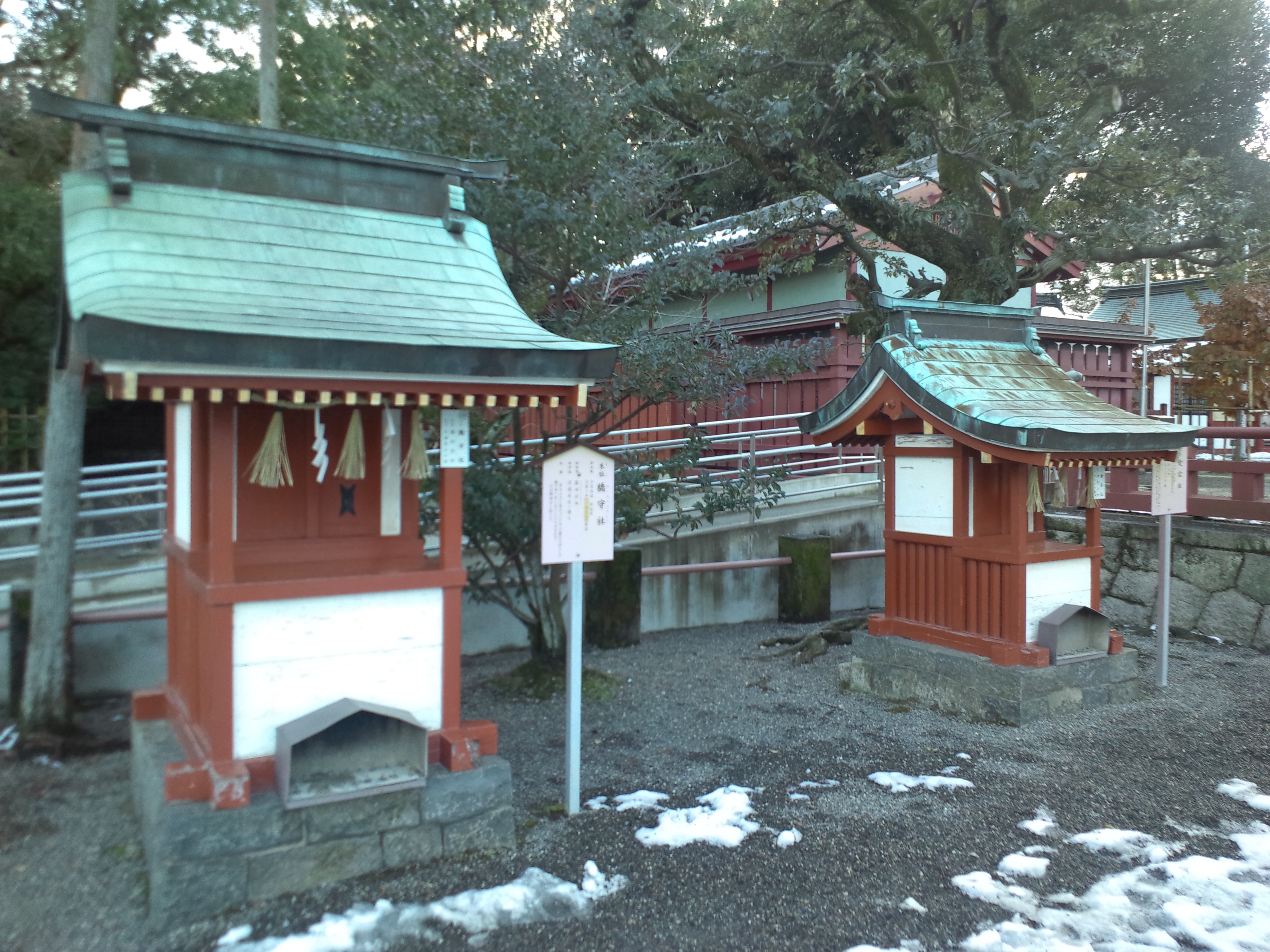
Tsushima Shrine
Every July, five boats glide down the Tenno River in Tsushima, each bearing a dome of 365 paper lanterns, one for every day of the year, their amber glow trembling on the black water while fireworks crack overhead. This is the Owari Tsushima Tenno Festival, a spectacle so magnificent that the warlord Oda Nobunaga considered it his favorite celebration and once tried to replicate it near his castle in Kyoto. The festival has been running for roughly 600 years, but the shrine that hosts it is far older. Tsushima Shrine, founded in 540 CE during the reign of Emperor Kimmei, stands as the head of approximately 3,000 branch shrines scattered across Japan, making it the center of the tenth-largest shrine network in the country and one of the most important sites of the Gozu Tenno cult.
The God Who Crossed the Sea
Shrine legend traces its origins to the semi-legendary Emperor Korei, who is said to have established the original shrine in Tsushima to worship Gozu Tenno, a deity of pestilences. According to tradition, the god's aramitama, its fierce and violent spirit, remained at the great Izumo Taisha shrine, while its nigemitama, the calm and benevolent aspect, journeyed to Japan from the Korean peninsula, stopping at Tsushima Island in the strait between Korea and Japan before continuing to its final home. The shrine relocated to its current site in what was then Owari Province in 540 CE. This migration story may explain the connection between the shrine and its island namesake. Over the centuries, the kami worshipped here merged with Susanoo, the storm god of Japanese mythology, and the shrine became closely linked to the broader Gion faith, making it a spiritual cousin to Kyoto's famed Yasaka Shrine.
Warlords and Wooden Gates
Tsushima Shrine attracted the devotion of Japan's most powerful figures during the feudal era. Oda Nobunaga, the first of the three great unifiers of Japan, worshipped the shrine's deity as his personal guardian. Toyotomi Hideyoshi, Nobunaga's successor, donated a two-story Romon gate to the shrine, completed in 1591. This imposing gate was designated an Important Cultural Property by the Japanese government in 1954. Hideyoshi's son Toyotomi Hideyori contributed the shrine's South Gate, while Matsudaira Tadayoshi donated the Main Hall, which is now recognized as a prefectural cultural property. Each contribution layered the shrine with the architectural ambitions of Japan's most consequential leaders, turning Tsushima into a living record of Sengoku-era patronage.
Rivers of Light
The Owari Tsushima Tenno Festival is considered one of Japan's three great river festivals and was designated a UNESCO Intangible Cultural Heritage. The celebration unfolds over two days, beginning on the fourth Saturday of July. During the evening Yoi Matsuri, five large Makiwara boats, each constructed by binding two vessels together with purified straw ropes, are launched onto the Tenno River. Each boat carries approximately 400 paper lanterns arranged in a dome that rises above the deck. The dome holds 365 lanterns for the days of the year, with 12 or 13 additional lanterns standing above in an antenna-like formation, and 30 red lanterns glowing beneath. As the boats drift through the darkness, traditional flute music drifts across the water and fireworks burst overhead. The five boats represent the five former villages that composed Tsushima. The following morning, the Asa Matsuri, the same boats reappear transformed, redecorated with elaborate red, black, and gold hand-woven tapestries and fitted with Karakuri Ningyo mechanical dolls dressed in Noh theater costumes.
A Network Spanning the Nation
What sets Tsushima Shrine apart from thousands of other Shinto sites is its role as the head of a vast network. Centered primarily in the Tokai region but extending across the country, approximately 3,000 Tsushima-affiliated shrines form the tenth-largest shrine network in Japan. All share the worship of Gozu Tenno and Susanoo, deities associated with protection from disease and misfortune. The shrine ranks on par with Kyoto's Yasaka Shrine in the hierarchy of Tennosha shrines. Today, visitors find the shrine grounds peaceful, shaded by ancient trees in the center of modern Tsushima city, with free admission and parking. But beneath that quiet surface lies a spiritual infrastructure that has connected communities across Japan for nearly fifteen centuries.
From the Air
Located at 35.178N, 136.719E in Tsushima, Aichi Prefecture, on the Nobi Plain west of Nagoya. The shrine grounds are situated near the Tenno River, which features prominently during the July Tenno Festival. Nearest airports: RJNA (Nagoya Airfield/Komaki, ~20 nm northeast), RJGG (Chubu Centrair International, ~40 nm south). Best viewed at 2,000-4,000 ft AGL. The surrounding flat agricultural plain makes the river and shrine complex identifiable from above.