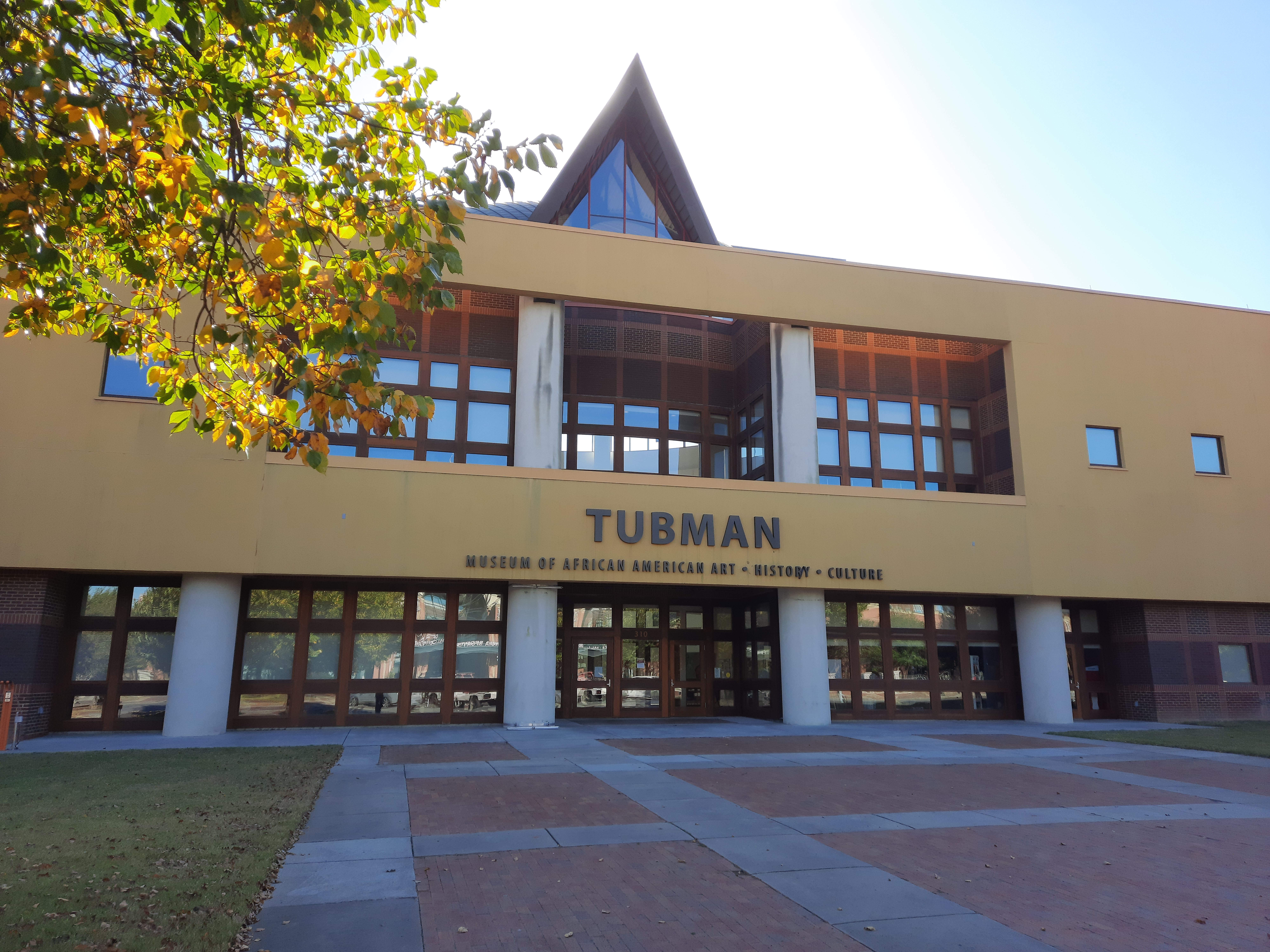
Tubman Museum
A Catholic priest walked into a bank in Macon, Georgia, in 1981, personally signed for a loan, and made the down payment on a building on Walnut Street. He had no board approval, no institutional backing, no guaranteed donors. What the Reverend Richard Keil had was a conviction formed over two decades of ministry in predominantly Black churches across the South: that Macon, with its central location and interstate access, was the right place for a museum honoring African American art, history, and culture. The building he bought that day would become the Tubman Museum, named for Harriet Tubman, and it would grow into the largest institution of its kind in the Southeast.
A Priest's Gamble
Keil was not acting on impulse. Assigned to St. Peter Claver Church in Macon, he spent years consulting with African American community leaders before taking action. When he found the Walnut Street building, he moved fast, confident that others would contribute once the project was real. And they did. High school principal Gloria Washington offered guidance. Mercer University professor Bobby Jones lent academic credibility. Contractor and county commissioner Albert Billingslea, along with his wife Margaret, provided practical support. Pearlie and John T. Oliver -- a bank vice president and state government official -- brought financial connections. Maureen Walker, then director of the Ruth Hartley Mosley Center, encouraged Keil to go for it. As Keil later wrote in his 2015 book "Lessons along the Way," the museum emerged from a web of community relationships, not from a single visionary acting alone.
From 8,500 to 49,500 Square Feet
For over three decades, the Tubman Museum operated from its original 8,500-square-foot building at the corner of Dr. Martin Luther King, Jr., Drive and Walnut Street. By 2001, the board of directors recognized the collection had outgrown its home and broke ground on a new facility. Then reality intervened. The economic downturn of 2007-2008 stalled construction, and the project languished for years. The old building finally closed on April 10, 2015, with a farewell party held six days later. On May 16, 2015, during Macon's Pan-African Festival, the new 49,500-square-foot museum opened its doors on Cherry Street, directly across from the Georgia Sports Hall of Fame and in front of historic Terminal Station. The ceremony included a march from the old building to the new one, a procession that traced the museum's journey from humble storefront to major cultural institution.
From Africa to America
Inside the new building, the centerpiece is a mural by contemporary Macon artist Wilfred Stroud titled "From Africa to America," which chronicles the African American experience beginning in 1619. The museum's galleries rotate through exhibitions that range from national touring shows to deeply local stories. "I Dream a World: Portraits of Black Women Who Changed America" has graced its walls, as has "Sankofa: A Century of African American Expression in the Decorative Arts." Permanent collections include an Inventors Gallery, a Local History wing, Folk Art displays, and a gallery dedicated to Black Artists of Georgia. The museum also functions as an educational center, offering classes in dance, drama, drumming, photography, and visual art, all grounded in African American cultural traditions. Students from kindergarten through college pass through its doors for programs designed to connect them with a heritage that textbooks often abbreviate.
Macon's Museum District
The Tubman Museum does not stand alone. It anchors a stretch of downtown Macon that has become a genuine museum district, sitting near the former site of the Georgia Music Hall of Fame and alongside the Georgia Sports Hall of Fame. This clustering is no accident. Macon occupies the geographic center of Georgia, a crossroads city where Interstate 75 meets Interstate 16, making it reachable from Atlanta, Savannah, and everywhere between. That accessibility was part of Keil's original vision -- a museum placed not in a major metropolis but in a city that the entire state could reach. The result is a cultural anchor that draws visitors into a part of Macon's story that might otherwise go untold, housed in a building six times larger than the one a priest bought on faith four decades ago.
From the Air
The Tubman Museum sits at 32.834N, 83.625W in downtown Macon, Georgia, on Cherry Street across from the Georgia Sports Hall of Fame. From the air, downtown Macon is identifiable by the Ocmulgee River to the east and the convergence of Interstate 75 and Interstate 16. The museum is in the cluster of large buildings on the western edge of the downtown core. Nearest airports: Middle Georgia Regional Airport (KMCN) approximately 8nm south, Herbert Smart Downtown Airport (KMAC) about 3nm east, and Robins Air Force Base (KWRB) roughly 12nm south.