Tucson Museum of Art
The oldest house on the museum campus predates Arizona statehood by 64 years. The Cordova House, its thick adobe walls first rising in 1848, now serves as a pottery school where students shape clay just as O'odham peoples did in this same river valley centuries before European contact. This unlikely pairing -- territorial-era architecture repurposed for contemporary art education -- captures everything essential about the Tucson Museum of Art and Historic Block. On four acres in Tucson's Presidio District, the museum stitches together 3,000 years of human creativity, from Mesoamerican ceremonial vessels to paintings by Jasper Johns, all anchored by the physical remnants of the city's Spanish colonial past.
From Women's Club to Western Art Powerhouse
The museum began modestly on March 20, 1924, when members of the Tucson Women's Club and 50 other citizens established the Tucson Fine Arts Association. For its first three years, the organization operated as little more than a gallery space with monthly lectures. The move to the Temple of Music and Art in 1927 signaled greater ambitions. By 1941, the association was presenting exhibitions by Maynard Dixon, the painter who had spent decades capturing the American Southwest on canvas. A 1947 show called A New Look at Art drew over 7,400 visitors to see work by local artists -- a remarkable turnout for a desert city that still felt closer to its frontier past than its metropolitan future. The Craft Show launched in 1950 would evolve into the Arizona Biennial, now the longest-running statewide art exhibition in Arizona.
The Pleasants Collection and Deep Time
The transformation from regional gallery to serious museum happened in 1967 through several major donations. The largest came from Frederick R. Pleasants, who had served as Curator of Primitive Art at the Brooklyn Museum from 1949 to 1956. His pre-Columbian collection alone comprises nearly 600 objects: jewelry, ceremonial vessels, figurines, masks, sculptures, textiles, and featherwork spanning approximately 3,000 years and 30 distinct cultures from Mesoamerica through the Central Andean region. The Stela of Central Mexico, dated between 100 BC and 250 BC, and the Feline Head Fragment from Peru, dated between 500 BC and 300 BC, anchor a permanent collection that now exceeds 8,000 objects. Additional donations from the Lockett, Frikart, and Peterson families built strength in Spanish Colonial and Western American art.
The Building and Its Ghosts
Architect Andy Anderson of the William Wilde firm designed the main museum building, which opened on May 1, 1975. The inaugural exhibition, Tucson Collects, borrowed from 43 private collections and drew 50,000 visitors in its first year, a statement of intent from a city determined to prove that serious art happened west of the Mississippi. The 74,000-square-foot exhibition space now hosts eight to nine concurrent exhibitions at any time, balancing international traveling shows with permanent collection displays. But what distinguishes this museum from larger institutions is the historic block itself: 19th-century adobe structures adapted for modern use, their thick walls holding cool against the Sonoran summer while galleries beyond display works by Chuck Close, James Turrell, and local Arizona artists like James Pringle Cook and Bailey Doogan.
A Living Campus
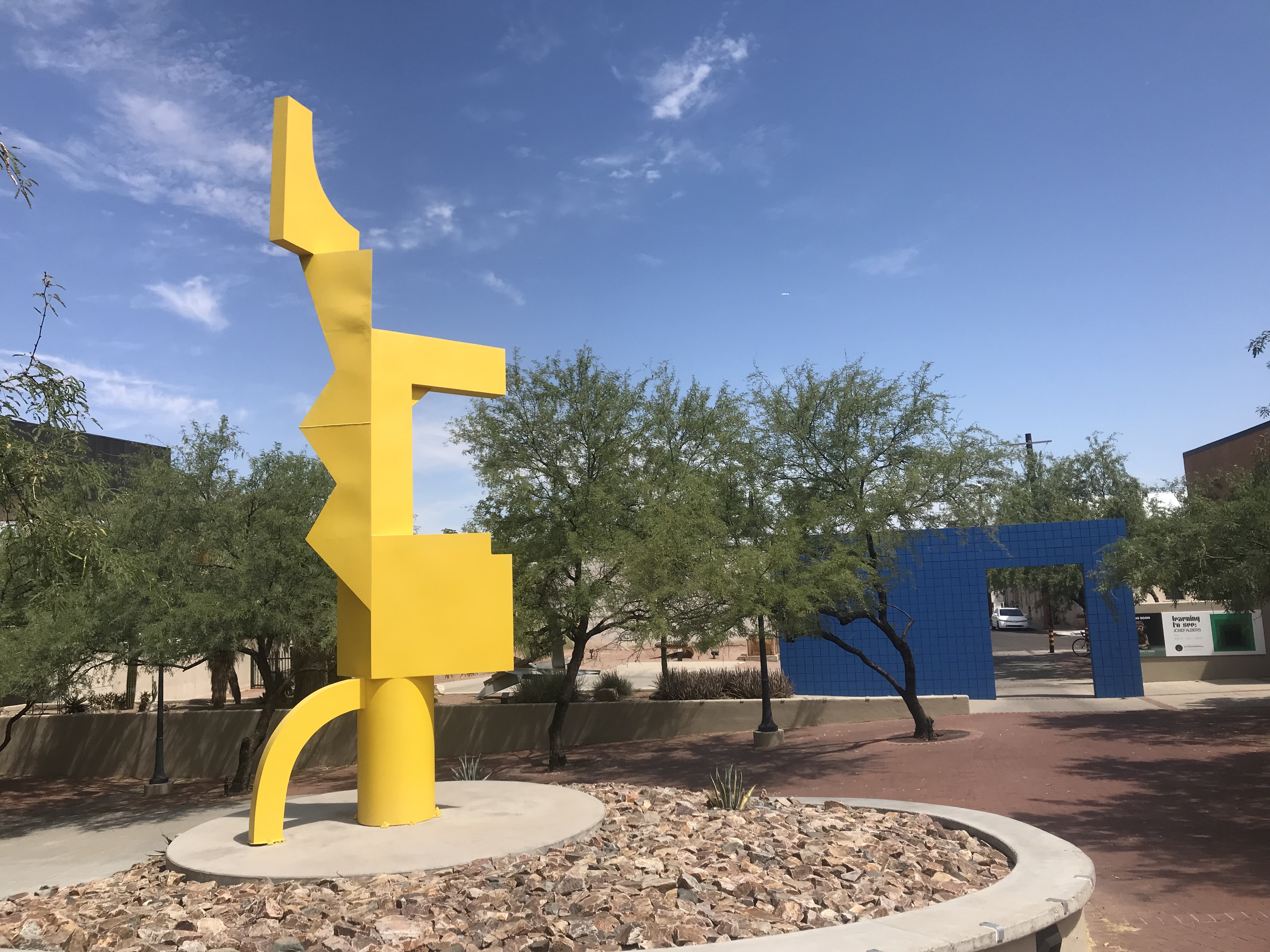
True West magazine named the Tucson Museum of Art one of the Top Western Art Museums in the United States in 2015, but the designation misses the museum's broader identity. The landscaped plazas host Dia de los Muertos celebrations, artisan markets, live performances, and community events that draw the city together across cultural lines. Cafe a la C'Art, the full-service restaurant and bakery on campus, earned recognition from Food and Wine Magazine as one of the top museum restaurants in the country. The Research Library holds over 13,000 titles, including rare books from Pleasants' personal collection on Native American, African, and pre-Columbian art. This is not merely a place to look at objects but a civic institution where Tucson's past and present continuously negotiate their relationship.
From the Air
Located at 32.2234°N, 110.9754°W in downtown Tucson's Presidio District at approximately 2,400 feet MSL. The museum occupies a four-acre block roughly one mile northeast of Tucson International Airport (KTUS). From the air, the historic block appears as a cluster of low adobe structures amid downtown's grid pattern, distinguishable by mature landscaping and courtyards. Best viewed during approach or departure from KTUS Runway 11L/29R. Ryan Field (KRYN) lies 15 nm southwest. Davis-Monthan AFB (KDMA) restricted airspace begins approximately 6 nm southeast.