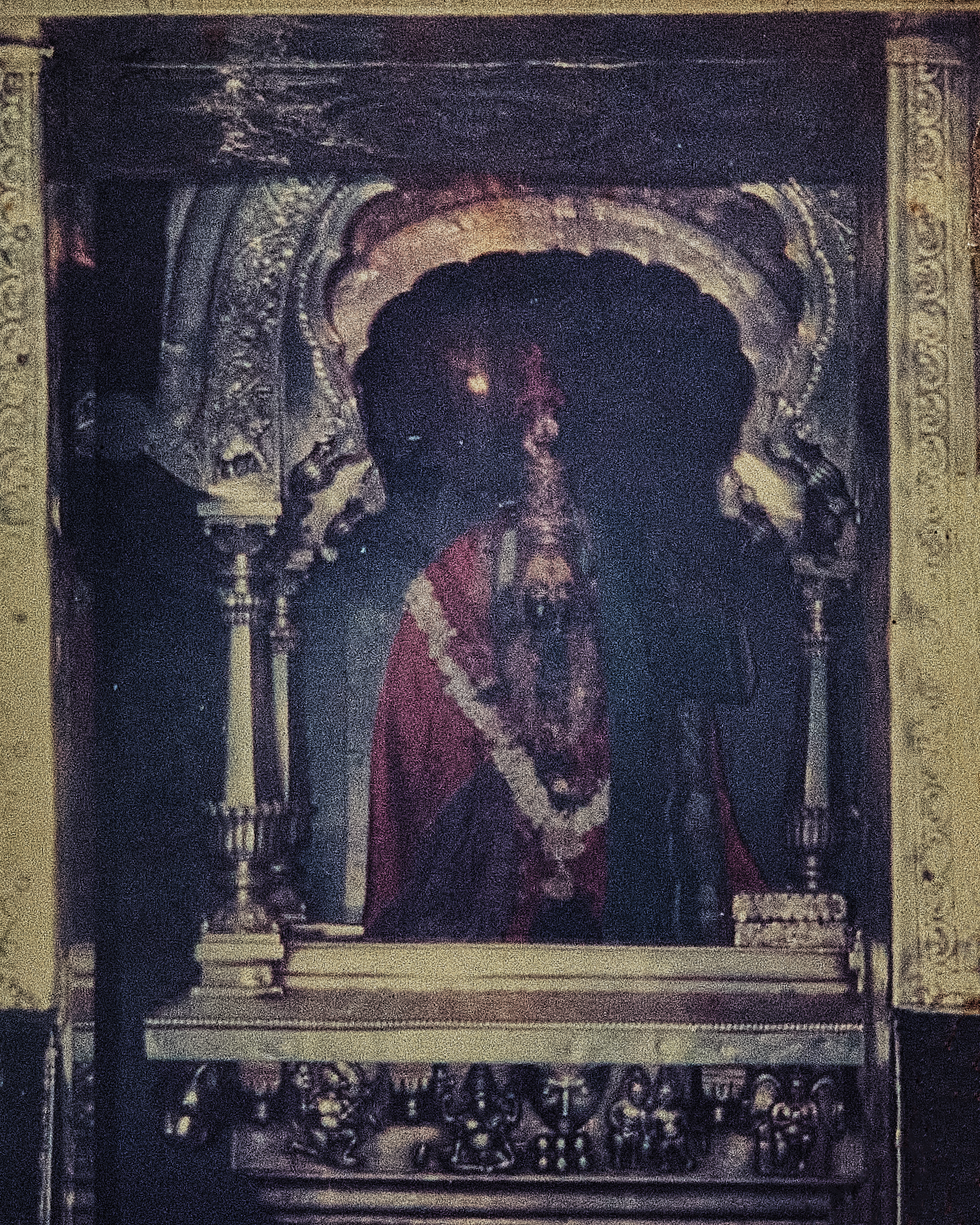
Tulja Bhavani Temple
Before Chhatrapati Shivaji rode to war, he climbed this hill. The founder of the Maratha Empire made repeated pilgrimages to the Tulja Bhavani Temple at Tuljapur, seeking the blessings of the fierce goddess whose eight granite arms hold weapons and whose feet rest on the head of the slain demon Mahishasura. Shivaji was not the first to come, nor the last. Around four million pilgrims visit each year, making this 12th-century temple on the Yamunachala Hill of Maharashtra's Balaghat Range one of Maharashtra's most important religious sites. The goddess Bhavani -- "giver of life" in Sanskrit -- serves as clan deity for dozens of Maratha communities, binding families to this hillside across generations.
The Goddess on the Hill
The temple sits on the Yamunachala Hill, part of the Balaghat Range, overlooking the Mandakini River and the Bori Dam. Built in the 12th century CE by Mahamandaleshwara Maradadeva of the Kadamb dynasty, it is counted among the 51 Shakti Pithas -- seats of divine feminine power scattered across the subcontinent. The three-foot granite idol of the goddess is considered swayambhu, self-manifested rather than carved by human hands. Before her stands a yagna kund, a sacred fire pit where rituals have been performed for nearly nine centuries. Together with the Renuka temple at Mahur, the Mahalaxmi temple at Kolhapur, and the Saptashringi temple at Vani, Tulja Bhavani completes the quartet of Maharashtra's four great Shaktipithas -- temples so significant that pilgrimages linking all four remain a defining practice of Maharashtrian devotional life.
Legends Older Than the Stone
The Skanda Purana, composed in the 8th century or earlier, preserves the mythology that gives this site its name. In the telling, a sage named Kardama died and left his wife Anubhuthi alone with an infant child on the Yamunachala hillock. She performed penance to the goddess on the banks of what is now called the Bori River. When demons known as Madhu-Kaitabha tried to disrupt her devotion, the goddess appeared and destroyed them. From that day she took the name Tulaja Bhavani and settled on this hill at the prayer of her devotee. A separate tradition holds that Bhavani slew Mahisha, a demon disguised as a buffalo, and took refuge on the same hilltop. The two legends layer over each other, reinforcing the site's identity as a place where divine power intervened directly in human affairs.
Where Shivaji Found His Courage
The temple's three entrances bear the names of the Maratha Empire's founding family. The main gate honors Sardar Nimbalkar, a Maratha noble. The other two carry the names of Shivaji's parents: his father Shahaji and his mother Jijabai. These are not merely decorative tributes. Shivaji's association with Tulja Bhavani is central to Maratha identity and political mythology. He visited frequently, and the tradition held that the goddess blessed his sword before his campaigns against the Mughal Empire. Two libraries within the complex bear the names of the great Marathi saints Dnyaneshwar and Tukaram, weaving literary and spiritual heritage into the same sacred space. The compound also houses temples to the sage Markandeya, to Ganesh as Siddhi Vinayak, and to Adi Maya, whose worship precedes that of the main deity in the ritual sequence.
A Living Temple in a Changing World
Daily life at the temple follows an elaborate ritual calendar. Priests bathe the idol each morning, change her garments, offer food four times daily, and perform evening prayers before ceremoniously putting the deity to rest. On the ninth day of the autumn Navratri festival, goats are sacrificed in honor of the goddess -- a practice carried out by the Mahar community, whose priests also serve the Matangi Devi and Adimaya Devi temples within the complex. This role reflects the temple's layered social history, where caste communities hold specific ritual responsibilities passed down across centuries. The temple draws pilgrims from across Maharashtra, Gujarat, Rajasthan, northern Karnataka, and Nepal. In 2025, the Government of Maharashtra announced a 1,865 crore rupee development plan for a Tulja Bhavani Temple Corridor, scheduled for completion by 2028 -- an investment that signals the state's recognition of the temple's enduring centrality to Maharashtrian spiritual life.
From the Air
Tulja Bhavani Temple (18.01N, 76.13E) is located at Tuljapur in Dharashiv district, Maharashtra, on the Yamunachala Hill of the Balaghat Range, 45 km northeast of Solapur. The Bori Dam and Mandakini River are visible nearby. The nearest major airport is Solapur Airport (VASL). The terrain features the low hills of the Balaghat Range rising from the Deccan Plateau. Look for the hilltop temple complex and the town of Tuljapur clustered at its base. Best viewed at 3,000-5,000 ft AGL where the hill and dam provide clear orientation.