Tulsa, Oklahoma
The name Tulsa derives from Tallasi, a Creek word meaning 'old town,' and there is something fitting about a city that has reinvented itself repeatedly while never quite escaping the gravitational pull of its origins. The Lochapoka band of Creek Native Americans settled here between 1828 and 1836, gathering beneath what became known as the Council Oak Tree. Most of Tulsa still sits within the territory of the Muscogee (Creek) Nation. Northwest Tulsa lies in the Osage Nation, while North Tulsa falls within the Cherokee Nation. Formally incorporated in 1898, the city exploded in the early twentieth century when oil gushed from the ground and money flooded in behind it. Today, with 413,066 residents as of the 2020 census, Tulsa is Oklahoma's second-largest city and the anchor of a metropolitan area home to more than a million people.
Black Gold and Art Deco Dreams
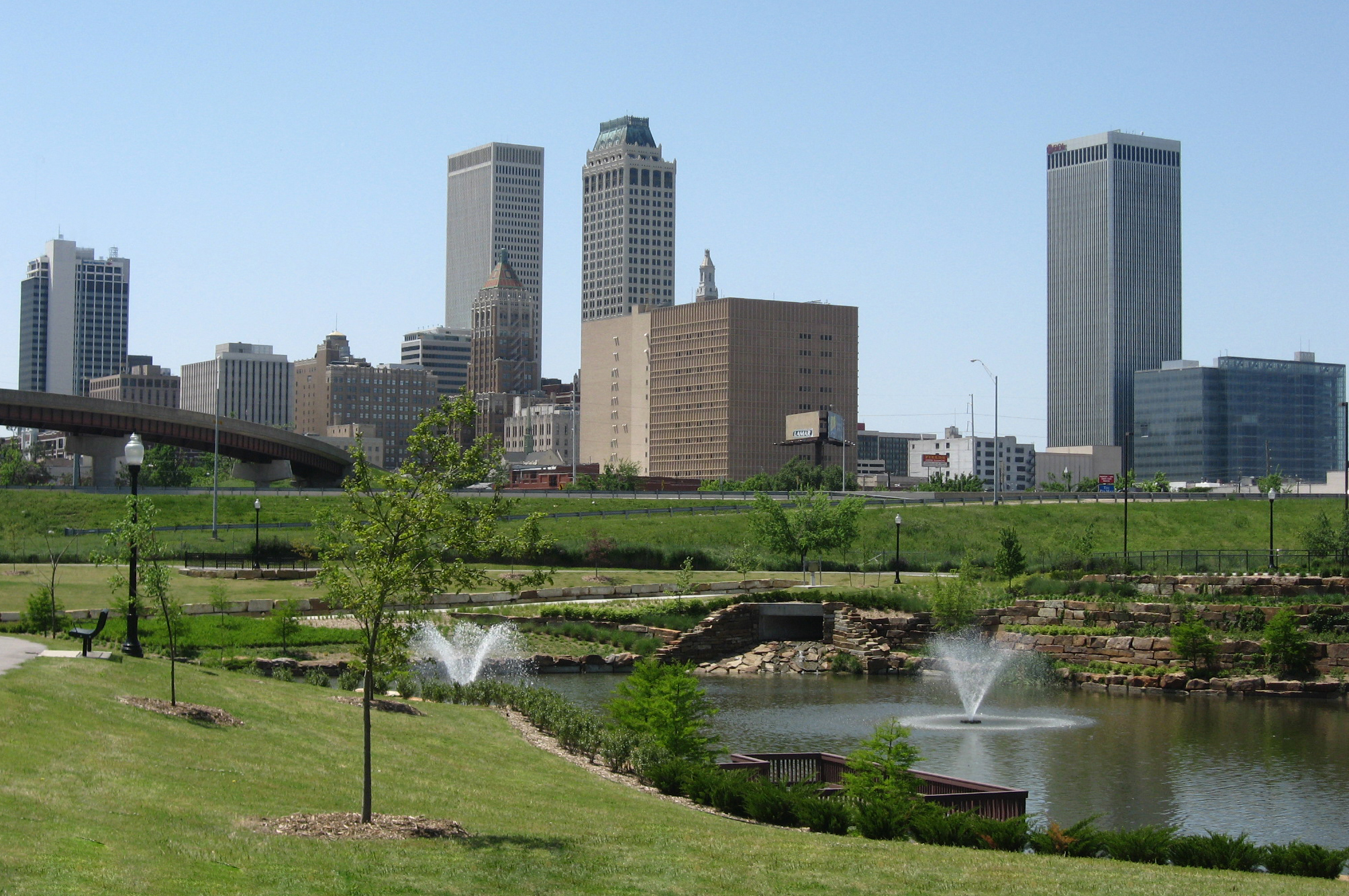
The United States Oil and Gas Association was founded in Tulsa on October 13, 1917, and for decades the city served as the undisputed headquarters of the American petroleum industry. Warren Petroleum, Skelly Oil, Getty Oil, and CITGO all called Tulsa home. The wealth that flowed from those wells transformed the skyline. The Boston Avenue Methodist Church, a stunning art deco tower designed with significant input from artist and TU professor Adah Robinson, became one of the finest examples of ecclesiastical art deco architecture in the nation. Oil tycoon Waite Phillips built a Mediterranean villa that now houses the Philbrook Museum of Art, considered one of the top 50 fine art museums in the United States, with works by Picasso, Rodin, and Georgia O'Keeffe. The 76-foot Golden Driller statue, standing guard at the Tulsa County Fairgrounds since 1953, remains the city's most recognizable icon -- a concrete-and-steel reminder of the industry that built modern Tulsa.
The Greenwood Wound
No honest telling of Tulsa's story can avoid the Tulsa Race Massacre of 1921. The Greenwood District, known as Black Wall Street for its thriving African American business community, was attacked by white mobs over two days beginning May 31. Homes, businesses, churches, and schools were burned. Hundreds were killed, and thousands were left homeless. For decades the massacre was suppressed in public memory. The Greenwood Cultural Center now preserves the history of what was destroyed and what endured. The city's flag, adopted in 2018, incorporates a dreamcatcher representing the Creek settlement under the Council Oak Tree, with the color red honoring those who died in the massacre. Reconciliation remains an ongoing process, but the district's story has become central to how Tulsa understands itself.
Where Western Swing Was Born
Cain's Ballroom, a dance hall on North Main Street, earned its reputation as the birthplace of Western Swing when Bob Wills and the Texas Playboys made it their performance headquarters during the 1930s. The Tulsa Sound -- a genre blending rockabilly, country, rock and roll, and blues -- emerged in the 1960s and 1970s through the work of J.J. Cale and Leon Russell. Eric Clapton drew heavily from both musicians. Leon Russell's Church Studio, a converted 1915 church in the Pearl District listed on the National Register of Historic Places, became a legendary recording space. The Woody Guthrie Center opened downtown in 2013, housing the iconic Oklahoma folk singer's personal archives. Next door, the Bob Dylan Center opened in May 2022 to display The Bob Dylan Archive. From Garth Brooks to Hanson to St. Vincent, the city's musical pipeline shows no sign of slowing.
Coney Dogs, Chimchangas, and Oklahoma Tenderloin
Tulsa's food scene reflects its position at a cultural crossroads. Lebanese steakhouses, founded by Syrian and Lebanese families who immigrated before Oklahoma statehood, once served tabbouleh alongside smoked barbecue bologna -- the latter nicknamed 'Oklahoma tenderloin.' Greek immigrants arriving via Brooklyn and Pennsylvania brought Coney Island-style hot dogs; Coney I-Lander has served them since 1926. Ike's Chili Parlor opened in 1910, reportedly using a recipe acquired from a Latino-Texan named Alex Garcia. The wild onion dinner, a festive gathering originating with Southeastern tribes now calling eastern Oklahoma home, features wild onion, pork, frybread, and a distinctive dish called grape biscuits. The Tulsa Indian Women's Club has hosted annual Wild Onion Dinners since at least 1932. UNESCO City of Gastronomy? Not yet -- that honor went to Tucson -- but Tulsa's culinary identity is genuine, layered, and defiantly regional.
Gathering Place and the Green Country
Tulsa manages 134 parks across the city, but Gathering Place has become the crown jewel since its opening. The park features playgrounds, a boathouse, splash grounds, sports courts, a skate park, wetland gardens, and an amphitheatre spread across its generous acreage. Along the Arkansas River, the River Parks system stretches for miles from downtown to the Jenks bridge, with Turkey Mountain Urban Wilderness Area offering dirt trails for hiking, mountain biking, and horseback riding on the west bank. The Gilcrease Museum in the Osage Hills holds the world's largest collection of art and artifacts of the American West, built from the personal collection of Native American oilman Thomas Gilcrease. The region calls itself Green Country -- a name that surprises visitors who expect Oklahoma to look like the Dust Bowl -- and the rolling hills of northeastern Oklahoma deliver on the promise.
From the Air
Located at 36.154°N, 95.993°W at approximately 700 feet MSL in northeastern Oklahoma along the Arkansas River. Tulsa International Airport (KTUL) lies northeast of downtown. Richard Lloyd Jones Jr. Airport (KRVS) serves general aviation south of the city. The Arkansas River is the primary visual navigation feature, winding through the metropolitan area with prominent River Parks development along both banks. The Gathering Place park and the Philbrook Museum grounds are visible from lower altitudes. The Golden Driller at Expo Square and the downtown art deco skyline are identifiable landmarks. The Tulsa Port of Catoosa, connecting the city to the McClellan-Kerr Arkansas River Navigation System, lies east-northeast. Best aerial views at 5,000-8,000 feet reveal the contrast between the green, hilly terrain of northeastern Oklahoma and the flatter western prairies.
Sources
- Wikipedia - Tulsa, Oklahoma
- Wikipedia - United States Oil and Gas Association
- American Oil and Gas Historical Society - Golden Driller
- Wikipedia - Tulsa Race Massacre
- Cains Ballroom official history
- Bob Dylan Center - Wikipedia
- Tulsa city flag adoption - KTUL
- Coney I-Lander - Wikipedia
- The Church Studio - Wikipedia