Tumu Crisis
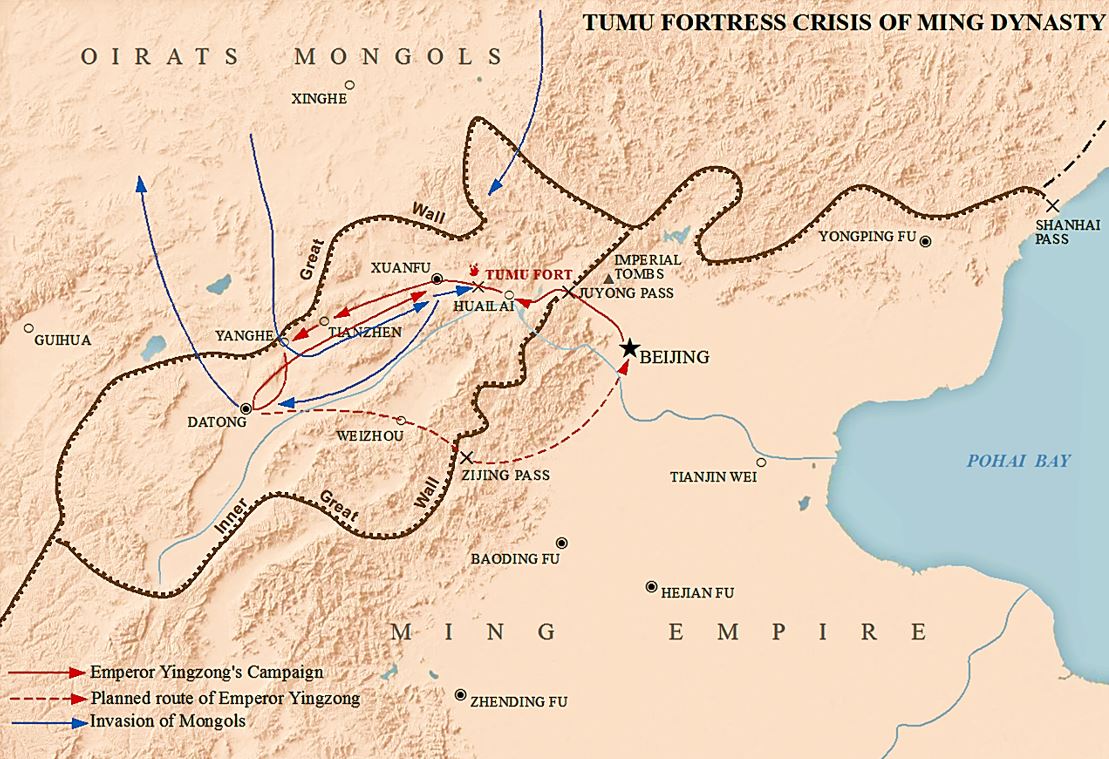
The last person to try stopping Emperor Yingzong threw himself in front of the imperial palanquin as the army marched out of Beijing. He was a supervising secretary, a minor official, and his protest was futile. The emperor was twenty-one years old, intoxicated by military parades organized by his favorite eunuch, Wang Zhen, and determined to personally lead a punitive expedition against the Oirat Mongols. Ministers of war, ministers of personnel, and seasoned generals had all objected. None succeeded. On August 4, 1449, an army hastily assembled, poorly supplied, and commanded by a eunuch who had never fought a battle marched northwest toward disaster.
A Trade Dispute Turned to War
The roots of the Tumu Crisis lay in horse markets and rejected marriage proposals. The Oirat Mongols, united under the ambitious leader Esen Taishi, depended on trade with Ming China for tea, silk, and luxury goods essential to maintaining tribal loyalty. The Ming government restricted this trade to designated border towns, with Datong serving as the main hub. As Esen's power expanded, so did the number of armed Mongol horsemen arriving at border markets -- up to two thousand each year by the late 1440s. The Ming court, alarmed by the security implications, tightened restrictions further. In 1449, they rejected Mongol trade requests and provided only a fifth of what was asked. When the Ming also refused Esen's request to marry an imperial princess to his son, diplomacy collapsed. Esen launched a three-pronged invasion of northern China in July 1449.
An Army Marching to Starve
The expedition was doomed before it left Beijing. Soldiers had only three days to prepare. Supplies were inadequate for an army that some estimates place at half a million, though the actual number was likely far smaller. Wang Zhen, the eunuch who served as de facto commander-in-chief despite having no military experience, drove the troops forward through relentless rain. After seven days they reached Xuanfu, where commanders pleaded for the emperor to turn back. Wang Zhen refused. By the time they arrived at Datong on August 18, more soldiers had died from starvation than from fighting. The fields along the route to Datong were already corpse-strewn from an earlier Ming defeat at Yanghe Pass. Local intelligence confirmed what everyone except Wang Zhen already knew: continuing into the steppe would be suicidal. The expedition was declared victorious, and the army began its retreat.
The Catastrophe at Tumu
The retreat unraveled quickly. Wang Zhen insisted on returning by the same route to avoid damaging crops near his hometown, then reversed course again when he worried about his personal baggage. On August 30, Mongol cavalry destroyed the Ming rear guard at Xuanfu, then ambushed and killed 40,000 cavalrymen under General Zhu Yong at Yao'er Gorge. The following day, the exhausted army stopped at the Tumu post station, just 10.5 kilometers from the walled city of Huailai. Ministers begged Wang Zhen to march the remaining distance to safety behind walls. He refused -- he wanted to keep his baggage carts. The Mongols blocked the army's access to the nearby river. By dawn on September 1, hungry and desperately thirsty soldiers found themselves surrounded. Esen offered to negotiate. Wang Zhen ordered the army toward the river instead. Only 20,000 Mongol fighters were involved in the battle that followed, but the disorganized Ming troops could barely resist. Nearly half the army was lost. Two dukes, two marquises, five counts, the veteran general Zhang Fu, and hundreds of officials died. In the chaos, a Ming officer killed Wang Zhen. The emperor was captured.
A Capital Saved, an Emperor Caged
Esen had not planned to capture an emperor. He initially tried ransoming Yingzong and then marched on a Beijing he expected to find defenseless. He was wrong. Vice Minister of War Yu Qian rallied the panicking capital, threatened to execute anyone who suggested fleeing south, arranged for the emperor's brother to ascend the throne as the Jingtai Emperor, and assembled 220,000 defenders. When Esen arrived at Beijing's walls on October 27 with 70,000 troops, he found a city prepared to fight. After five days, the Mongols withdrew. Emperor Yingzong remained in captivity for twelve and a half months before being released in September 1450 -- only to be placed under house arrest by his own brother. Esen, whose failure to exploit his stunning victory at Tumu eroded his authority among the Mongol tribes, declared himself Khan in 1453 but was assassinated two years later. The crisis that began with a eunuch's vanity ended with both its principal victors destroyed by the very victories they had won.
From the Air
The battle site is located at approximately 40.38N, 115.60E, near present-day Huailai County, Hebei Province, between Juyong Pass and Datong. The terrain is hilly and sits on the inner side of the Great Wall. Nearest significant airport is Beijing Capital International (ZBAA/PEK), approximately 120 km southeast.