Tunisian Campaign
Three hours before the German tanks came through the Faid Pass on February 14, 1943, General Dwight Eisenhower had stood at that very spot, inspecting the American positions. By dawn, 140 panzers were pouring through the gap under cover of a sandstorm, and the inexperienced soldiers of the US II Corps were about to learn what the war in North Africa really meant. The Tunisian Campaign, six months of grinding combat across mountain passes and desert plains, would transform the Allied war effort from a collection of untested armies into a force capable of invading Europe.
The Race Nobody Won
It began as a gamble. When Operation Torch landed Allied forces in Morocco and Algeria on November 8, 1942, the prize was Tunisia, five hundred miles to the east. Whoever controlled its deep-water ports at Tunis and Bizerte controlled the central Mediterranean. The Allies knew the Axis would rush reinforcements from Sicily, only 120 miles away, and they were right. Within days of the landings, German aircraft were flooding into Tunisian airfields. By month's end, three German divisions had arrived, including the formidable 10th Panzer Division. The British First Army's small advance force pushed eastward through winter rain on poor roads, reached within thirty kilometers of Tunis at Djedeida, and then was thrown back. A daring raid by Stuart light tanks destroyed more than twenty Axis planes on the ground at Djedeida airfield, but without infantry support, the attackers had to withdraw. By Christmas, the Allies held a defensive line at Medjez el Bab, having suffered over twenty thousand casualties. The race for Tunis was lost.
America's Bitter Classroom
What followed in February 1943 was the most humiliating American defeat of the European war. Major General Lloyd Fredendall, commanding the II US Corps, set up his headquarters eighty miles behind the front at Tebessa and rarely visited the lines. He dispersed his forces across isolated hilltop positions, overruled his divisional commanders, and left his units too far apart for mutual support. The Germans exploited every mistake. At Sidi Bou Zid, the 10th and 21st Panzer Divisions encircled American infantry on isolated djebels, then destroyed the armored counterattack sent to relieve them. Combat Command C lost forty-six medium tanks in a single afternoon, caught on flat, exposed ground between the two panzer divisions. At the Kasserine Pass, Rommel's forces punched through American and French defenders, driving nearly to Thala before a desperate overnight march by forty-eight American artillery pieces from the 9th Infantry Division helped stabilize the line. The Axis forces had proven their point: American soldiers were well equipped but poorly led.
The Reckoning That Changed Everything
The defeats, however terrible, produced exactly the transformation the Allies needed. Fredendall was relieved and replaced by George Patton, who imposed discipline, aggression, and accountability with characteristic ferocity. Command structures were reorganized. Air support was centralized. British, American, and French forces learned to coordinate their operations across a two-hundred-mile front. Meanwhile, the Axis made the opposite error: their early success bred overconfidence. German and Italian commanders concluded that American troops were soft targets, an assumption that would prove fatal. When Montgomery's Eighth Army broke through the Mareth Line from the southeast and the reinforced First Army pressed from the west, the noose tightened around the Axis bridgehead. The terrain that had favored defense now became a trap. Supply ships from Sicily ran an ever-more-deadly gauntlet of Allied air and naval interdiction.
The End in Africa
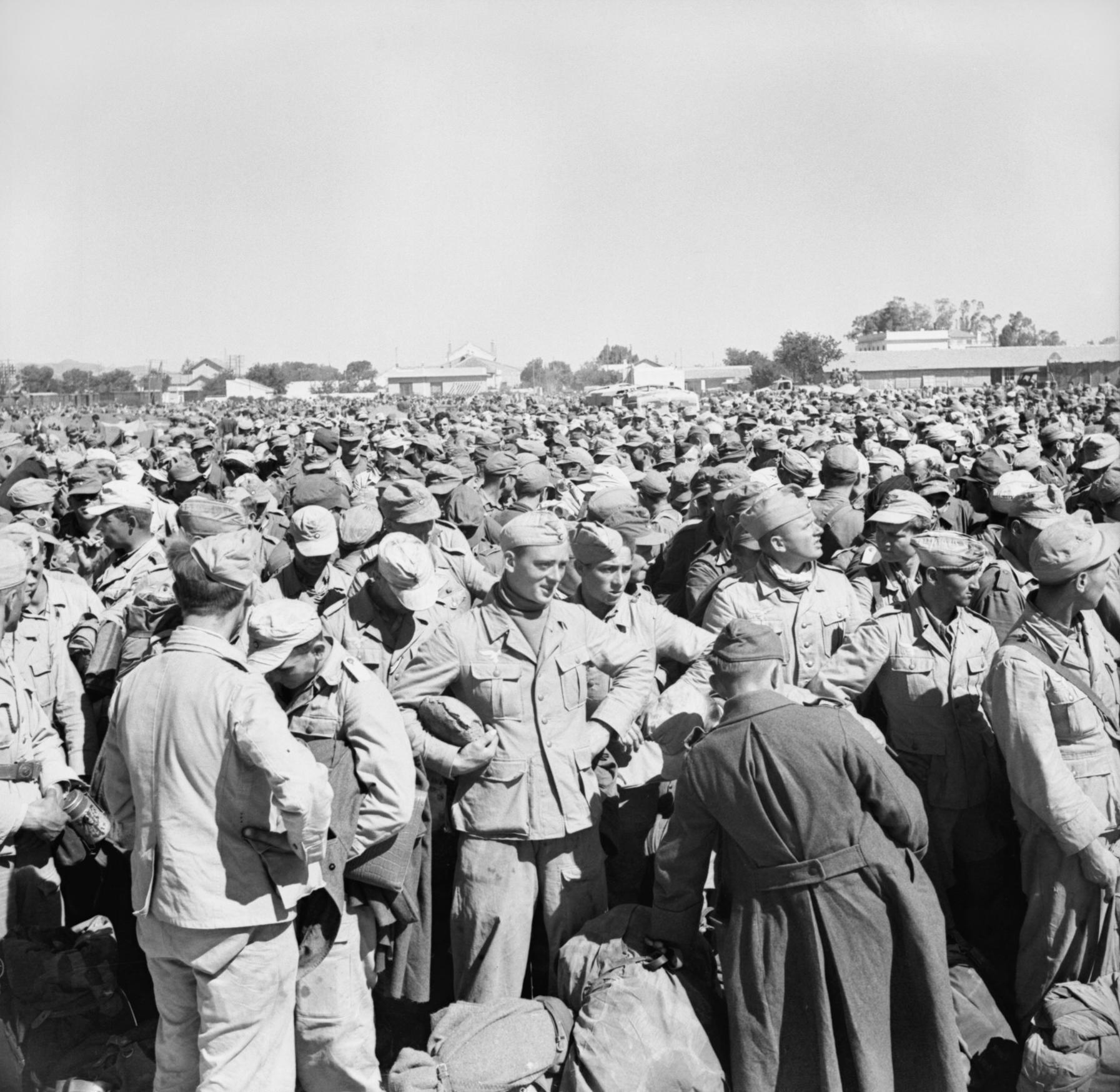
The final Allied offensive began in late April 1943. British, American, and French forces attacked simultaneously across the Tunisian front, cracking through defenses that the Axis could no longer reinforce. On May 7, the 7th Armoured Division entered Tunis while American forces took Bizerte. The collapse was sudden and complete. Over 260,000 German and Italian soldiers surrendered, including most of the Afrika Korps, a haul of prisoners comparable to Stalingrad. The Mediterranean was open to Allied shipping, freeing enormous transport capacity previously devoted to the long route around the Cape of Good Hope. More importantly, the campaign had forged the Anglo-American military partnership that would carry the war to Sicily, Italy, and Normandy. The soldiers who had fled at Kasserine in February were, by May, the veterans who would storm the beaches of Europe.
From the Air
The Tunisian Campaign stretched across most of Tunisia, roughly centered at 35.0°N, 9.0°E. Key battle sites include Kasserine Pass (35.17°N, 8.65°E), Sidi Bou Zid (34.87°N, 9.48°E), Medjez el Bab (36.65°N, 9.61°E), and the Mareth Line (33.65°N, 10.33°E). The Eastern and Western Dorsale mountain ranges of the Atlas are clearly visible from altitude. Nearest major airports include Tunis-Carthage (DTTA) and Sfax-Thyna (DTTX). Overfly the mountain passes at 5,000-8,000 ft AGL for dramatic views of the terrain that shaped these battles.