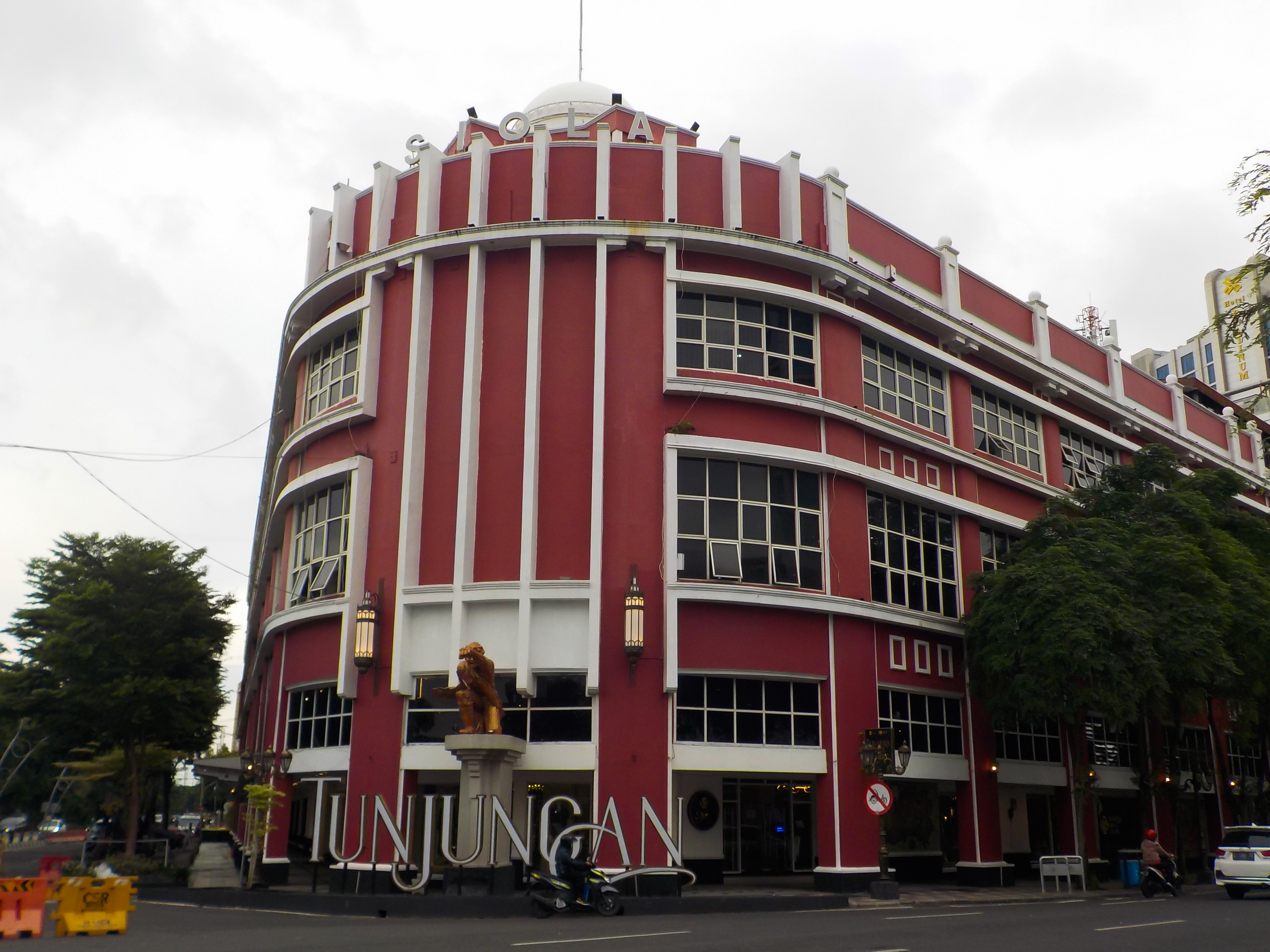
Tunjungan: The Street That Tore a Flag in Half
On the morning of 19 September 1945, a crowd of young Indonesians surrounded the Hotel Yamato on Tunjungan Street and did something that would become a founding myth: they climbed the flagpole, tore the blue stripe from the Dutch tricolor, and left the red and white flying alone - the newborn flag of a republic that had declared independence barely a month before. The hotel still stands, now called Hotel Majapahit and managed as part of the MGallery collection. The street still carries the name Tunjungan. Between them, they contain more than a century of Surabaya's ambition, grief, and reinvention, layered into a single boulevard that remains the heartbeat of Indonesia's second-largest city.
The Golden Triangle
Tunjungan was never an accident. Since the Dutch East Indies era, colonial planners designed this road as a commercial spine, connecting it to Jalan Embong Malang and Jalan Blauran in what locals still call the golden triangle. Shops, offices, and hotels rose along its wide sidewalks, and the street became the place where Surabaya displayed its prosperity. The Siola Building arrived in 1877, built by an Englishman named Robert Laidlaw as a wholesale center under the Whiteaway Laidlaw & Co brand - at the time one of the most recognized retail names in Asia. By the early 1900s, Siola was the largest shopping center in the Dutch East Indies. Trams rattled past its doors. The Hellendorn restaurant drew aristocrats and wealthy merchants for lavish dinners. To walk Tunjungan was to walk through the colony's commercial showcase, a street designed to impress and built to profit.
An Armenian Hotelier and a Javanese Boulevard
Among the most enduring landmarks on Tunjungan is the hotel that an Armenian entrepreneur planted at its heart. Lucas Martin Sarkies - whose family also built the Raffles in Singapore, the Strand in Myanmar, and the Eastern & Oriental in Penang - commissioned British architect James Afprey to design the Hotel Oranje. It opened in the early twentieth century and quickly became the social anchor of Tunjungan, the place where the colonial elite gathered. The Japanese renamed it Hotel Yamato during the occupation. It was in this building that the flag incident of September 1945 occurred, an act of defiance by the youth known as the arek-arek Suroboyo. Today the hotel operates as Hotel Majapahit, its Art Deco corridors and colonial gardens preserved under MGallery management - a building that has worn three nations' names without ever moving from its spot on the street.
The Battle and What Followed
The flag-tearing at Hotel Yamato was the prelude to something far worse. Weeks of tension between Indonesian republicans and Allied forces culminated in the Battle of Surabaya on 10 November 1945 - the largest single engagement of the Indonesian National Revolution. British forces bombarded the city from sea and air. Buildings along Tunjungan became positions for fighters strategizing against the British. The front of the Siola Building was destroyed by bombing. Thousands of Indonesians died, and over 200,000 civilians fled. The battle failed to hold the city, but it galvanized the independence movement. November 10 became Heroes' Day, celebrated across the archipelago. Tunjungan, the commercial boulevard, had become a battlefield - and that transformation from marketplace to monument is written into every building that survived.
Reinvention After Reinvention
The decades after independence brought their own cycles of change. The Siola Building was rebuilt in the 1960s as a retail center, thrived for three decades, then closed in 1998, unable to compete with modern shopping malls. It passed through the Ramayana Department Store chain and eventually became the Tunjungan Center. In the 1930s, a shop called Nam had stood at the junction of Tunjungan and Jalan Embong Malang; by 1938 it was replaced by Toko Kwang, and that site is now the Surabaya Struggle Press Monument. The street's name spawned Tunjungan Plaza, one of Surabaya's largest shopping centers, though the mall sits not on the street itself but between Jalan Basuki Rahmat and Jalan Embong Malang. Tunjungan today is wide enough for a comfortable walk, its sidewalks lined with heritage buildings that have been repurposed so many times their original functions are layered like sediment. The street endures not because it resists change but because it absorbs it.
From the Air
Tunjungan Street lies at 7.27S, 112.74E in central Surabaya, East Java, running roughly north-south through the downtown commercial district. The nearest major airport is Juanda International (WARR/SUB), approximately 20 km south of the city center, with dual 3,000-meter runways. Surabaya's dense urban grid, the Kalimas River corridor, and the Suramadu Bridge to Madura Island provide visual orientation from altitude. The street itself is not distinguishable from cruising altitude, but the city's rectangular block pattern and the broad Jalan Tunjungan corridor are identifiable at lower altitudes. Tropical monsoon climate with best visibility during dry season (May-October).