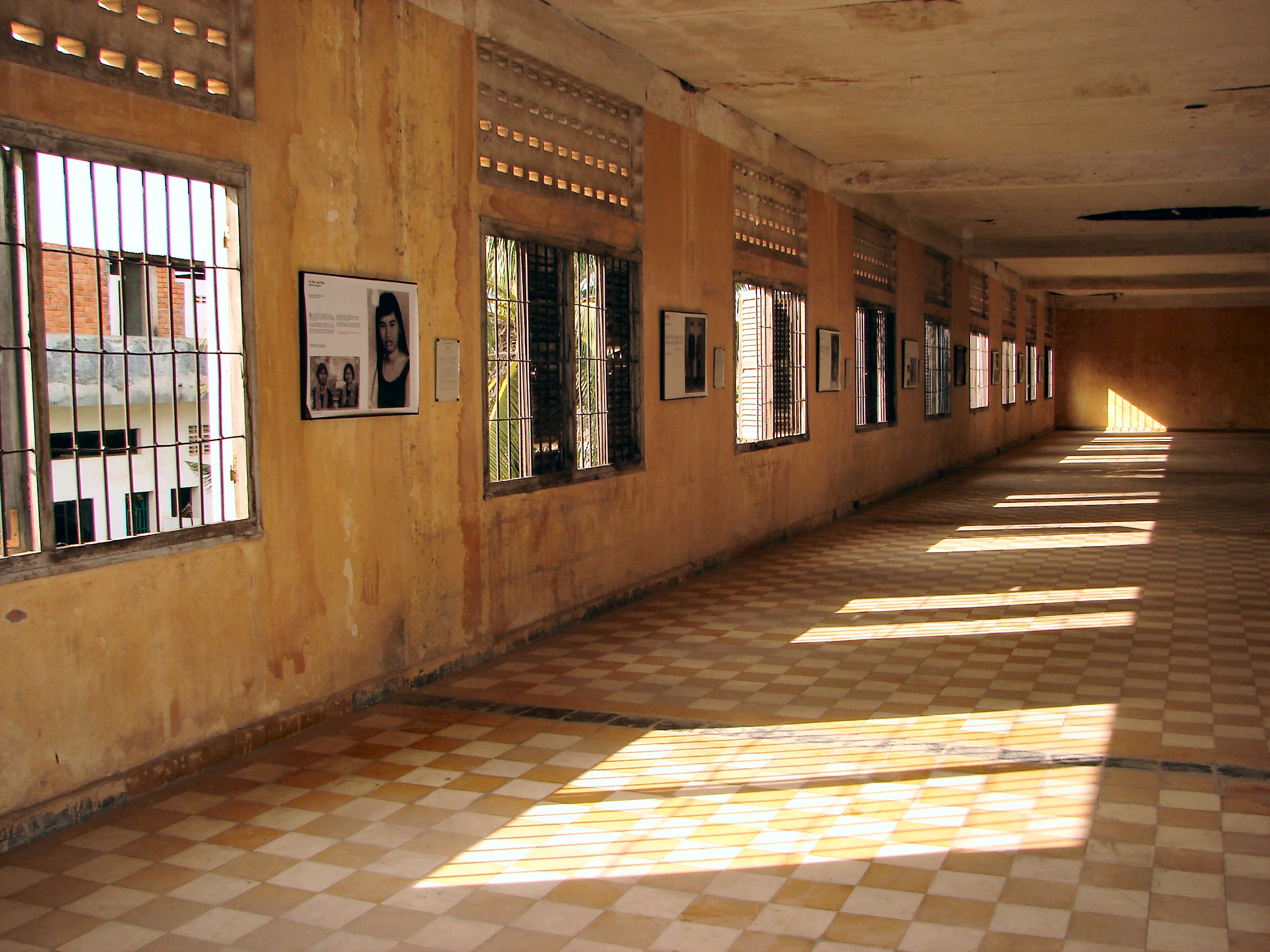
Tuol Sleng Genocide Museum
The classrooms still have their blackboards. But the desks are gone, replaced by iron bedframes and rusting shackles bolted to the floor. Tuol Sleng was once Tuol Svay Prey High School, named after a royal ancestor of King Norodom Sihanouk. In March or April of 1976, the Khmer Rouge converted its five buildings into Security Prison 21 -- S-21 -- one of between 150 and 196 torture and execution centers that operated across Cambodia. From 1976 to 1979, an estimated 20,000 people were imprisoned here. Fewer than two dozen survived.
From Schoolyard to Kill Zone
The conversion was methodical. Workers enclosed the school buildings in electrified barbed wire. Classrooms became tiny cells and interrogation rooms. Windows were covered with iron bars to prevent escapes and suicides. At any given time, the prison held between 1,000 and 1,500 people. In the early months, most prisoners came from the previous Lon Nol regime: soldiers, government officials, academics, doctors, teachers, monks, engineers. Then the Khmer Rouge's paranoia turned inward, consuming its own ranks. Thousands of party activists and their families were brought to Tuol Sleng, tortured into signing confessions that named friends and colleagues, and killed. Those named in the confessions were then arrested themselves. Some lists contained more than a hundred names. The cycle fed itself until it devoured people from every corner of Cambodian society.
The Confessions Machine
The interrogation system at S-21 operated with bureaucratic precision. Prisoners described their personal backgrounds, their work history under the Khmer Rouge, and their supposed treasonous activities in chronological order. Each confession ended with a list of alleged co-conspirators. The prison's director, Kang Kek Iew -- known as Comrade Duch -- acknowledged that "live prisoners were used for surgical study and training. Draining blood was also done." Medical experiments were performed on prisoners who had no anesthetic. Untrained medical staff offered treatment only to keep prisoners alive long enough for more interrogation. Blindfolds during transfers, absolute silence between guards and inmates, total isolation between prisoner groups -- every measure was designed to maximize fear and prevent any solidarity among the condemned.
Those Who Lived
Out of an estimated 20,000 prisoners, approximately 23 people survived the liberation of S-21 in January 1979, including five children. The adults who lived did so because they possessed skills the regime found useful. Bou Meng was an artist. Chum Mey could repair machinery. Vann Nath could paint -- and after liberation, he turned that skill against his captors, creating canvases depicting the torture he witnessed. Those paintings now hang in the museum. Chim Meth, held for two weeks before transfer to the nearby Prey Sar prison, may have been spared because she came from the same district as Comrade Duch. She deliberately emphasized her provincial accent during interrogations, distinguishing herself in a system designed to erase individuality. No foreign prisoner survived S-21. At least 79 foreigners from multiple countries passed through the prison, many of them sailors whose boats drifted into Cambodian waters.
Following the Stench
In January 1979, Vietnamese forces invaded Cambodia and drove out the Khmer Rouge. A combat photographer named Ho Van Tay followed the smell of decomposing bodies to the gates of Tuol Sleng. His photographs documenting what he found -- prisoners still chained to iron bedframes, killed by their fleeing captors hours before the prison fell -- are displayed in the museum today. The regime had kept meticulous records, including thousands of photographs of prisoners taken at intake: men, women, children, staring into the camera with expressions ranging from terror to blank incomprehension. Several rooms of the museum are now lined floor to ceiling with these black-and-white portraits. Building A holds the large cells where the last victims were discovered. Building B contains the photographic galleries. Building C preserves the small subdivided cells. Building D displays instruments of torture.
Memory Against Forgetting
In 2010, the Extraordinary Chambers in the Courts of Cambodia convicted Comrade Duch for crimes against humanity and grave breaches of the Geneva Conventions. He died in 2020 while serving a life sentence. Filmmaker Rithy Panh, who lost his family to the Khmer Rouge when he was eleven, brought survivors Vann Nath and Chum Mey face to face with their former captors in the 2003 documentary S-21: The Khmer Rouge Killing Machine. The film captures a painful divide: survivors wanting to understand what happened in order to warn future generations, and former guards unable to escape the horror of what they helped create. Today, Tuol Sleng operates alongside the Choeung Ek Memorial -- the Killing Fields -- as part of a study tour organized by the ECCC that drew approximately 27,000 Cambodian visitors in 2010 alone. The school buildings stand largely as the Vietnamese found them, preserved not as artifacts but as evidence.
From the Air
Located at 11.549N, 104.918E in central Phnom Penh, approximately 2.5 km south of the Royal Palace. The low-rise former school buildings are not individually distinguishable from altitude but sit in the dense urban grid south of the city center. Phnom Penh International Airport (VDPP) is approximately 9 km to the west. The Choeung Ek (Killing Fields) memorial is about 15 km to the southwest. Best approached during the dry season (November-April) for clear visibility.