Three Names, One Town
James Blakely was digging half a mile east of the Franklin Summers family cabin when he hit quartz laced with gold. He named the lode Eureka, and the mine became the nucleus of a town that would change its name twice before settling on one borrowed from the local Yokuts word for a cluster of stone wigwams. Summersville became Carters became Tuolumne, each renaming a quiet admission that the previous era had ended and a new one begun. Today, fewer than 1,800 people live in this census-designated place in the Sierra Nevada foothills, but the town punches well above its weight in California history - as a Gold Rush flashpoint, a lumber capital, and an unlikely film set for some of Hollywood's most famous westerns.
Eureka in the East Belt
The Franklin Summers family arrived in 1854 and built a log cabin that became the geographical center of the East Belt Placer Gold Rush of 1856 to 1857. Miners fanned out across the surrounding gulches, and small settlements sprouted like foothills wildflowers - Long Gulch two miles to the south, Cherokee two miles to the north. When Blakely discovered his quartz lode in 1858, the economy shifted from placer to hard-rock mining, and the town that had grown around the Summers cabin gained permanence. It was officially recognized as California Historical Landmark No. 407, commemorating the transition from scattered prospecting camps to a settled community with stores, a church, and the infrastructure that follows when gold moves from creek beds into rock. The area's first non-Indian settlers had staked their claim on ground that would sustain a town for over 170 years.
The Lumber Years
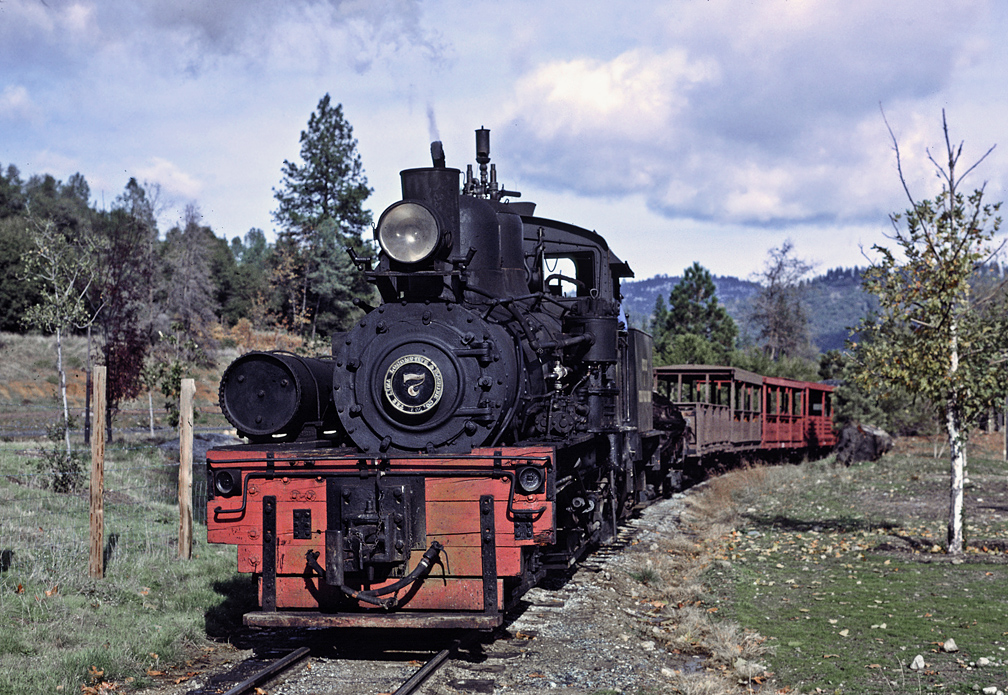
Gold built Tuolumne, but lumber sustained it. The surrounding Sierra Nevada forests drew major operations, and the West Side Lumber Company established a mill that became the town's economic engine for decades. The Sierra Railway, completed in 1897, connected Tuolumne to the outside world via Jamestown and Oakdale, hauling timber out and supplies in along tracks that wound through the oak-studded foothills. The West Side operated an extensive narrow-gauge logging railroad into the mountains, one of the last such systems in the American West. Logs came down; paychecks went out. The rhythm of the mill whistle replaced the clink of pickaxes as the town's defining sound. When the last narrow-gauge logging trains made their final runs in the 1960s, Tuolumne lost not just an industry but an identity, and the town began the quiet reinvention that small resource-dependent communities across the West know all too well.
When Hollywood Came to Town
In 1951, a film crew arrived in Tuolumne to shoot scenes for High Noon. Gary Cooper, playing Marshal Will Kane, walked to St. Joseph's Church to plead for help from the townspeople - a scene that became one of the most iconic in western cinema. The church and the dusty streets of Tuolumne stood in for the fictional town of Hadleyville, and Cooper's lonely walk resonated far beyond the screen. That same year, the adventure film Silver City used Tuolumne as a location. The town's film history actually stretches back further: in 1911, the Selig Polyscope Company shot The Sheriff of Tuolumne, a short film starring Hobart Bosworth and Bessie Eyton and directed by Francis Boggs. Decades later, the town appeared in a 1985 episode of Highway to Heaven titled 'Plane Death.' For a place with fewer than two thousand residents, Tuolumne has spent a remarkable amount of time in front of cameras.
Small Town, Outsized Characters
Tuolumne has produced personalities as colorful as its history. Bobby Adams, a Major League Baseball player who appeared in 1,281 games across fourteen seasons with the Cincinnati Reds, Chicago White Sox, Baltimore Orioles, and Chicago Cubs, was born here. So was Richard Myrle Buckley, better known as Lord Buckley, the hipster comedian and monologist who influenced Lenny Bruce, Bob Dylan, and the entire Beat Generation. Before he was performing jazz-inflected riffs on Shakespeare and the Gettysburg Address in Greenwich Village nightclubs, Buckley worked as a logger in the forests around Tuolumne. The leap from timber camp to stage seems improbable, but Tuolumne has always been a place where improbable things happen - where a cabin in the woods becomes the center of a gold rush, where a church becomes a movie set, and where a logger becomes a lord.
From the Air
Tuolumne City is located at 37.962N, 120.237W in the Sierra Nevada foothills of Tuolumne County, California. The small community is visible as a cluster of development surrounded by forested hills east of Jamestown along State Route 108. Best viewed at 3,000-5,000 feet AGL. Columbia Airport (O22) is approximately 8 nm southwest. Pine Mountain Lake Airport (E45) is about 12 nm north-northwest. The town sits at approximately 2,600 feet elevation in Gold Country.