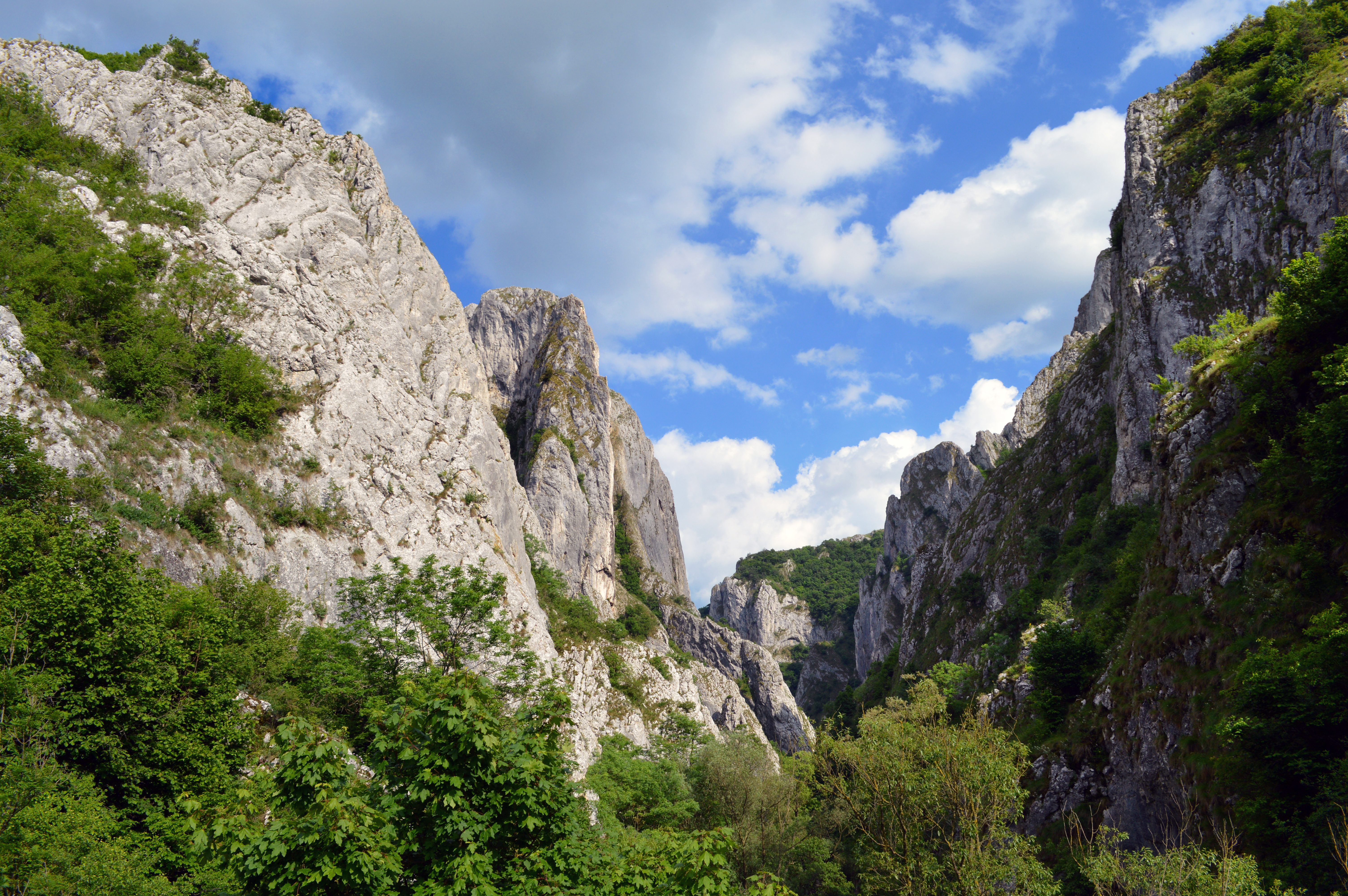
Turda Gorge
Sixty caves riddle the walls of Cheile Turzii, and not one of them stretches longer than 120 meters. That modesty is part of the gorge's character. Turda Gorge does not overwhelm with sheer scale the way the great Alpine canyons do. Instead, it pulls you in close, folding 300-meter limestone walls around a narrow passage carved by the Hasdate River through Jurassic-era rock. The canyon runs 2,900 meters from end to end, just six kilometers west of the city of Turda in Transylvania, and every meter of it is dense with life.
Written in Stone
The limestone that forms the gorge's towering walls was laid down during the Jurassic period, when this corner of what is now Romania lay beneath a warm, shallow sea. Over millions of years, the Hasdate River cut through the uplifted seabed, sculpting a canyon whose walls now rise as high as 300 meters. The total reserve covers 324 hectares, and within that compact area lies one of Romania's richest karst landscapes. Water has been patient here. It dissolved fissures into caves, dripped stalactites into darkness, and carved the kind of overhangs and rock shelves that made this place attractive to humans as far back as the Neolithic. People have been finding shelter in these walls for thousands of years, drawn by the same features that draw climbers and hikers today.
A Botanical Treasury
More than 1,000 plant species crowd the gorge's ledges, slopes, and riverbanks, a concentration of diversity that surprises even botanists who know the region well. Among them are rarities like Allium obliquum, a wild garlic relative, and Viola jooi, a violet endemic to the Carpathians. The variety exists because the gorge creates microclimates. South-facing walls bake in the sun, supporting species adapted to dry, rocky Mediterranean-like conditions. Shaded north-facing cliffs stay damp and cool, harboring plants more typical of alpine environments. The canyon floor, sheltered from wind and moderated by the river, offers yet another habitat. This layering of conditions within such a narrow space is what makes Cheile Turzii a natural reserve of national importance.
Wings and Fur
Sixty-seven bird species have been recorded in the gorge, including eagles of the genus Aquila that nest on the higher ledges. Butterflies from genera including Eublema and Dysauxes flutter through the sun-warmed openings between the walls. Down along the river, fish and amphibians occupy the quieter pools. On the forested slopes above, foxes, weasels, pine martens, and wild boars maintain the kind of unbroken food web that marks a healthy, well-connected ecosystem. The gorge functions as a corridor, linking the upland forests to the agricultural lowlands around Turda, and that connectivity is part of what keeps its wildlife populations viable.
The Climber's Cathedral
Turda Gorge is one of Romania's premier rock climbing destinations. The Jurassic limestone offers the kind of featured, frictioned surfaces that climbers prize: pockets, crimps, and natural holds shaped by millions of years of differential erosion. Routes range from accessible scrambles to serious multi-pitch climbs on the higher walls. But the gorge is not only for technical athletes. A well-maintained trail follows the canyon floor, crossing the Hasdate River on a series of small bridges. The walk from one end to the other takes roughly two hours at a relaxed pace, and the reward is constant: at every turn, the walls shift perspective, light changes angle, and the river's voice echoes differently off the rock. Just a few kilometers away, two more canyons, Cheile Turului and Cheile Borzesti, offer quieter alternatives for those who want to extend the day.
A Painted Canyon
Artists discovered Turda Gorge long before tourism boards did. The 19th-century painter Henric Trenk captured the entrance to the gorge in oils, drawn by the same dramatic contrasts of light and shadow that still stop visitors in their tracks. From the town of Turda itself, the gorge appears as a dark cleft in the hills to the west, an invitation into a different world. That proximity to a substantial city, Turda has over 47,000 residents, and Cluj-Napoca lies only 15 kilometers to the northwest, makes Cheile Turzii one of the most accessible wilderness experiences in Transylvania. In under an hour, you can move from a university town's coffee shops to a Jurassic canyon where the only sounds are water, wind, and the occasional call of an eagle circling above the rim.
From the Air
Located at 46.56N, 23.68E in the Transylvanian highlands, roughly 15 km southeast of Cluj-Napoca. The gorge appears as a narrow dark cleft in the limestone hills west of Turda. Best viewed below 5,000 feet AGL for canyon detail. Nearest significant airport is Cluj-Napoca International (LRCL), approximately 20 km northwest. The Hasdate River valley provides a visual guide to the gorge entrance from the air.