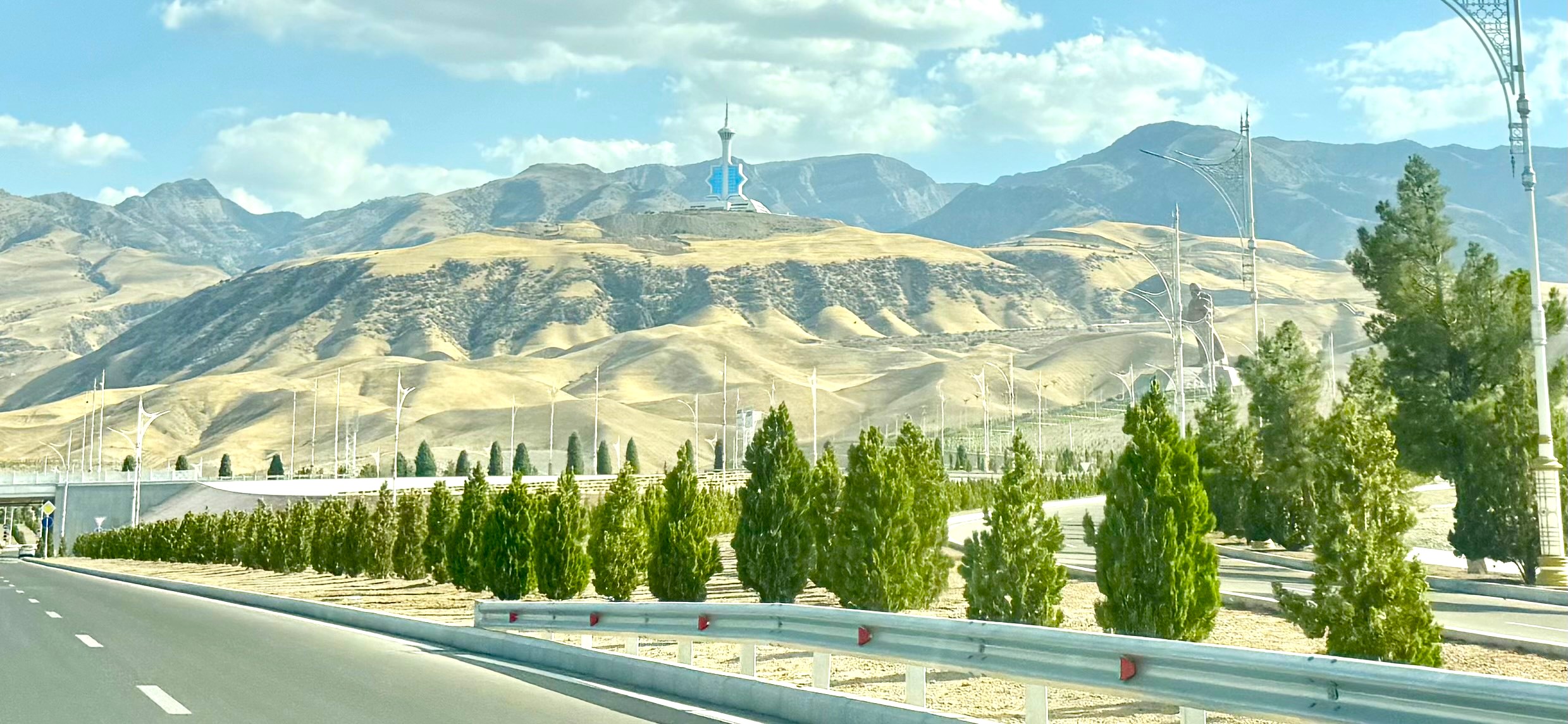
Turkmenistan Tower
The eight-pointed star at its base measures 3,240 square meters of glass, making it the largest architectural star ever built. That distinction alone would make the Turkmenistan Tower memorable. But the 211-meter communications tower, completed in 2011, is really a statement about the city it overlooks. Ashgabat holds its own Guinness record for the highest density of white marble-clad buildings on Earth -- 543 structures sheathed in gleaming stone across 22 square kilometers. The tower rises above all of it, the tallest structure in Turkmenistan, broadcasting television and radio signals across a 100-kilometer radius while simultaneously serving as an observation deck for a capital that has transformed itself into something almost too surreal to describe.
A City Rebuilt from Rubble
Ashgabat did not always gleam. On October 6, 1948, a magnitude 7.3 earthquake struck at 1:12 in the morning, reducing the city to rubble in ten seconds. Estimates of the death toll range as high as 110,000 -- roughly two-thirds of the population. The Soviet government rebuilt the city in utilitarian concrete. Decades later, President Saparmyrat Nyyazow launched a "White City" renewal project that replaced Soviet-era blocks with the marble-clad monuments visible today. The Turkmenistan Tower, completed under his successor Gurbanguly Berdimuhamedow, crowns this transformation. Sitting at roughly 1,000 meters above sea level in the foothills of the Kopet Dag range, the tower is visible from virtually anywhere in the capital.
Spinning Above the Marble
The tower's revolving restaurant occupies the 29th floor, 142 meters above the ground. Turkmen national motifs blend with modern design as the platform rotates, unspooling a slow panorama of Ashgabat's boulevards, parks, and the brown foothills of Kopet Dag to the south. One floor below, on the 28th, a VIP room offers a quieter version of the same spectacle. Higher still, at 150 meters on the 30th floor, the main observatory provides a full 360-degree view. A second, specialized observatory sits nearby. From either platform, the scale of Ashgabat's reconstruction becomes clear: block after block of white stone reflecting sunlight, punctuated by gold domes and monumental arches.
The Star and the Signal
The decorative octagonal Star of Oguzkhan at the tower's base earned Guinness recognition in 2011, the same year the tower opened. The Oguz Khan star is Turkmenistan's national emblem, and rendering it at 3,240 square meters in glass was meant to celebrate the 20th anniversary of independence. But the tower's primary purpose remains functional. Seven television and radio stations broadcast from its antennas -- Altyn Asyr, Yashlyk, Miras, Turkmenistan, Turkmen Owazy, Ashgabat, and Turkmen Sport -- carrying signals in both analog and digital formats across the surrounding landscape.
Monument and Metaphor
The Turkish construction firm Polimeks broke ground in 2008 and delivered the finished tower for its official opening ceremony on October 17, 2011. It is one of several monumental projects Polimeks built in Ashgabat, including the nearby Wedding Palace. Whether the tower functions as a proud national landmark or an emblem of lavish state spending depends on the observer. What remains undeniable is its physical presence: a slender spire anchored by a massive glass star, rising from a plateau one kilometer above sea level, overlooking a city that chose to rebuild itself as the whitest place on Earth.
From the Air
Located at 37.86N, 58.24E in the foothills south of central Ashgabat. The tower stands 211 meters tall at an elevation of roughly 1,000 meters above sea level, making it visible well before reaching the city. Ashgabat International Airport (ICAO: UTAA) lies approximately 10 km to the northwest. The Kopet Dag mountain range rises steeply to the south, reaching over 2,000 meters. Best viewed from the north or west on approach, in clear conditions. The surrounding white marble cityscape makes Ashgabat unmistakable from altitude.